
Titan rain-splash cycles may assemble membrane-like compartments without water
This digest was compiled by AI from multiple sources — links to the originals are below.
A 2025 study proposes that rain-splash cycles on Saturn's moon Titan could assemble membrane-like compartments from hydrocarbon surface films. Christian Mayer of the University of Duisburg-Essen and Conor Nixon of NASA Goddard outline the geometric pathway in the International Journal of Astrobiology. The proposal remains a theoretical pathway, not a detection or completed laboratory demonstration.
Key Facts
- Christian Mayer of the University of Duisburg-Essen and Conor Nixon of NASA Goddard proposed the rain-splash pathway in a 2025 paper in the International Journal of Astrobiology.
- Titan's surface temperatures are around 90 to 94 kelvin, close to minus 180 degrees Celsius.
- Cassini radar mapped seas and smaller lakes near Titan's poles, while the Huygens probe saw rounded cobbles, channels and a landscape shaped by flowing liquid.
- The proposal is a geometric pathway, not a detection or a completed laboratory demonstration.
Rain-Splash Compartment Formation
A surface film coats droplets thrown from a hydrocarbon lake on Titan. When a droplet returns through the film, it gains another layer and becomes a closed compartment. The disturbance that folds one surface over another may be rain, according to Mayer and Nixon. The proposal is geometric as much as chemical, focusing on interfaces and repeated disturbances.
Membrane Chemistry Without Water
On Earth, many membranes are built from amphiphiles with water-compatible heads and water-avoiding tails. Two molecular sheets can align tail to tail, leaving their heads facing the watery interior and exterior, and if the sheet closes, it forms a vesicle. Titan reverses the solvent problem because its exposed liquids are non-polar hydrocarbons rather than water. Any membrane-like structure on Titan would need chemistry and orientation appropriate to liquid methane and ethane at cryogenic temperature. The topology could resemble an Earth vesicle while the substances and molecular direction are different.
Titan's Hydrocarbon Cycle
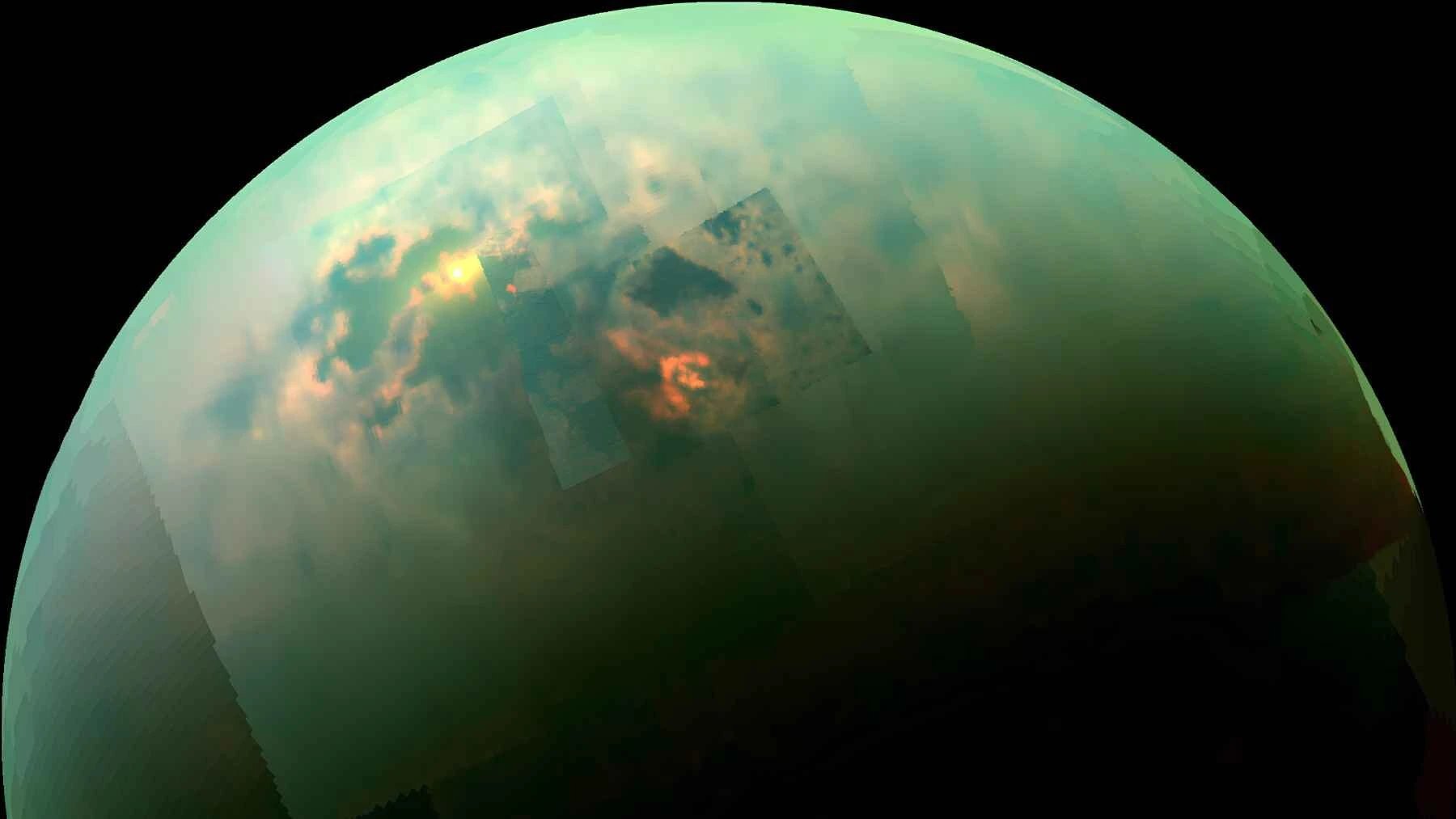
Methane on Titan evaporates, forms clouds, falls as rain and returns through rivers. Cassini radar mapped seas and smaller lakes near Titan's poles. The Huygens probe saw rounded cobbles, channels and a landscape shaped by flowing liquid. Surface temperatures are around 90 to 94 kelvin, close to minus 180 degrees Celsius.
1 source
Time · lag behind first