
North Korea-Russia road bridge nears completion at Tumangang
This digest was compiled by AI from multiple sources — links to the originals are below.
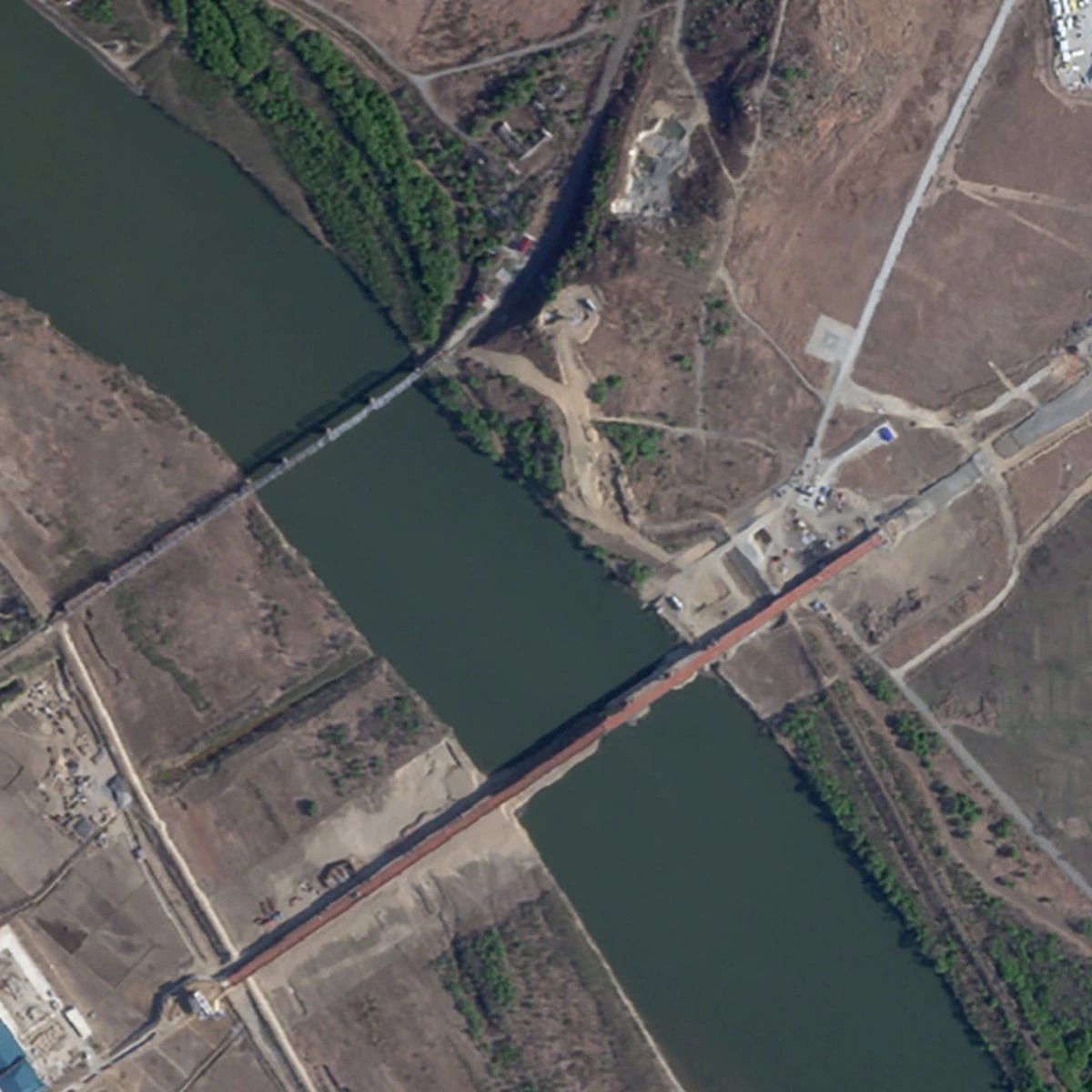
The first road bridge linking North Korea and Russia across the Tumen River is close to completion, satellite imagery shows. Construction on the North Korean side is finished, while work on the Russian side continues. The crossing at Tumangang reflects deepening military cooperation between Pyongyang and Moscow.
Key Facts
- Satellite imagery from Planet shows the North Korean approach to the bridge fully built, including a customs building and controlled entry point.
- Construction on the Russian side is still ongoing, with border facilities and the road itself visibly incomplete.
- The border between North Korea and Russia is 17 kilometers long.
- Activity at Tumangang has increased sharply since 2022, when Pyongyang began supplying Moscow with artillery shells and troops for the war in Ukraine.
- John Ford, a research fellow at the Foreign Policy Research Institute, said the bridge may address a bottleneck at the existing rail link where cargo is transloaded by hand.
Satellite Imagery
Half-meter resolution Planet imagery captured in recent weeks shows the North Korean approach to the bridge fully built, including a customs building and a controlled entry point several hundred meters from the riverbank. Work on the Russian side, by contrast, is still continuing, with construction on border facilities and even the road itself still visibly ongoing. While the footprint for a large customs building and the gravel for a future highway have been laid, the border is still far from opening to commercial traffic on the Russian side.
Strategic Context
The crossing sits at Tumangang, a longstanding rail hub on the North Korean-Russian border that handled Soviet-era bulk trade before falling largely dormant after 1991. Activity there has picked up sharply since 2022, coinciding with Pyongyang's decision to supply Moscow with artillery shells and troops for its war in Ukraine, and Russia's decision to turn a blind eye to the application of UN sanctions against the Kim regime. The border between North Korea and Russia is just 17 kilometers, or 11 miles, long, but increasingly geopolitically significant.
Expert Assessment
"It's clear that Kim Jong Un has decided, 'Our way forward is with Russia,' and this is emergent proof of it," said John Ford, a research fellow at the Foreign Policy Research Institute, who has tracked North Korean infrastructure and arms production for years. Ford noted that Pyongyang had sought a symbolic road bridge at the crossing for decades, only for Moscow to rebuff the idea until the diplomatic fallout from its full-scale invasion of Ukraine reshaped the relationship. According to Ford, the bridge may aim to address a persistent bottleneck at Tumangang's existing rail link, where North Korea's lack of standardized ISO shipping containers has forced cargo to be transloaded by hand between rail cars. A functioning road crossing could let trucks bypass that chokepoint, though Ford cautioned it remains unclear whether it would primarily move Russian goods into North Korea, or North Korean goods, including munitions, out.
1 source
Time · lag behind first