
WASP-127b equatorial winds reach 33,000 km/h, 16 times Neptune's
This digest was compiled by AI from multiple sources — links to the originals are below.
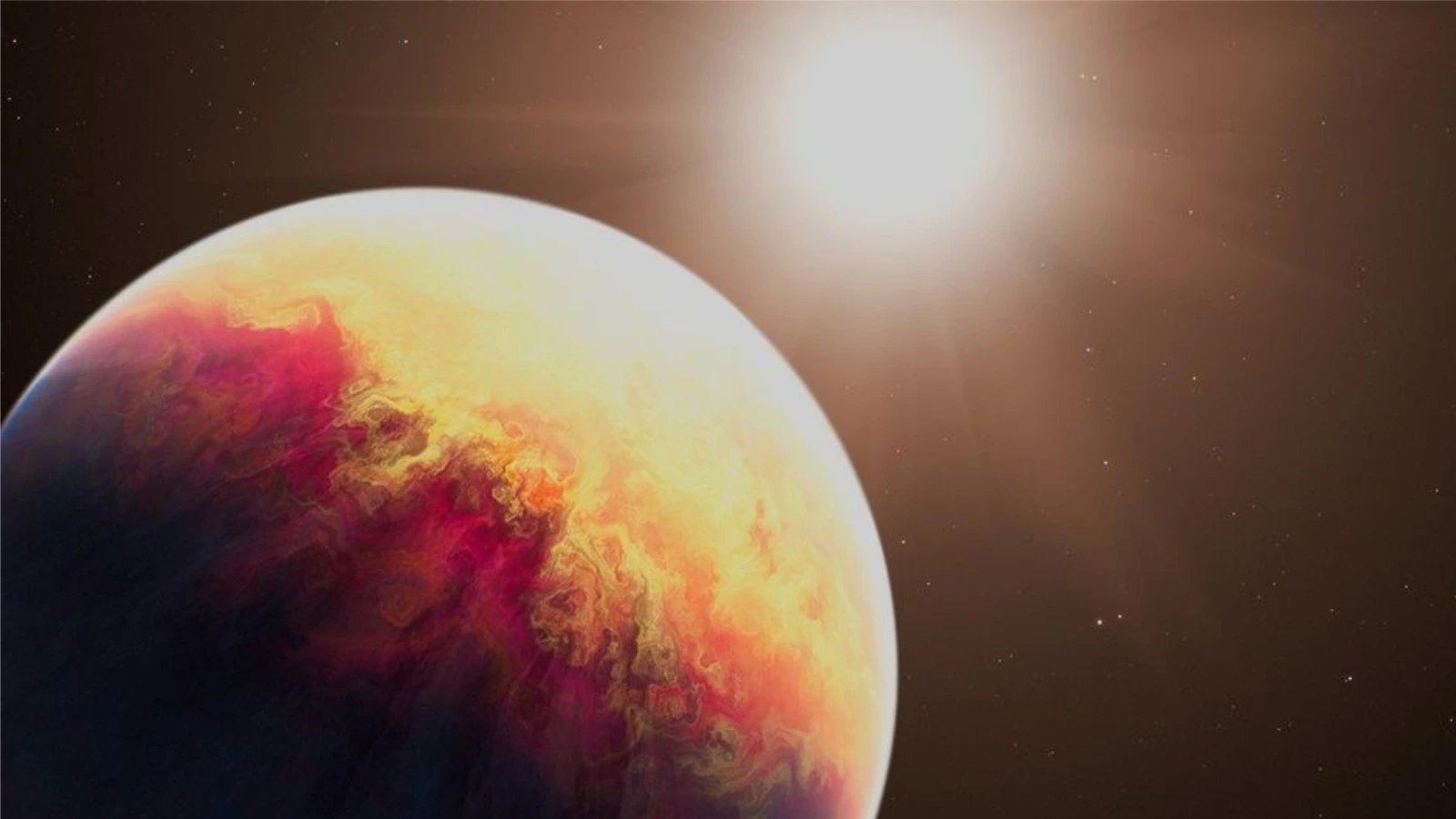
Astronomers measured equatorial winds on exoplanet WASP-127b at 33,000 km/h, 16 times Neptune's strongest winds. The measurement used the CRIRES+ spectrograph on the Very Large Telescope in Chile during a transit in early 2025. The record was overtaken four weeks later by a faster flow on another exoplanet.
Key Facts
- WASP-127b's equatorial winds were measured at 33,000 km/h, about 16 times Neptune's strongest winds.
- The planet orbits a Sun-like star in Sextans every 4.18 Earth days at 0.048 AU, about one-eighth Mercury's distance from the Sun.
- WASP-127b has a radius 1.31 times Jupiter's but only 0.165 Jupiter masses, giving it an average density about one-tenth that of water.
- The wind speed was inferred from spectral lines using the CRIRES+ spectrograph on the Very Large Telescope, not from direct cloud tracking.
- On 18 February 2025, another team reported a faster equatorial flow on a different exoplanet, overtaking WASP-127b's record.
Wind Measurement
For 28 days in early 2025, WASP-127b held the record for fastest measured atmospheric winds on an exoplanet. Atmospheric material around the equator was inferred to move at 9 km/s, or 33,000 km/h. That speed is about 16 times the strongest winds commonly quoted for Neptune, the Solar System's wind champion. The observing team used CRIRES+, a high-resolution infrared spectrograph on the European Southern Observatory's Very Large Telescope in Chile. The instrument followed WASP-127b through one transit and dispersed the incoming light into a finely divided spectrum.
Planet Characteristics
WASP-127b was discovered in 2016 and circles a Sun-like star in the constellation Sextans. The planet completes a year every 4.18 Earth days at an orbital distance of about 0.048 astronomical units. NASA's exoplanet catalogue gives WASP-127b a radius about 1.31 times Jupiter's and a mass of only 0.165 Jupiters. Its average density is roughly one-tenth that of water, making it an inflated, puffy planet. This inflated structure strengthens molecular fingerprints during transits, enabling detailed atmospheric study.
Record Overtaken
On 18 February 2025, four weeks after the WASP-127b announcement, another observing team reported a faster equatorial flow on a different exoplanet. The two 2025 studies traced different atoms and molecules at different heights on planets with very different temperatures. Their speeds were recovered from spectral lines and physical models, not from a distant weather camera. The short life of the record does not diminish the result, which showed a planet 520 light-years away could be treated as a place with an equator, two limbs, and different polar conditions.
1 source
Time · lag behind first