
d-Matrix Unveils Raptor 3D DRAM With SRAM-Class Bandwidth at 1/10th HBM Power
This digest was compiled by AI from multiple sources — links to the originals are below.
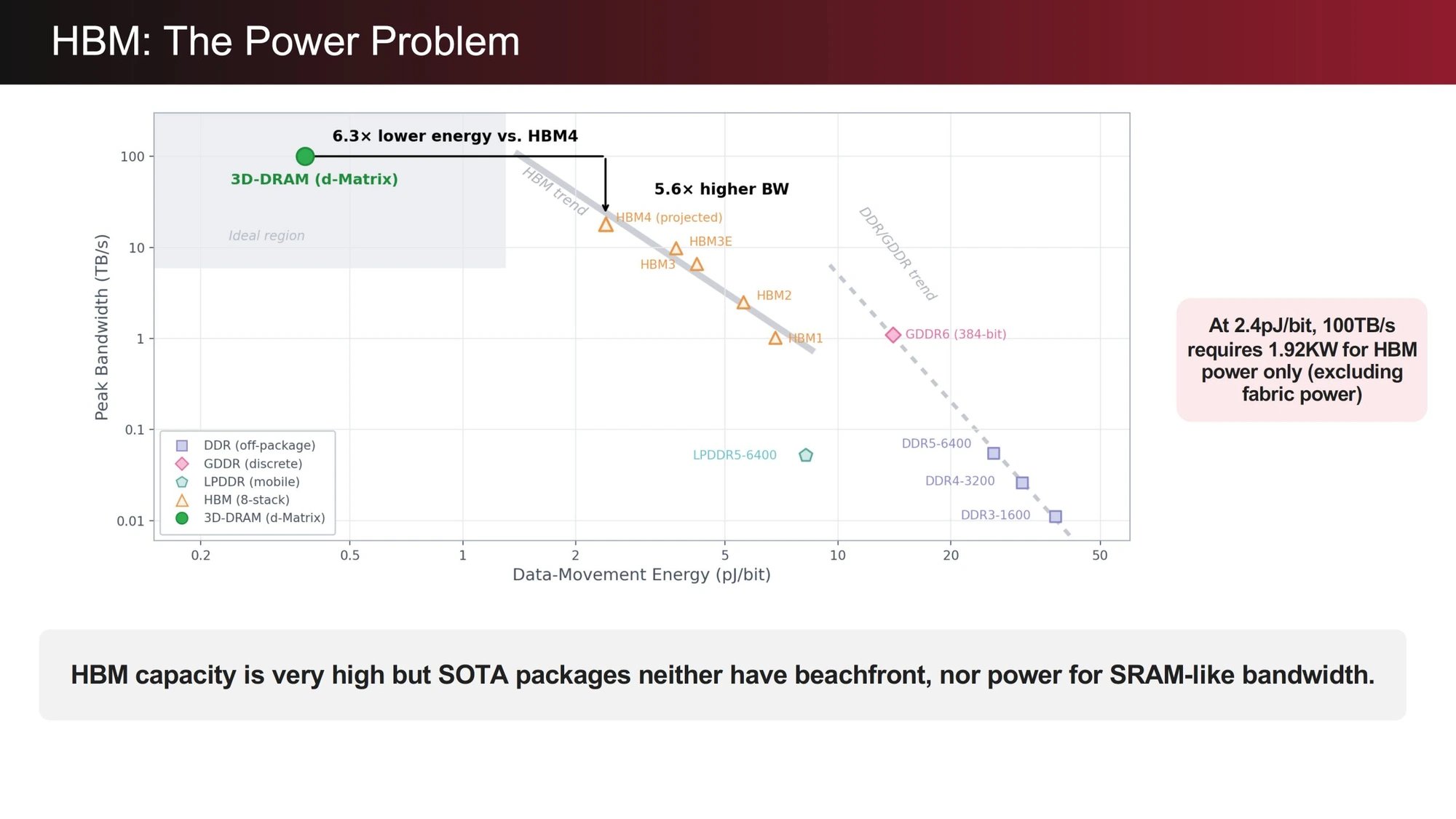
d-Matrix unveiled its Raptor 3D DRAM solution, claiming SRAM-class bandwidth of about 100 TB/s at 0.3–0.37 pJ/bit. The company says the technology delivers 6–7× better energy efficiency than HBM and roughly 10–20× better overall energy/bandwidth. The announcement comes as AI model sizes and KV caches strain existing memory technologies.
Key Facts
- Raptor 3D DRAM delivers approximately 100 TB/s bandwidth at 0.3–0.37 pJ/bit, compared with HBM4's roughly 20 TB/s at 2.4–2.5 pJ/bit.
- A 100 TB/s HBM solution would require about 1.92 kW for HBM power alone, while Raptor's I/O power is about 300 W.
- Raptor offers 32 GB capacity per single-high stack, intermediate between SRAM's sub-2 GB scalability limit and HBM's multi-stack capacity.
- d-Matrix proposes two 3D DRAM stacking methods: DRAM on top of logic, which poses thermal challenges, and DRAM beneath logic, which poses power-delivery challenges.
- A 1-Hi stack with logic-on-top at under 0.5 W/mm² power density can be reliably liquid-cooled with DRAM below 100°C, according to d-Matrix.
Raptor Architecture
d-Matrix's Raptor 3D DRAM stacks DRAM dies with compute logic to achieve SRAM-like bandwidth and power characteristics. The company describes two stacking approaches: placing stacked DRAM on top of the logic die, or stacking DRAM dies beneath the logic die. The logic-on-top method faces a thermal challenge because heat must escape through the thermally sensitive DRAM stack. The DRAM-beneath-logic method faces a power-delivery challenge, as hundreds of watts must be delivered through TSVs in the DRAM stack. d-Matrix states that a 1-Hi stack with logic-on-top at a power density below 0.5 W/mm² can be reliably liquid-cooled, keeping DRAM below 100°C.
Memory Technology Comparison
SRAM offers extremely high bandwidth in the hundreds of TB/s and about 0.1 pJ/bit energy efficiency, but capacity is hard to scale beyond roughly 2 GB and it costs about 100× more than HBM. HBM provides very high capacity with multiple stacks per package, but bandwidth scaling is constrained by power, process, and packaging limits. The leading HBM4 DRAM solution provides roughly 20 TB/s bandwidth, far below the 300 TB/s offered by SRAM solutions such as Corsair's SRAM accelerator. Raptor's measured energy efficiency of 0.3–0.37 pJ/bit is 6–7× better than HBM's 2.4–2.5 pJ/bit, and d-Matrix claims 10–20× better overall energy/bandwidth versus HBM. Raptor's density is about half that of HBM4, while its capacity of 32 GB per single-high stack is higher than SRAM but lower than HBM.
1 source
Time · lag behind first