Former Prime Minister Kim Min-seok wins Democratic Party chair in ranked-choice runoff
This digest was compiled by AI from multiple sources — links to the originals are below.
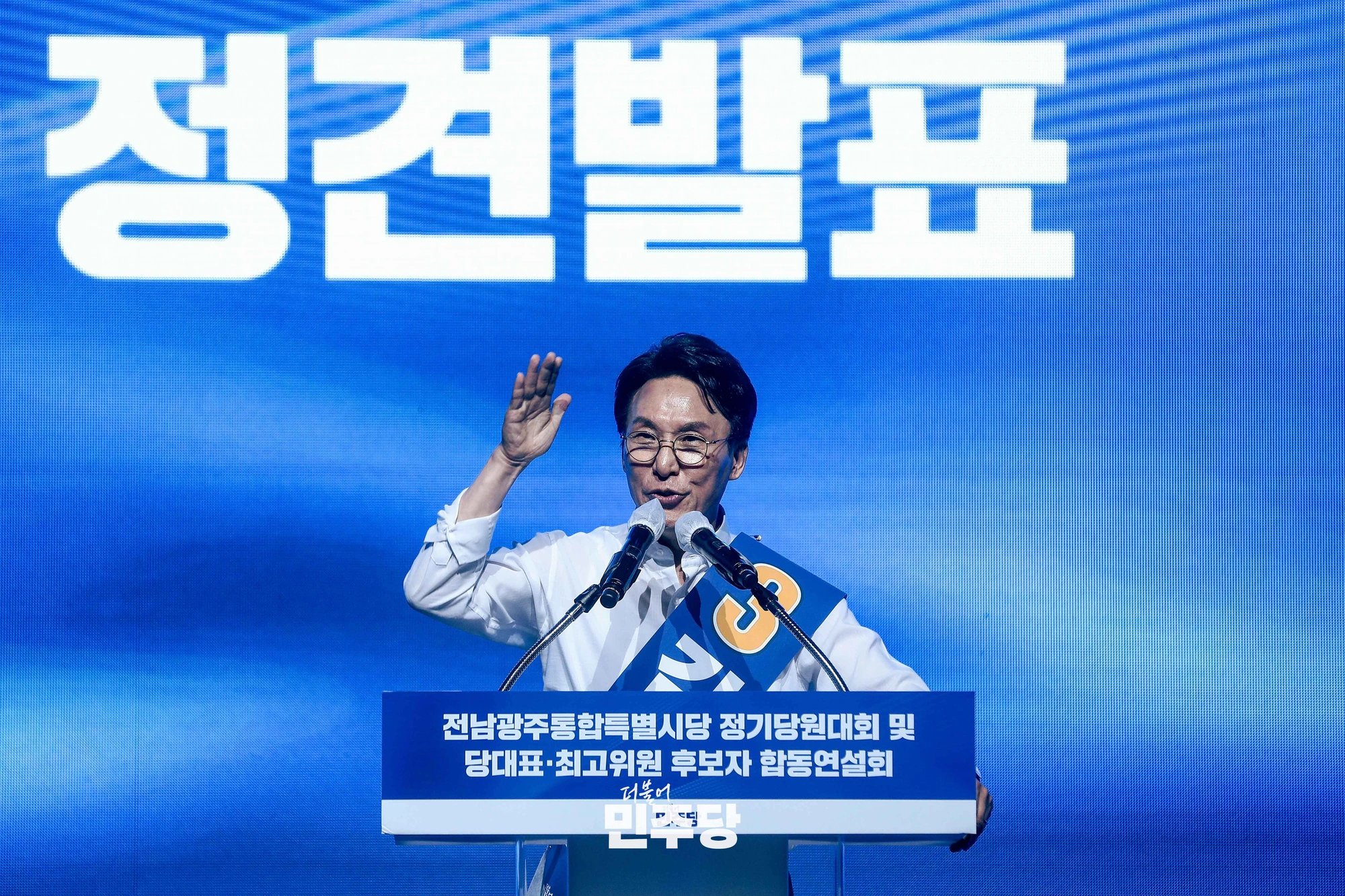
Former Prime Minister Kim Min-seok won the ruling Democratic Party leadership with 54.08 percent of the final vote at the national convention in Daejeon, defeating Jung Chung-rae, who took 45.92 percent. The first ranked-choice runoff in the party's history followed a six-week race that exposed divisions between President Lee Jae-myung's allies and a harder-line faction. Kim will oversee candidate nominations for the April 2028 general elections.
Key Facts
- Second-choice votes from backers of third-place finisher Rep. Song Young-gil were redistributed between Kim Min-seok and Jung Chung-rae, producing Kim's final margin.
- The contest was the Democratic Party's first chair race under a one-member, one-vote system, with dues-paying members and delegates weighted 70 percent and a national public opinion survey weighted 30 percent.
- Kim will oversee candidate nominations for the general elections in April 2028.
- President Lee Jae-myung's approval rating slipped to 44 percent, the lowest since he took office in 2025, according to local media reports.
The Ranked-Choice Runoff
The Democratic Party adopted ranked-choice voting because no rule guaranteed a majority winner in its first one-member, one-vote chair race. Under the process, if no candidate clears 50 percent on first-preference ballots, the last-place finisher is eliminated and votes are reallocated by second choice. Kim Min-seok fell short of a first-round majority, triggering the party's first ranked-choice runoff in its history. Second-choice votes from backers of third-place finisher Rep. Song Young-gil were redistributed between Kim and Jung Chung-rae, producing Kim's final margin of 54.08 percent to 45.92 percent. The national convention in Daejeon announced the final result after six weeks of voting.
Regional Vote Waves
Voting opened August 1 in Chungcheong, where Kim narrowly outpolled Jung, 45.05 percent to 44.61 percent, with Song third at 10.34 percent. Jung responded the next day in Busan, Ulsan, and South Gyeongsang Province, beating Kim 46.65 percent to 43.85 percent. Kim then won Jeju and Incheon on August 8 with 47.75 percent to Jung's 42 percent. Kim's strongest results came in Gwangju and the Jeolla provinces and the greater Seoul area after President Lee Jae-myung announced an 800 trillion won ($564 billion) semiconductor investment package for the Gwangju region.
Lee's Consolidation Test
The race was widely seen as a proxy fight between the pro-Lee camp and a harder-line faction associated with outgoing chair Jung Chung-rae, who has pushed back on the pace of judicial overhaul. Kim's campaign speech in July framed the contest as a referendum on whether the party would fully back President Lee Jae-myung's agenda. Lee, who assumed the presidency in 2025, saw his approval rating slip to 44 percent, the lowest since he took office, according to local media reports. The new leader will oversee candidate nominations for the April 2028 general elections.
1 source
Former Prime Minister Kim Min-seok wins Democratic Party chair in ranked-choice runoff