Guyana's Rodrigues-Birkett leads UN secretary-general race after second vote
This digest was compiled by AI from multiple sources — links to the originals are below.
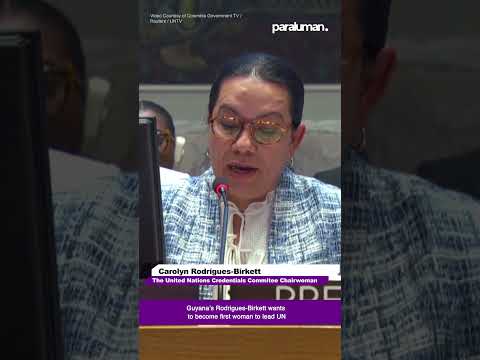
Guyana's Carolyn Rodrigues-Birkett topped the second UN Security Council straw poll for secretary-general with 8 encourage votes, 3 discourage and 4 no opinion. Costa Rica's Rebeca Grynspan and IAEA chief Rafael Grossi of Argentina tied at 7 encourage votes, but Grossi faced 6 discourage votes. No candidate reached the 9-vote threshold needed for Security Council recommendation.
Key Facts
- Carolyn Rodrigues-Birkett of Guyana received 8 encourage votes, 3 discourage and 4 no opinion in the second UN Security Council straw poll.
- Rebeca Grynspan of Costa Rica and Rafael Grossi of Argentina each received 7 encourage votes, but Grossi faced 6 discourage votes compared to Grynspan's 4.
- Uganda's Olara Otunnu more than doubled his July result, receiving 5 votes in each of the three categories.
- Former Chilean president Michelle Bachelet saw support fall from 6 votes in the first round to 2 encourage votes, with 6 discourage and 7 no opinion.
- No candidate reached the 9-vote threshold required for Security Council recommendation, leaving the race open.
Second Straw Poll Results
The UN Security Council held its second closed straw poll on the secretary-general succession, with eight candidates on the ballot. Carolyn Rodrigues-Birkett of Guyana led the field with 8 encourage votes, 3 discourage and 4 no opinion. Rebeca Grynspan of Costa Rica, the first-round leader on 30 July, slipped to second place with 7 encourage votes, 4 discourage and 4 no opinion. Rafael Grossi of Argentina, director general of the International Atomic Energy Agency, also received 7 encourage votes but faced 6 discourage votes and 2 no opinion. Senegal's former president Macky Sall received 6 encourage votes, 7 discourage and 2 no opinion, while Ecuador's María Fernanda Espinosa received 4 encourage, 3 discourage and 8 no opinion.
Vote Threshold and Regional Rotation
A candidate needs at least 9 encourage votes and no veto from any of the five permanent members — the United States, Russia, China, the United Kingdom and France — to be recommended by the Security Council. Since no candidate reached 9 votes in the second round, none has secured a decisive lead. Daniel Forti of the International Crisis Group noted that as permanent members clarify their positions, the balance of support shifts and new candidates may enter the race. Under the unwritten principle of regional rotation, the current mandate is seen as Latin America and the Caribbean's turn, with six candidates from the region. The new secretary-general, who will succeed António Guterres on 1 January, must be approved by the General Assembly by 31 December.
1 source
Guyana's Rodrigues-Birkett leads UN secretary-general race after second vote