
UCLA scientists find lunar pits stay near 17°C as surface swings 127 to −173°C
This digest was compiled by AI from multiple sources — links to the originals are below.
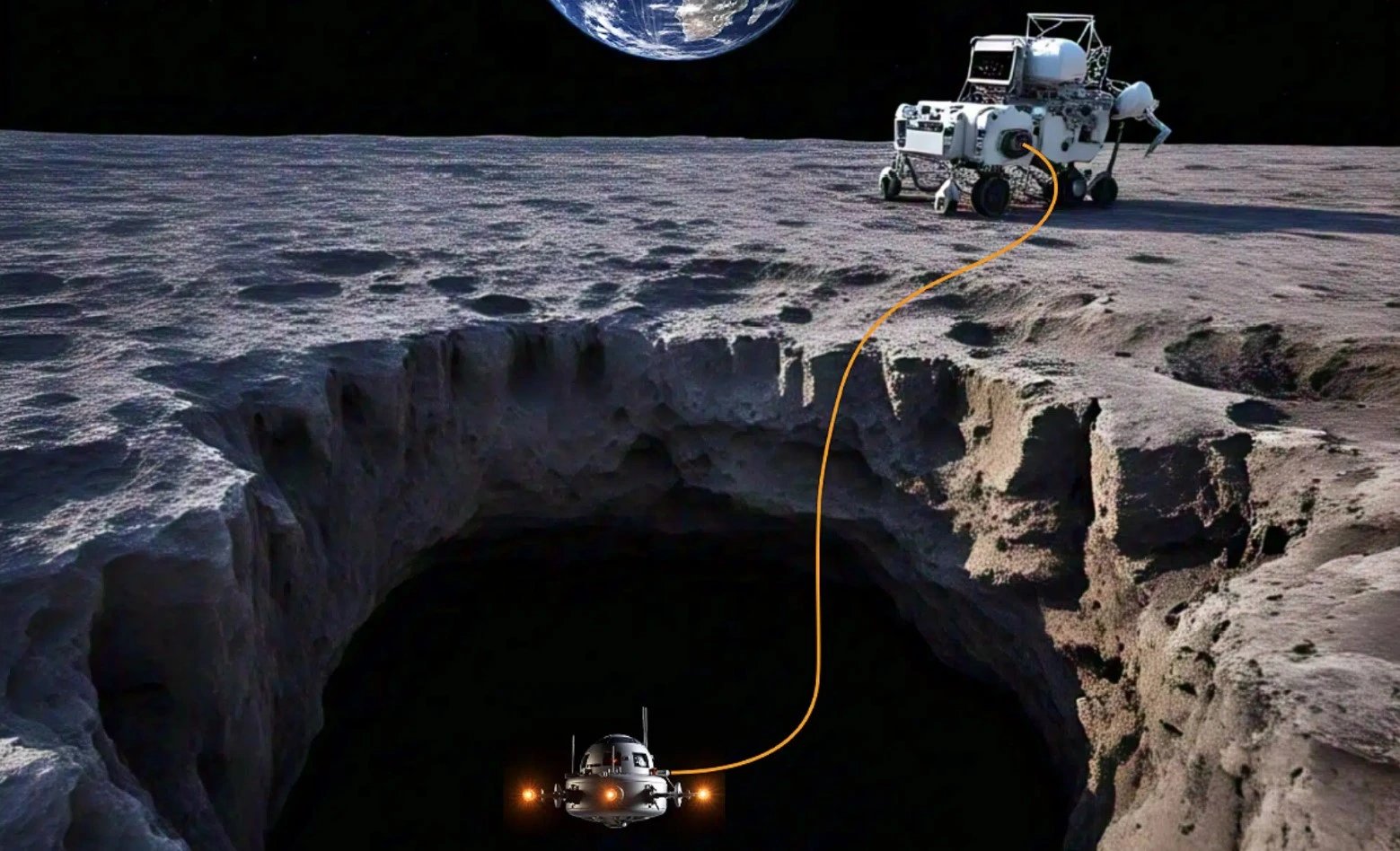
A team led by UCLA planetary scientist Tyler Horvath found that permanently shaded parts of lunar pits stay near 17°C while exposed surface swings between 127°C and −173°C. Modelling based on Diviner radiometer data from NASA's Lunar Reconnaissance Orbiter predicts a similarly steady temperature in a connected cave. The finding identifies an unusually favourable thermal environment for a permanent lunar address.
Key Facts
- A team led by UCLA planetary scientist Tyler Horvath found that permanently shaded parts of lunar pits stay near 17°C with only small variation.
- NASA uses the 127°C to −173°C range when contrasting exposed lunar terrain with shaded pits.
- The Diviner Lunar Radiometer Experiment aboard NASA's Lunar Reconnaissance Orbiter has mapped the Moon through repeated day and night passes since 2009.
- The study concentrated on pits in Mare Tranquillitatis and Mare Ingenii; the Tranquillitatis feature is near the equator and roughly 100 metres deep with a football-field-sized floor.
- The peer-reviewed Geophysical Research Letters study matched Diviner observations with two-dimensional simulations of rock, regolith, sunlight and radiative heat exchange.
Lunar Surface Extremes
Sunlight heats exposed lunar ground to about 127 degrees Celsius during a lunar day that lasts roughly two Earth weeks. Through the equally long night, exposed ground falls to about minus 173 degrees Celsius. NASA uses the 127°C to −173°C range when contrasting exposed terrain with shaded pits. Actual temperatures depend on latitude, slope, local time, rock abundance and illumination. The figures are representative surface extremes, not values reached by every point on the Moon.
Pit Thermal Buffer
A team led by UCLA planetary scientist Tyler Horvath found that protected parts of certain lunar pits remain close to 17 degrees Celsius, with only small variation. The team's modelling predicts a similarly steady temperature in a connected cave throughout the lunar year. Pit geometry changes which surfaces can see the Sun and cold space, producing a natural thermal buffer before engineers add any machinery. A habitat on open ground must survive the 127°C to −173°C cycle while keeping people, batteries, electronics and life-support fluids within narrower limits. Insulation, radiators, heaters and power storage all add mass, and repeated expansion and contraction fatigue materials and connections.
Diviner and Modelling
Horvath processed observations from the Diviner Lunar Radiometer Experiment aboard NASA's Lunar Reconnaissance Orbiter. Diviner measures infrared energy emitted by the surface, allowing scientists to infer temperature. The instrument has mapped the Moon through repeated day and night passes since LRO entered orbit in 2009. The study concentrated on pits in Mare Tranquillitatis and Mare Ingenii, and the Tranquillitatis feature is near the equator and roughly 100 metres deep. The peer-reviewed Geophysical Research Letters study matched those observations with two-dimensional simulations of rock, regolith, sunlight and radiative heat exchange.
1 source
Time · lag behind first