
Max Planck team discovers first triple supermassive black hole system in galaxy J0148-4214
This digest was compiled by AI from multiple sources — links to the originals are below.
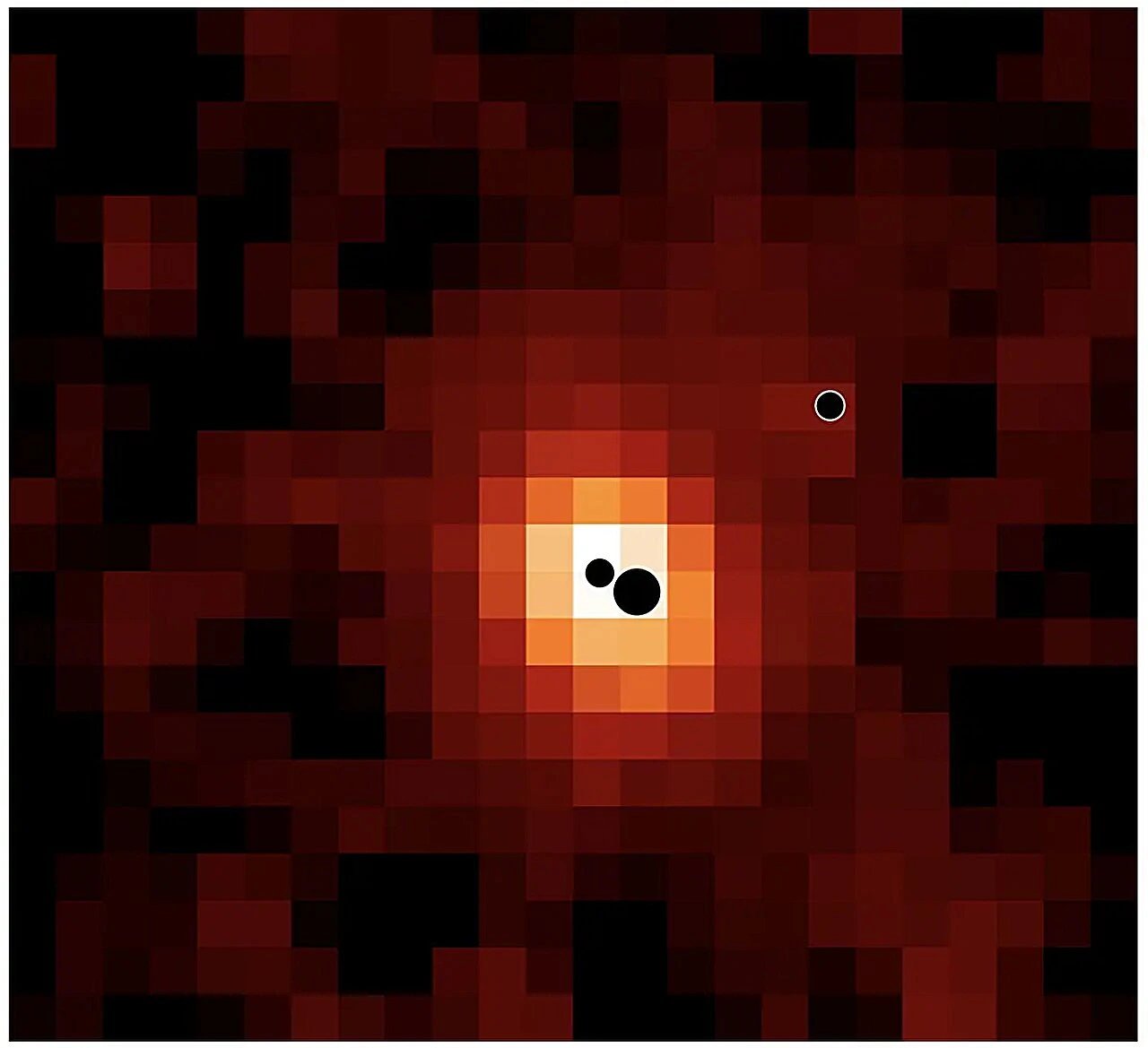
An international team led by the Max Planck Institute for Extraterrestrial Physics has identified three actively accreting supermassive black holes in galaxy J0148-4214, more than 12.5 billion light-years from Earth. The discovery, published in Astronomy & Astrophysics, is the first evidence of three active black holes in a single galaxy in the distant universe. Two central black holes are separated by only 620 light-years in projection, while a third sits about 5,500 light-years from the center.
Triple Black Hole System
The system lies in galaxy J0148-4214 at redshift z=5.02, meaning its light travelled 12.5 billion years and shows the galaxy as it appeared about 1.2 billion years after the Big Bang. Two of the black holes sit in the galactic center, separated by only 620 light-years in projection. A third lies in the outer region roughly 5,500 light-years from the center. The team, led by Hannah Übler at the Max Planck Institute for Extraterrestrial Physics, reports the finding in Astronomy & Astrophysics.
Detection Method
Researchers identified the black holes through spectral fingerprints of hydrogen atoms moving at high velocity in the black holes' gravitational potential. The central spectrum showed a complex structure best explained by two closely separated black holes. The team applied spectro-astrometry to measure spatial shifts in line emission across the galaxy, allowing them to determine positions even without resolving separate point sources. This technique also revealed the third black hole in the outer region.
Masses and Accretion
The analysis yields black hole masses of approximately 80 million, 0.6 million and 2 million solar masses. The most massive black hole is accreting at a lower rate than the nearby 0.6-million-solar-mass black hole, which is actively feeding and even exceeding the Eddington limit. According to the team, this suggests that processes in the early universe were efficient at bringing massive black holes together, setting the stage for mergers detectable by future gravitational wave observatories.
1 source
Time · lag behind first