
Illinois researchers reveal 3D schematics of sorghum leaf interior to reduce crop water loss
This digest was compiled by AI from multiple sources — links to the originals are below.
University of Illinois researchers have produced the first three-dimensional schematics of a sorghum leaf’s interior ventilation system, revealing how stomatal pores connect to photosynthetic centers and water pathways. The X-ray analysis, conducted at Argonne National Laboratory’s particle collider beamline, provides a blueprint for engineering crops that lose less water during photosynthesis. The work could help staple crops like corn withstand hotter, drier growing seasons.
Water-Use Tradeoff
Every land plant faces a fundamental trade-off during photosynthesis: while stomata take in carbon dioxide, 300 to 400 water molecules escape for each CO₂ molecule captured. On hot, bright days, this water loss can be extreme, limiting crop growth to regions with adequate rainfall. Researchers at the University of Illinois Urbana-Champaign seek to engineer plants that minimize water loss without sacrificing CO₂ uptake.
3D Leaf Imaging
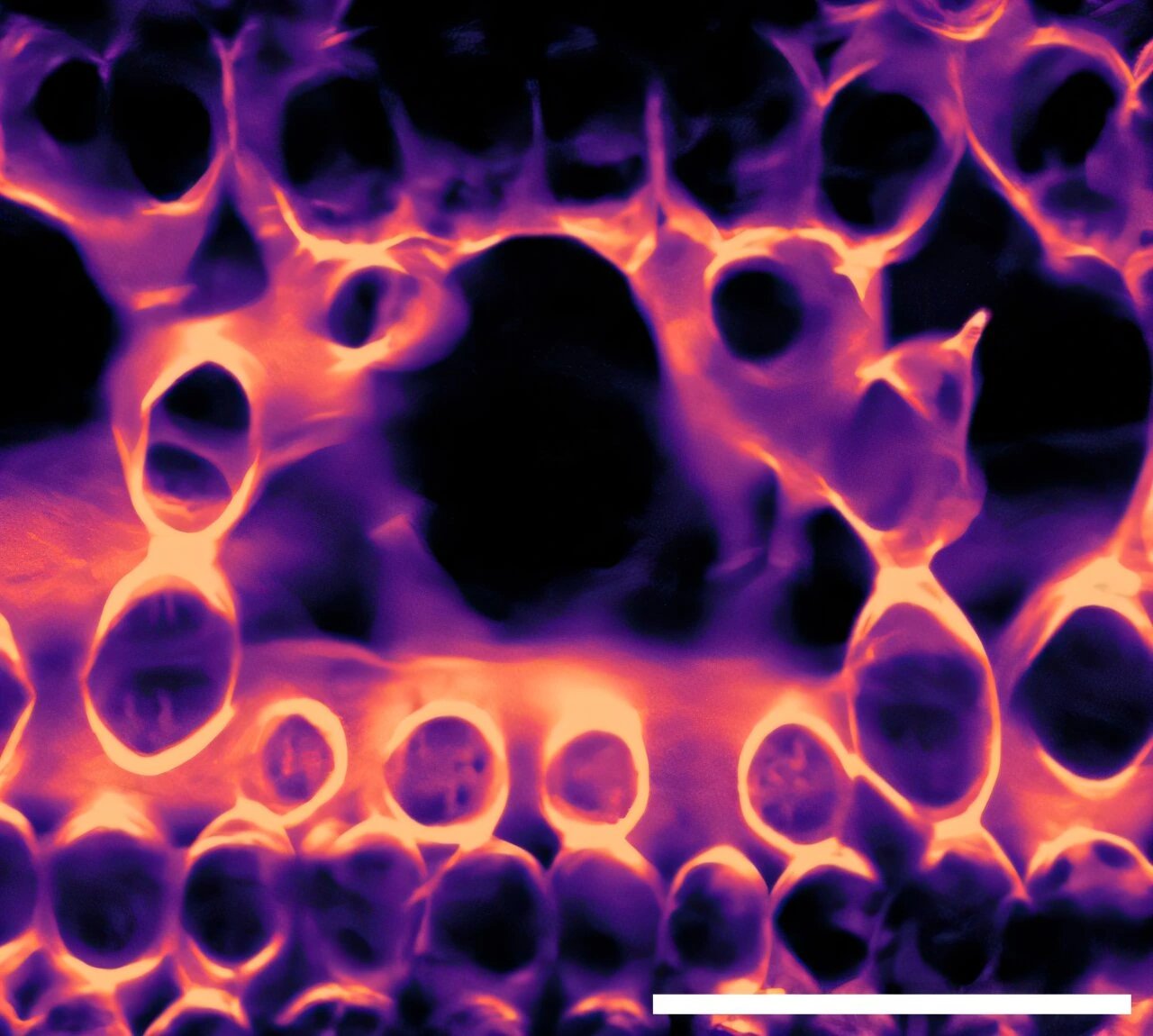
Using X-rays at Argonne National Laboratory’s Advanced Photon Source, the team produced the first detailed three-dimensional images of sorghum leaf interior. The images reveal a highly organized system connecting stomatal pores on the leaf surface to air pathways, photosynthetic cells, and veins beneath. ‘There are connections between each component of the leaf,’ said postdoctoral researcher James Fischer. ‘It’s a highly organized system.’
Engineering Possibilities
With precise schematics, scientists can now quantify how easily CO₂ molecules navigate the leaf’s internal ventilation to reach photosynthetic sites. This knowledge guides efforts to breed or genetically modify crops with fewer stomata, a strategy already proven in sorghum by the Center for Advanced Bioenergy and Bioproducts Innovation. ‘We’re now really interested in quantifying how easily a CO₂ molecule can work its way through the interior ventilation system of the leaf,’ said Professor Andrew Leakey, the study’s senior author.
1 source
Time · lag behind first