
Imperial College researchers unveil Clavina reconfigurable quantum processor in Nature Photonics
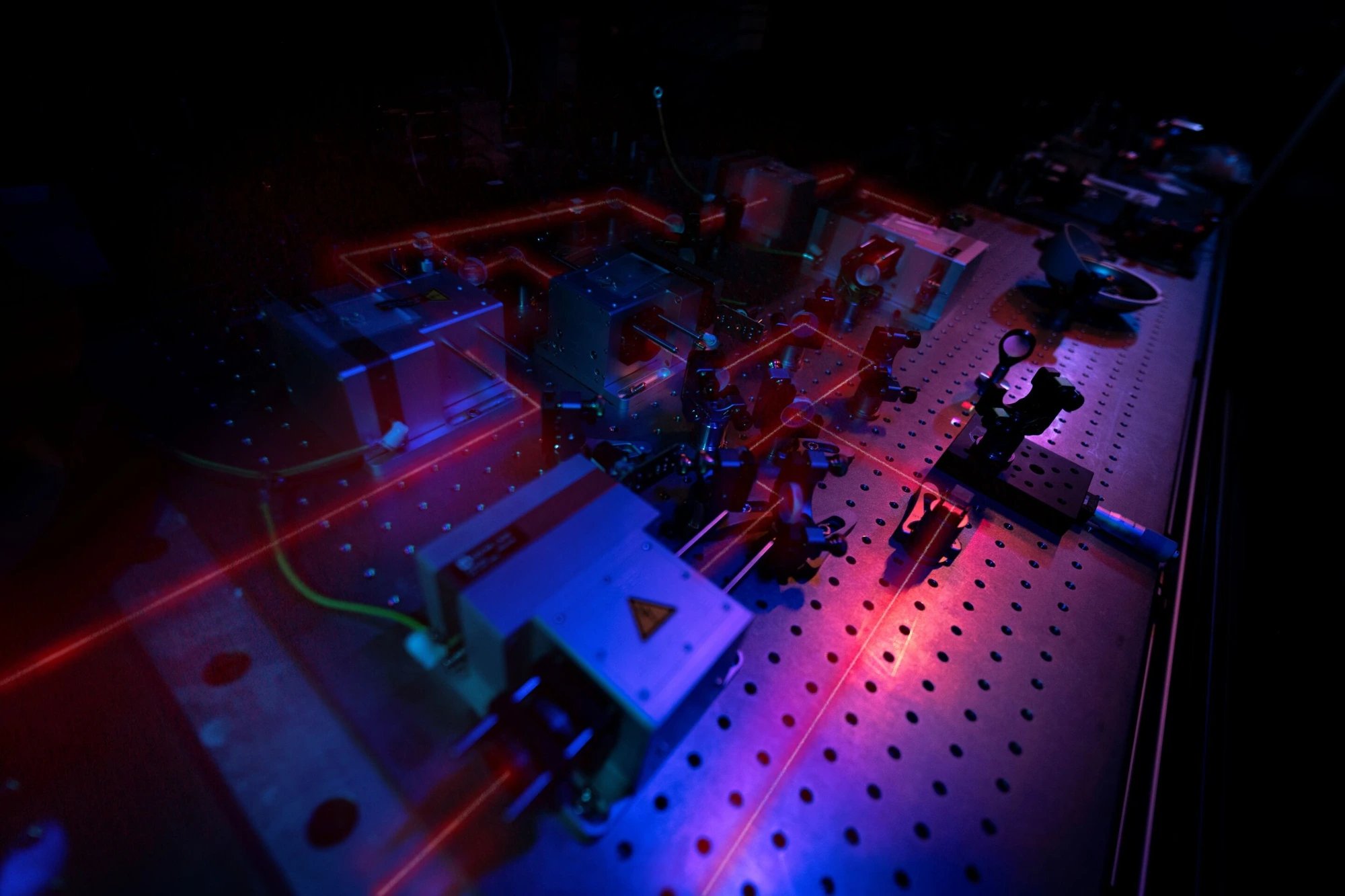
This digest was compiled by AI from multiple sources — links to the originals are below.
Researchers from Imperial College London develop a programmable photonic quantum processor, dubbed Clavina, that combines linear and nonlinear operations within a single reconfigurable architecture, according to a study published 6 August in Nature Photonics. The team demonstrates the processor’s versatility by simulating the Bose-Hubbard model in condensed matter physics and generating Gottesman-Kitaev-Preskill states for more reliable quantum error correction.
Reconfigurable Architecture
The Clavina processor is designed as a modular system, with a central control unit directing information between a programmable optical network and specialized nonlinear modules. Dr. Shang Yu of Imperial College, the study’s lead author, said the architecture is ‘scalable, modular and extensible, allowing different functional modules to be used depending on the computational task.’ Unlike traditional photonic systems that are hardwired for specific tasks, Clavina can be reconfigured without hardware changes, inspired by classical computer processors that combine specialized components for graphics and AI.
Proof-of-Concept Demonstrations
To validate the platform, the team performed two complex experiments. First, Clavina simulated the Bose-Hubbard model, a fundamental problem in condensed matter physics describing interacting quantum particles. Dr. Jinzhao Sun of Queen Mary University of London noted that the hardware’s integration of nonlinear and linear operations enabled simulations involving many-body interactions, which are ‘also restricted on superconducting quantum computers.’ Second, the processor generated Gottesman-Kitaev-Preskill (GKP) states, an important resource for error correction that encodes information in a noise-resistant format.
1 source
Time · lag behind first