
Caltech researchers quadruple microscope resolution using entangled photons
This digest was compiled by AI from multiple sources — links to the originals are below.
Caltech researchers led by Lihong Wang achieved a fourfold increase in light microscope resolution, surpassing the classical diffraction limit. The breakthrough, published in Science Advances, uses a new optical design that routes entangled photons through the microscope multiple times. The advance builds on the team's 2023 demonstration that doubled resolution using quantum entanglement.
Quantum Entanglement Microscopy
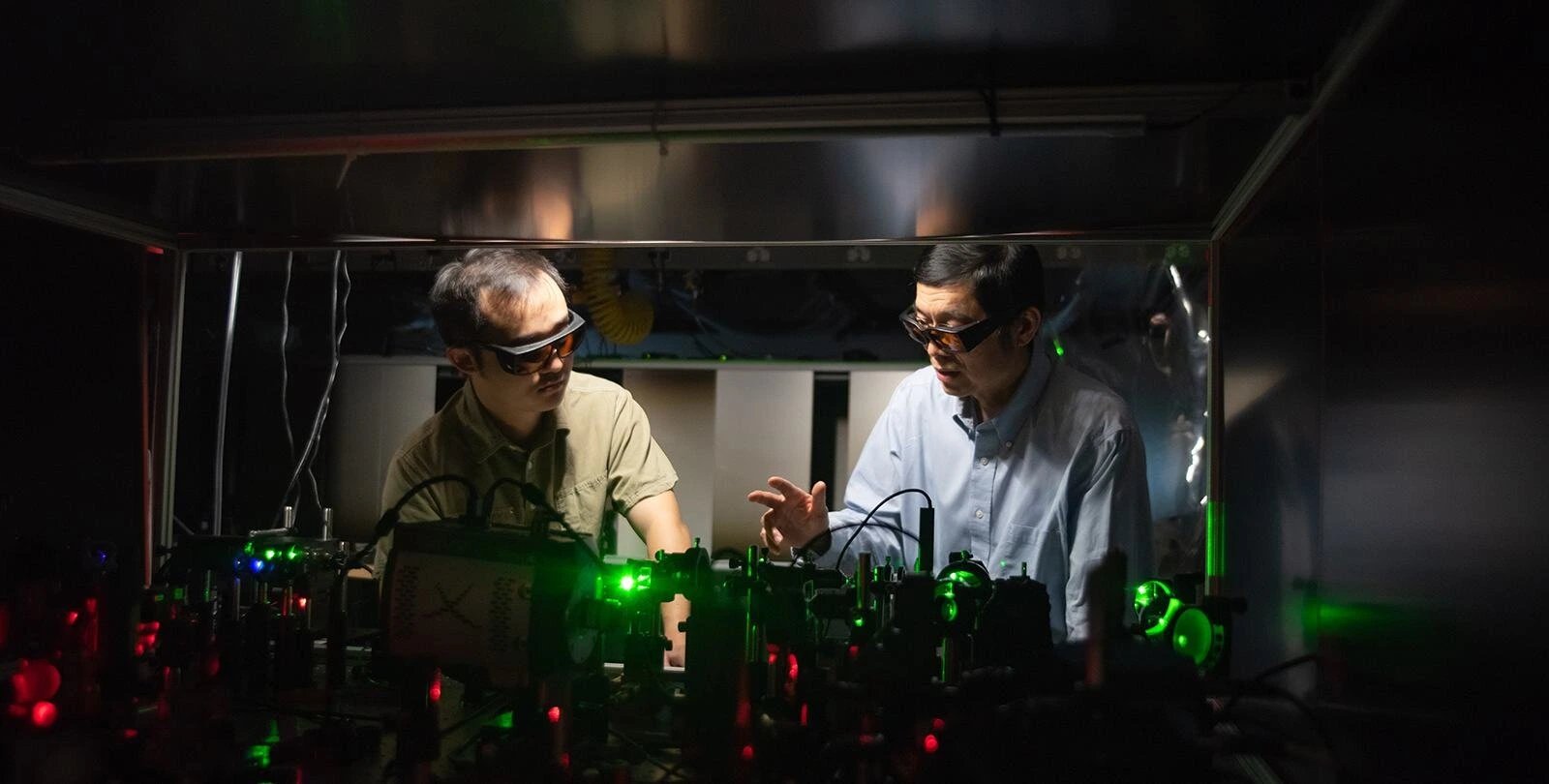
Quantum microscopy by coincidence (QMC) splits entangled photon pairs, with the signal photon passing through the sample and the idler taking a parallel path. The pair effectively behaves as a single particle with twice the momentum, halving the wavelength and doubling the classical resolution. In the new design, the idler is routed back through the microscope's lenses three times using magnetic fields and polarization-controlling beam splitters, while the signal passes once. This routing multiplies the resolution boost to a factor of four.
Experimental Validation and Future Potential
The team, led by Lihong Wang—Bren Professor of Medical Engineering at Caltech—published the results in Science Advances. Wang stated that the work enters a new physical regime, surpassing the presumed twofold limit for a single photon pair. He indicated that further refinements could push resolution improvements to 10 or even 100 times beyond the classical diffraction limit.
1 source
Time · lag behind first