
Apophis to fly inside geostationary orbit on April 13, 2029; OSIRIS-APEX to study aftermath
This digest was compiled by AI from multiple sources — links to the originals are below.
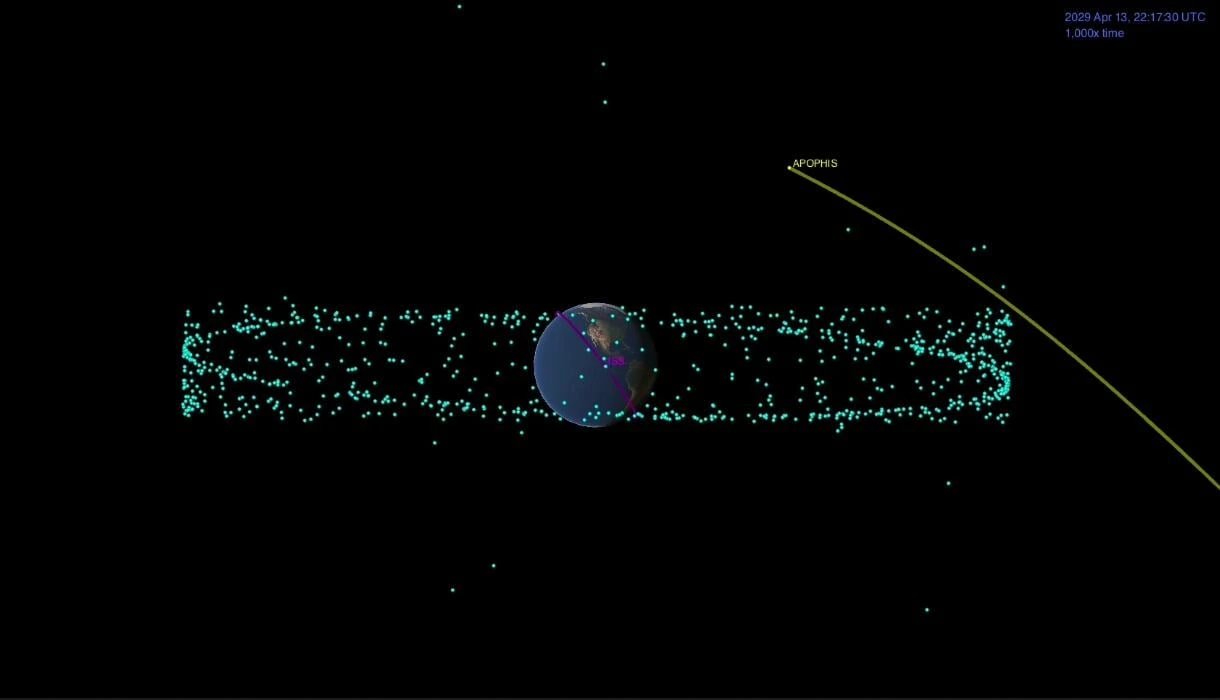
On April 13, 2029, asteroid 99942 Apophis will pass 32,000 km above Earth, closer than geostationary satellites, in the closest known approach of an asteroid of its size. NASA’s OSIRIS-APEX spacecraft will observe from a distance and later rendezvous to inspect gravitational changes. The asteroid poses no collision risk, but Earth’s gravity is predicted to reshape its surface and alter its rotation.
The Flyby
Apophis measures about 340 meters in diameter and will pass less than one-tenth the average Earth-Moon distance away. At its closest approach, it will be inside the altitude of geostationary satellites but will not intersect the equatorial satellite belt, posing no risk to spacecraft. The event will make Apophis visible as a moving point of light across much of the globe.
Gravitational Effects on Apophis
Earth’s gravity will alter Apophis’s heliocentric orbit from an Aten to an Apollo type, extending its solar orbit beyond one year. The encounter is expected to modify the asteroid’s tumbling spin state and may trigger seismic shaking, boulder shifts, or landslides, though these outcomes are predictions rather than certainties. Even a quiet surface after the flyby would place useful constraints on Apophis’s internal structure.
OSIRIS-APEX Observation Plan
OSIRIS-APEX will begin observing Apophis as a point of light on April 2, 2029, from about 5 million kilometers away. During closest approach on April 13, the spacecraft will remain at roughly 50,000 kilometers, then perform its own Earth gravity assist about an hour after Apophis passes. It will subsequently catch up to the asteroid for detailed surface mapping.
1 source
Time · lag behind first