
Physicists build crystal from 13-sided 'einstein' tile, bending light into pinwheel pattern
This digest was compiled by AI from multiple sources — links to the originals are below.
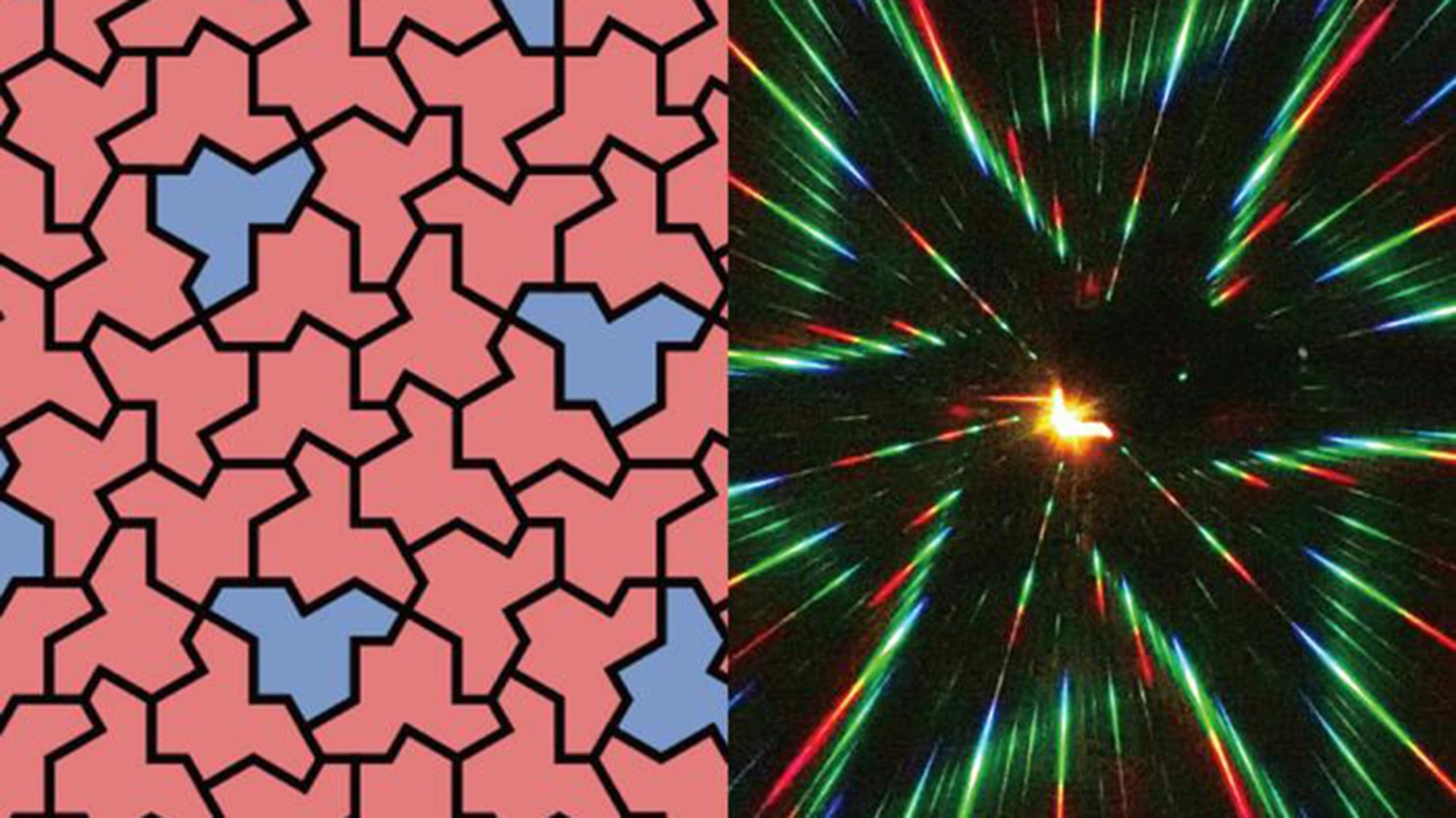
University of Tokyo physicists have fabricated a photonic crystal using the 13-sided 'hat' tile, a shape that tiles a plane without repeating. The crystal, described in Nature Communications, scatters laser light into a swirling pinwheel pattern that changes with the light's spin. The nanoscale structure was made by etching hundreds of thousands of 100-nanometer-radius holes into silicon nitride.
The Hat Tile's Origin
Mathematicians long sought a single shape—an 'einstein'—capable of covering a surface with an aperiodic pattern. In the 1970s, Roger Penrose showed that two shapes could achieve this, but the single-shape solution remained elusive. In 2023, geometry enthusiast David Smith discovered a 13-sided polygon, dubbed the 'hat' tile, that finally solved the einstein problem. The tile can tile infinitely with no repeating patches, a property called aperiodic order.
Crystal Fabrication
Yuto Moritake, an experimental physicist at the University of Tokyo, encountered the hat tile in a 2024 popular science book and decided to integrate it into a photonic crystal. Using electron beam lithography and etching, his team carved hundreds of thousands of holes, each 100 nanometers in radius, into a silicon nitride film. The holes were arranged according to the hat tile's aperiodic pattern, covering a chip about half a millimeter wide. Silicon nitride is widely used in computer chips, providing a durable substrate.
Light-Scattering Results
When the team directed a laser at the chip, light diffracted into a pinwheel-shaped pattern of bright spots, known as Bragg peaks. The spots remained fixed regardless of the laser's position on the crystal, indicating long-range aperiodic order. The diffraction pattern also responded to the circular polarization of the laser, with a clockwise-spinning beam producing a different pattern than a counterclockwise one. Moritake first captured the phenomenon using a smartphone's long-exposure mode before detailed camera measurements.
1 source
Time · lag behind first