
JMU Würzburg team develops silicon-carbide maser operating above room temperature
This digest was compiled by AI from multiple sources — links to the originals are below.
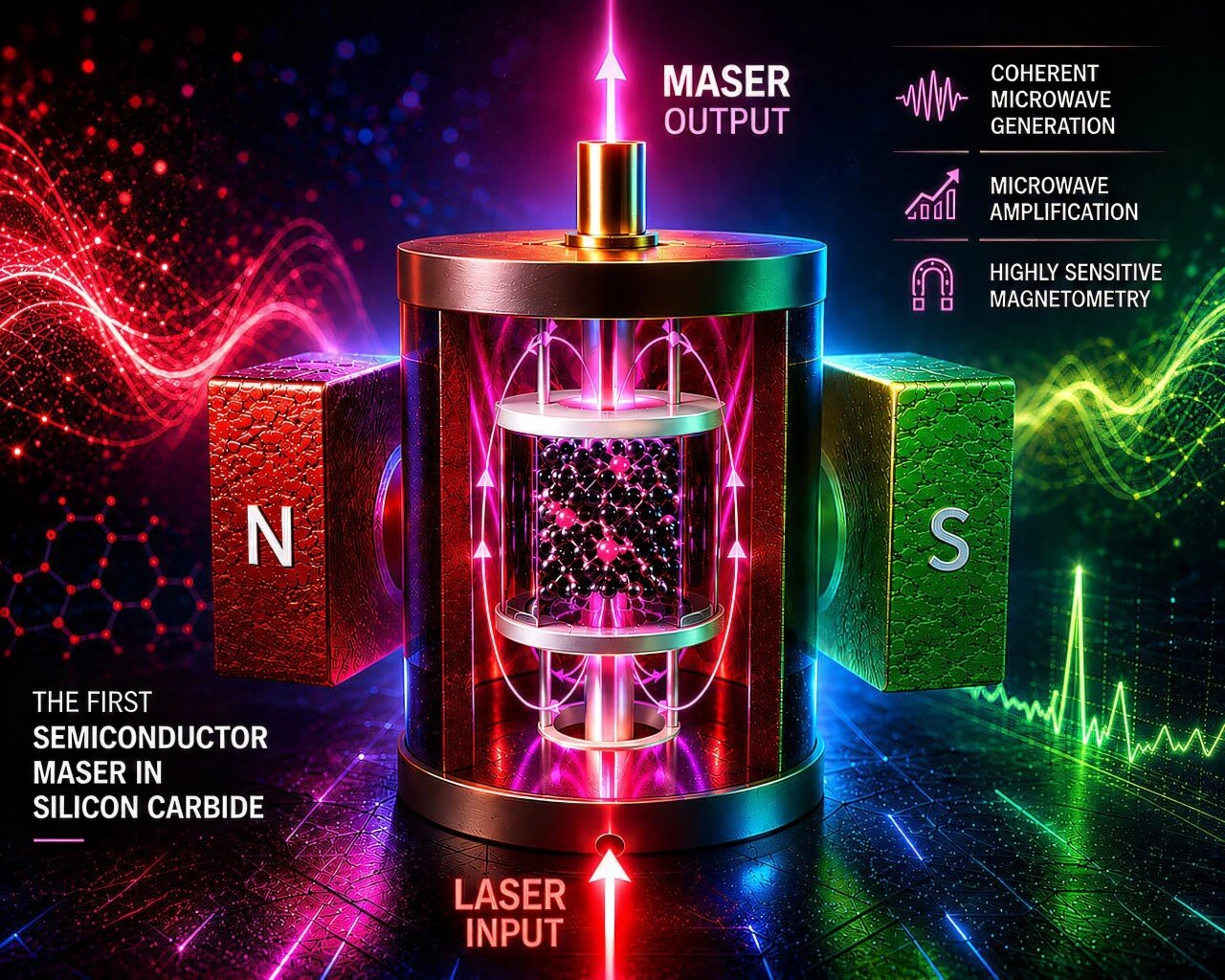
A research team from Julius-Maximilians-Universität Würzburg has built a silicon-carbide maser that operates continuously above room temperature. The device, detailed in Nature Communications, functions as both a microwave source and a low-noise amplifier, opening potential use in communications and quantum sensing.
Silicon Carbide Platform
The maser uses a silicon carbide crystal with deliberately removed silicon atoms to create atomic defects possessing well-defined quantum spin states. These defects can be optically excited to emit or amplify microwaves, turning the semiconductor into an active microwave medium. Silicon carbide is already used in power electronics at industrial scale, making it attractive for future device integration. The work was led by Professor Vladimir Dyakonov and Dr. Andreas Sperlich at JMU Würzburg, with Dr. Andreas Gottscholl as first author.
Room-Temperature Operation
To achieve continuous maser action at room temperature, the team engineered a high-quality-factor resonator that amplifies only the correct microwave frequency. The resonator works analogously to a laser cavity, allowing oscillations to build up. By optimizing the silicon-carbide spin system and resonator design, the maser operates at temperatures exceeding 20°C, eliminating the need for cryogenic cooling.
Low-Noise Amplification
Initial experiments show the maser can act as a low-noise amplifier for weak microwave signals, which is crucial for quantum computing readout, deep-space communication, and radar. The silicon-carbide platform offers compatibility with existing semiconductor manufacturing, suggesting a path to chip-scale maser arrays. Simulations confirmed amplification performance in line with theoretical predictions.
1 source
Time · lag behind first