
Astronomers detect vacuum birefringence in magnetar 1E 1547.0−5408
This digest was compiled by AI from multiple sources — links to the originals are below.
Astronomers report in Nature the detection of vacuum birefringence in the magnetar 1E 1547.0−5408, a long-standing quantum electrodynamics prediction. Measurements using IXPE, NICER, and the Parkes telescope reveal polarization degrees up to 80%, contradicting standard non-refractive emission models.
The Magnetar Observation
Researchers coordinated X-ray and radio observations of the radio magnetar 1E 1547.0−5408. The NASA-led Imaging X-ray Polarimetry Explorer (IXPE) and Neutron Star Interior Composition Explorer (NICER) provided X-ray data, while the Parkes/Murriyang Observatory in Australia supplied simultaneous radio measurements. The magnetar, with a surface magnetic field exceeding 10^14 gauss, is one of only about 30 known in the Milky Way. The team conducted phase- and energy-resolved polarization analysis across the star’s 2-second rotational period.
Exceptionally High Polarization
The soft X-ray band (1-4 keV) revealed striking polarization signals. A phase-averaged polarization degree (PD) of 65% was measured at 2 keV, dropping sharply between 2 and 4 keV. At specific rotational phases, the 2–3 keV PD reached nearly 80%. Even during the radio beam crossing, the PD remained above 40%. The polarization angles in both X-ray and radio bands aligned with the rotating vector model, indicating that the emission geometry traces the star’s large-scale magnetic field.
QED Effect Confirmed
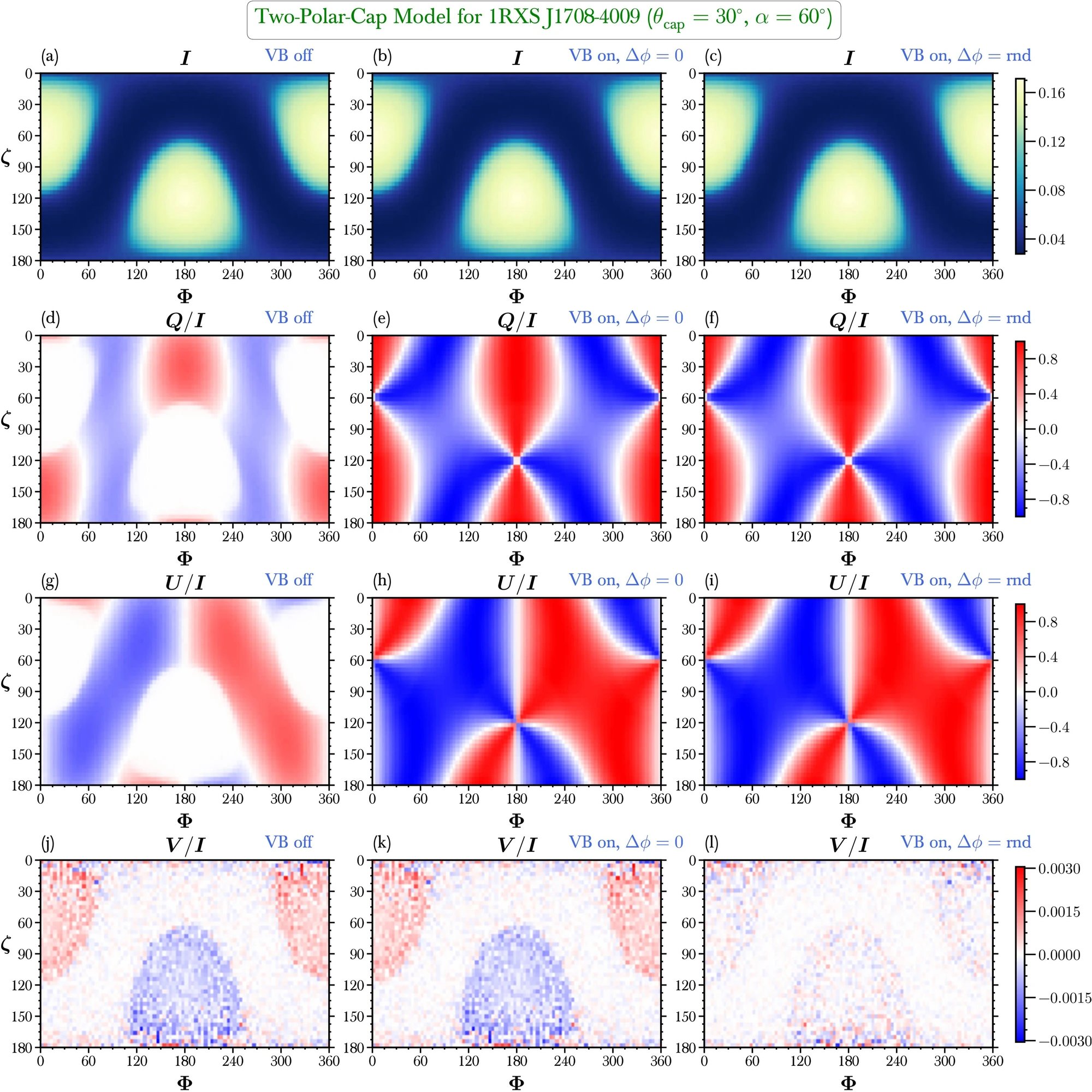
These results conflict with standard surface emission models that assume simple light propagation to infinity. Instead, they support the role of vacuum birefringence, a quantum electrodynamics (QED) prediction where strong magnetic fields alter the vacuum’s refractive index. This mechanism can naturally explain the observed polarization patterns. The study marks a significant advance in probing superstrong-field quantum physics. It opens a new avenue for testing QED in cosmic laboratories.
1 source
Time · lag behind first