
Cold-atom quantum simulator reveals pseudogap metal in Hubbard model
This digest was compiled by AI from multiple sources — links to the originals are below.
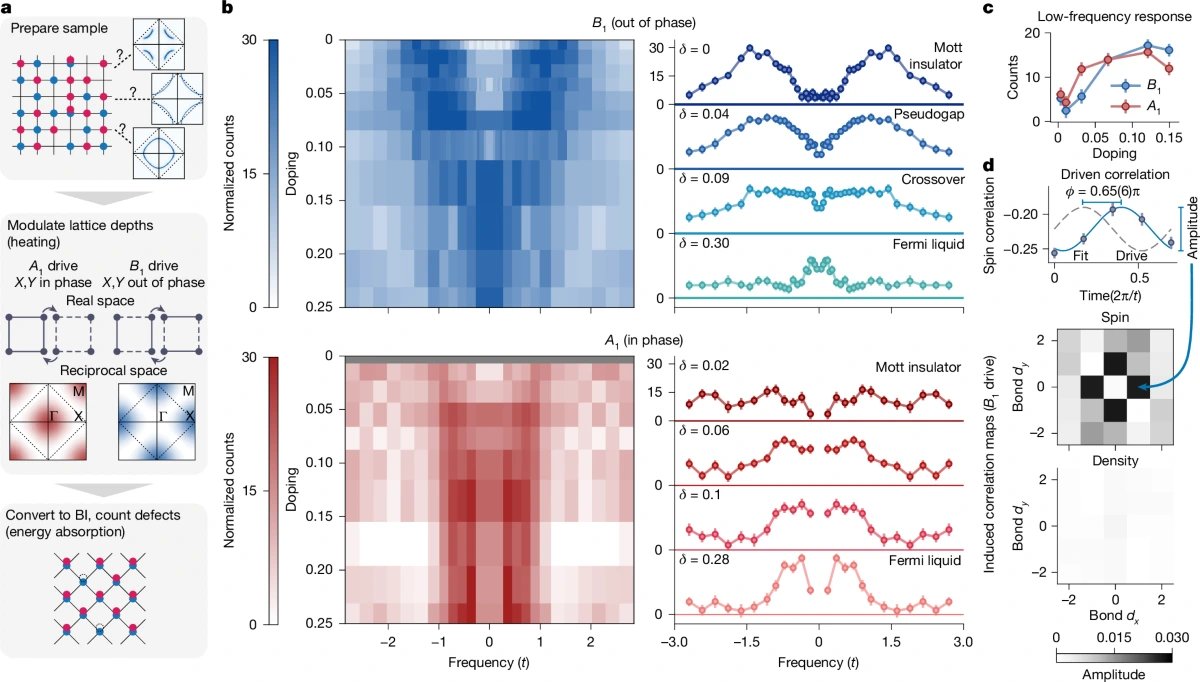
A cold-atom quantum simulator has observed a crossover from a normal metal to a pseudogapped metal in the Fermi-Hubbard model, a landmark for understanding high-temperature superconductivity. The finding, reported in Nature, establishes the pseudogap phase in the Hubbard model experimentally, revealing thermodynamic anomalies and a loss of low-energy spectral weight in the underdoped regime. The observation comes after a recent several-fold reduction in achievable temperatures in such simulators enabled probing of previously inaccessible states.
The Pseudogap Observation
An international team used a Fermi-Hubbard quantum simulator of ultracold atoms to realize the model at low temperatures. They observed a crossover from a normal metal to a pseudogapped metal as doping decreases. The pseudogap is a long-sought feature in cuprates, where it precedes high-temperature superconductivity. The team leveraged a recent several-fold reduction in achievable temperatures to reach the required regime.
Thermodynamic and Spectroscopic Evidence
The compressibility developed a maximum at intermediate doping, signaling an inflection point in the equation of state. Tracking this maximum versus interaction strength revealed a line of thermodynamic anomalies separating underdoped and overdoped metals. Lattice modulation spectra showed a loss of low-energy response in the antinodal regions of the Brillouin zone, directly indicating a pseudogap.
Phase Diagram and Implications
From these measurements, the researchers constructed a pseudogap phase diagram versus interactions and doping, establishing the pseudogap metal's boundaries in the Hubbard model. The results suggest connections to charge order that can be explored in future quantum simulation studies. This work demonstrates the power of cold-atom simulators to tackle correlated electron problems.
1 source
Time · lag behind first