
Formamidinium eutectic yields 31.5% efficient evaporated perovskite-silicon tandems
This digest was compiled by AI from multiple sources — links to the originals are below.
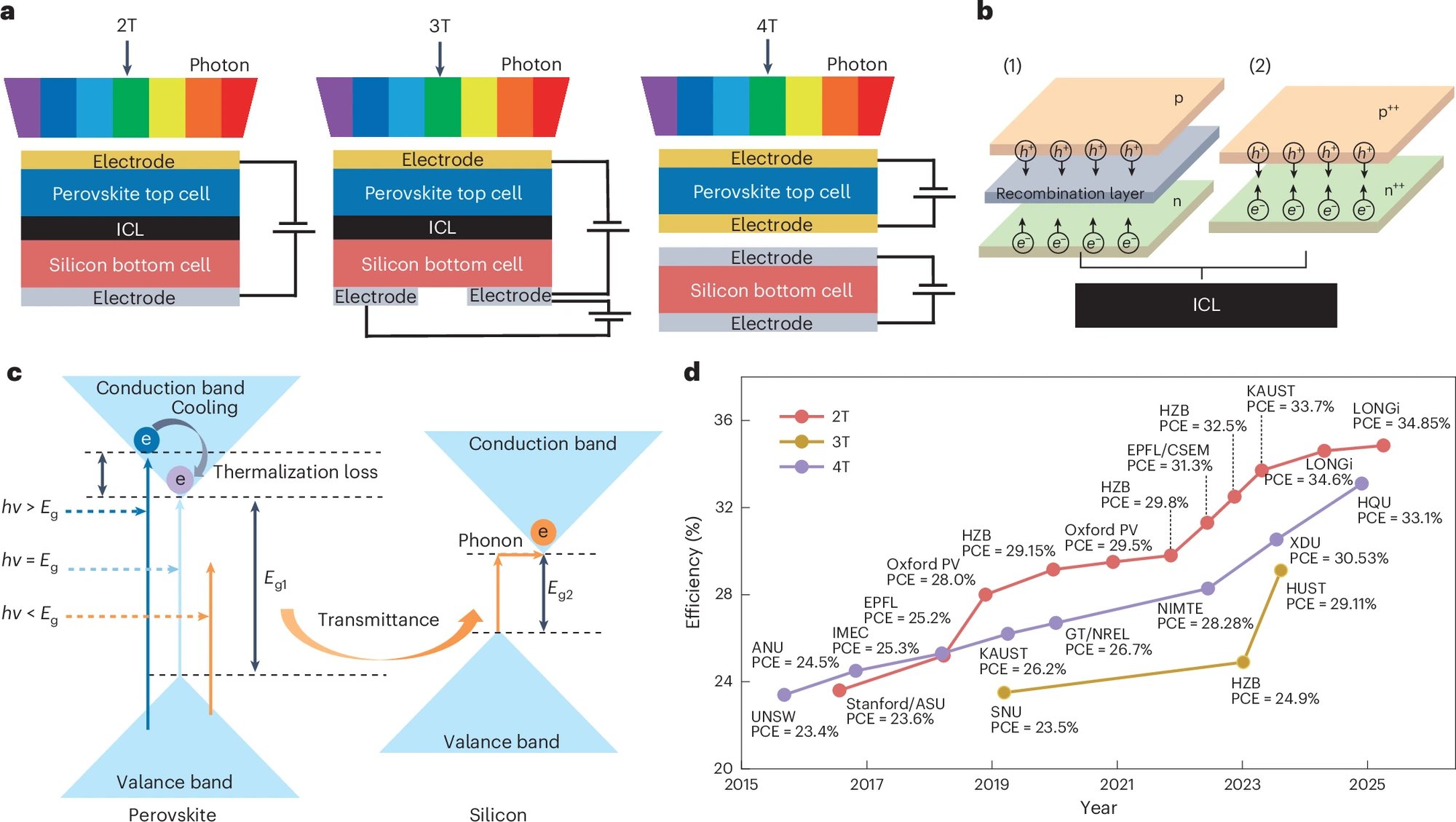
Researchers have developed a formamidinium-based eutectic that reduces the evaporation temperature of formamidinium iodide by 36°C, enabling stable thermal evaporation of perovskite films for tandem solar cells. The approach achieves a steady-state efficiency of 31.5% on 1 cm² devices and 30.0% on 200 cm² commercial wafers, with the lowest reported efficiency loss upon scaling. The tandems retain 95% of initial efficiency after 2000 hours of damp-heat aging and show negligible power loss after two months outdoors.
The Eutectic Innovation
Thermal evaporation of formamidinium iodide (FAI) is attractive for industrial perovskite/silicon tandem production but degrades at high temperatures needed for evaporation. Researchers synthesized a formamidinium-based eutectic that lowers the effective evaporation temperature of FAI by an average of 36°C, below its degradation threshold. This prevents thermal degradation, yielding perovskite films with enhanced crystallinity and atomic-scale compositional uniformity. The method is compatible with sequential evaporation processes on silicon substrates.
Efficiency and Scalability
The sequentially evaporated perovskite/Si tandems achieved a steady-state efficiency of 31.5% for 1 cm² devices. On a commercial half-cut G12 wafer of 200 cm², the first large-area thermally evaporated tandem reached 30.0% efficiency. Scaling from 1 to 200 cm² incurred only a 3.99% relative efficiency loss, the lowest reported penalty for area scaling in perovskite tandems. The results demonstrate that thermal evaporation can produce uniform, high-performance films over large areas.
Durability Testing
The eutectic-based tandems retained 95% of their initial efficiency after 2000 hours of damp-heat aging at 85°C and 85% relative humidity. After two months of real-world outdoor operation, the devices showed negligible power loss. These stability metrics suggest that the approach can meet commercial reliability requirements. The combination of high efficiency and robustness positions evaporated tandems as a viable route for mass production.
1 source
Time · lag behind first