JWST Reveals Warped Structure in TW Hydrae’s Protoplanetary Disk
This digest was compiled by AI from multiple sources — links to the originals are below.
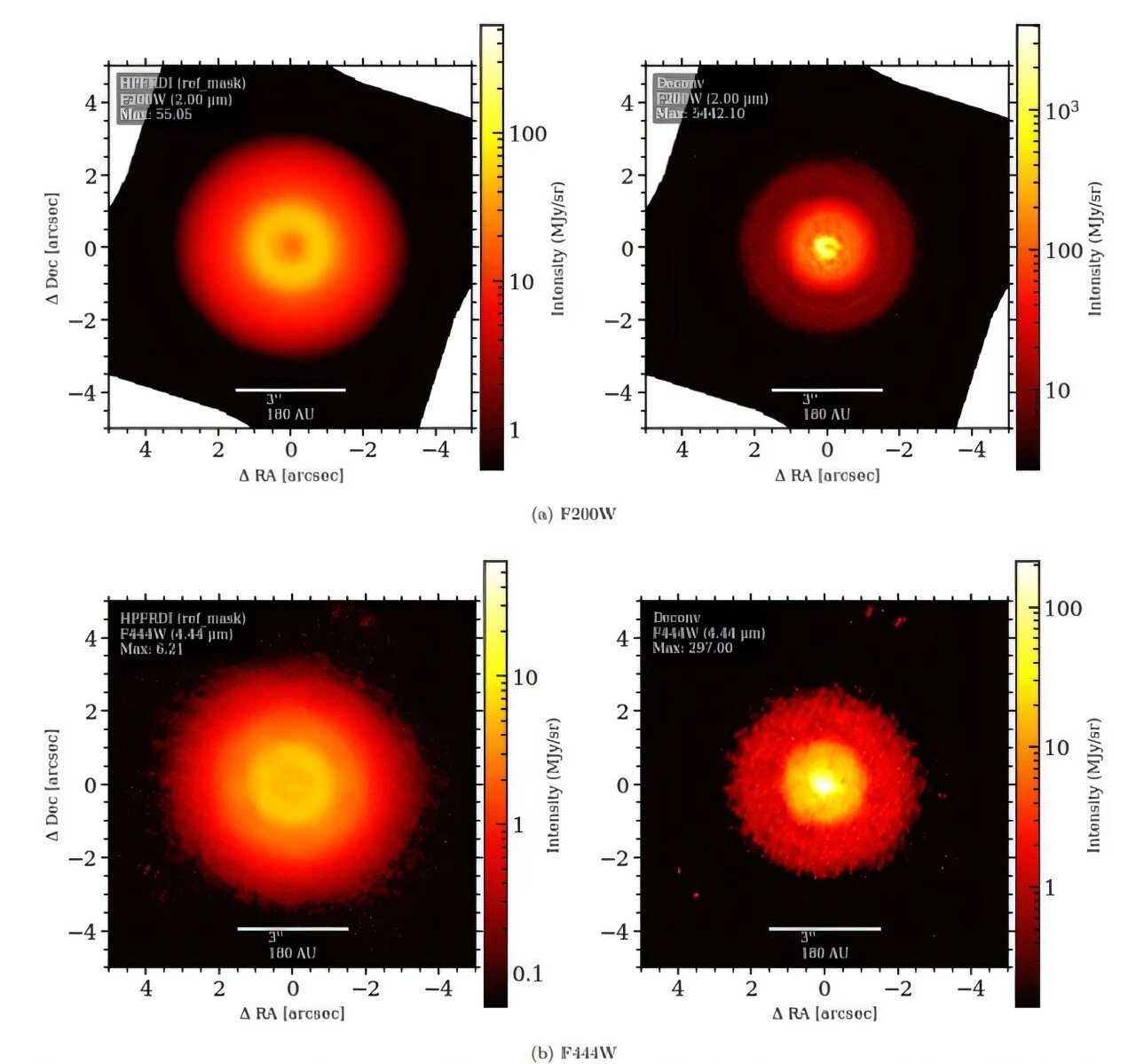
The James Webb Space Telescope has captured images revealing a warped structure and a bifurcation feature in the protoplanetary disk around TW Hydrae, the nearest such disk to Earth. The disk’s average inclination is 8.74 degrees and its surface is brighter than previously measured, with a disk-to-star flux ratio of 2.44%, astronomers report July 27 on arXiv.
Disk Structure and Brightness
JWST’s NIRCam observations of TW Hydrae, a T Tauri star 194 light-years away, reveal an average disk inclination of 8.74 degrees and a position angle of 75.62 degrees. Radial variations in these parameters indicate a warped disk architecture. The disk surface appears brighter than in previous Hubble images, with a measured disk-to-star flux ratio of 2.44%. Scattered light is predominantly blue, suggesting micron- to submicron-sized dust grains dominate the scattering surface.
Bifurcation and Companion Limits
A previously detected feature at 120 astronomical units from the star is now resolved as a distinct bifurcation, likely stemming from dynamical planet-disk interactions. The team, led by the University of Arizona, also searched for stellar companions and ruled out nonembedded objects more massive than 0.5 Jupiter masses at separations beyond 0.5 arcseconds. This tightens constraints on the presence of giant planets in the inner disk regions.
What's Next
The research team plans further JWST observations to probe the disk’s chemical composition and search for smaller, embedded planets. It remains unclear whether the warped structure is caused by a hidden planet or another mechanism.
1 source
JWST Reveals Warped Structure in TW Hydrae’s Protoplanetary Disk