
Chinese team creates ultrathin single-electron memory device
This digest was compiled by AI from multiple sources — links to the originals are below.
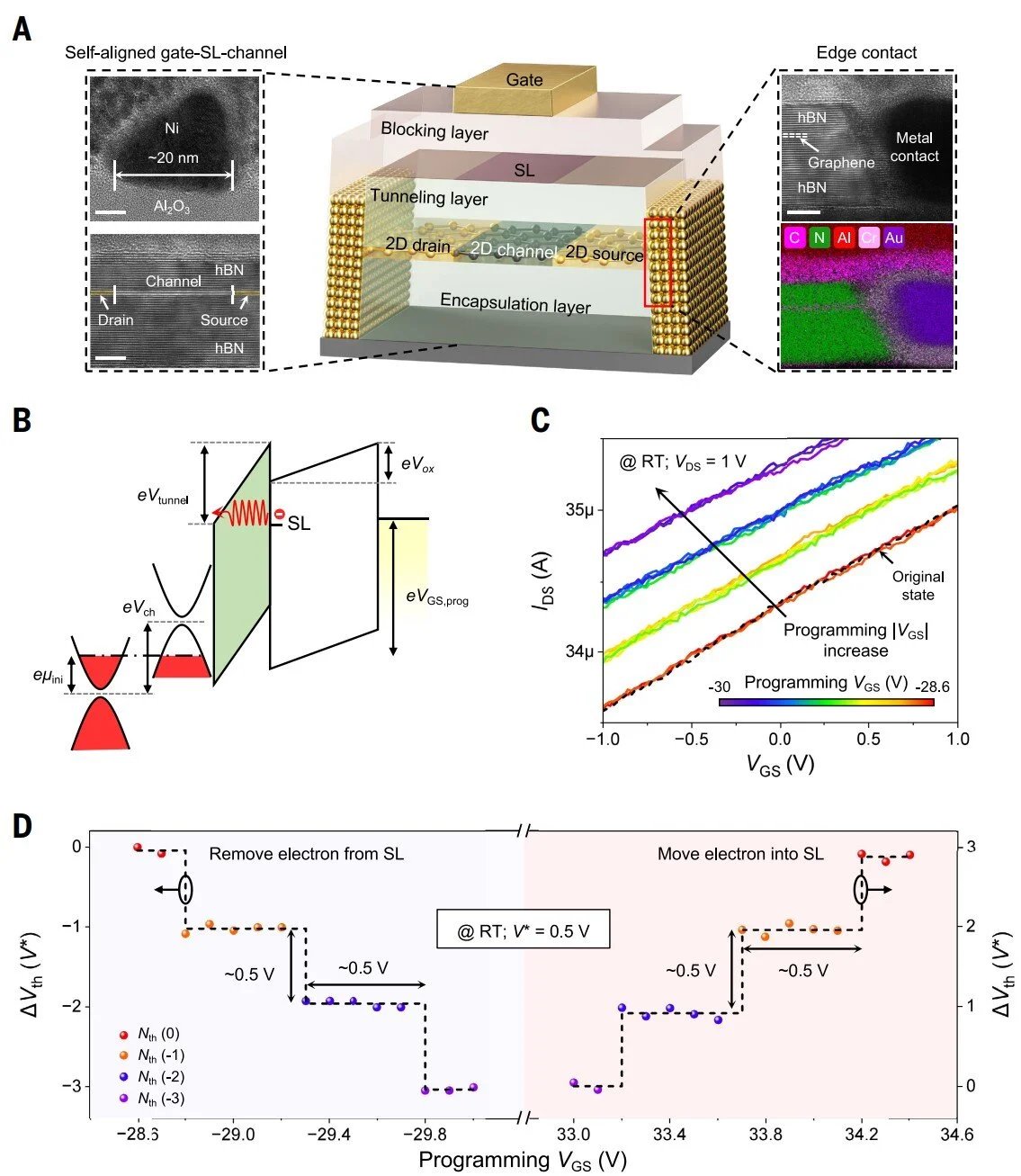
A research team in China has demonstrated a two-dimensional memory device that stores information using individual electrons, overcoming the fringe capacitance that plagued earlier attempts, according to a study published in Science. The graphene-based transistor registers the addition or removal of an electron as a 0.5-volt threshold voltage step and retains distinct states for at least 5,000 seconds at room temperature, with potential decade-long stability.
The Capacitance Problem
Single-electron memory has long been sought for its theoretical efficiency, requiring just one electron per bit instead of the thousands used in conventional devices. Earlier attempts were hampered by stray electrical coupling, known as fringe capacitance, which muted the signal from a single electron and made states indistinguishable at room temperature. One nanoscale polysilicon dot design achieved a detectable voltage but retained data for only five seconds, underscoring the need for a solution that suppresses capacitance without sacrificing thermal stability.
Ultrathin Graphene Solution
The Chinese team engineered a transistor with an atomically thin graphene channel and a coplanar drain-channel-source layout, which minimized fringe capacitance near the memory region. The device detected single-electron changes as a 0.5-volt threshold voltage step and maintained distinct states for at least 5,000 seconds in direct tests, with analysis pointing to possible decade-long retention. A complementary mechanism, termed “density-of-states scissors,” allowed the researchers to deliberately skip certain quantum memory states in a device cooled to 10 kelvin, demonstrating precise manipulation of individual quantum levels.
1 source
Time · lag behind first