
Skoltech-led team demonstrates first electrically pumped perovskite polariton laser diode
This digest was compiled by AI from multiple sources — links to the originals are below.
A Skoltech-led team has demonstrated the first electrically pumped perovskite polariton laser diode, published in Nature. The device lases at a threshold current of 60 microamperes under continuous electrical injection. The breakthrough enables cheap nonepitaxial laser diodes for optical sensing, high-speed computing, and neuromorphic computing.
The Perovskite Polariton Laser
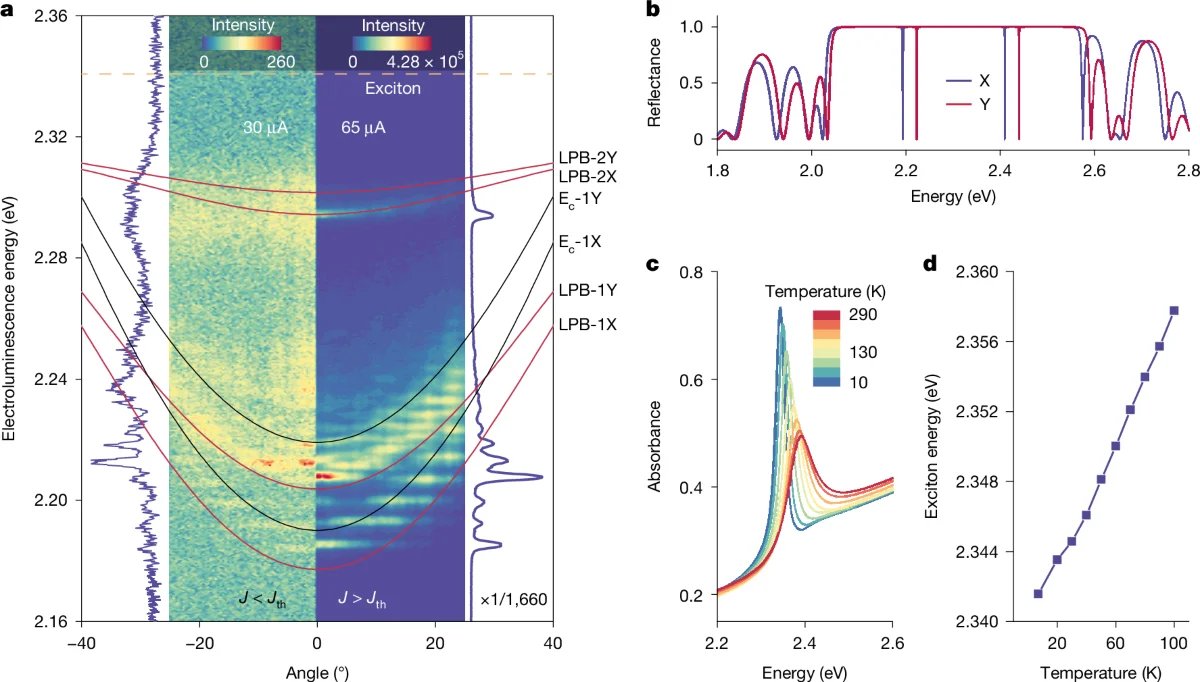
The team integrated a solution-grown perovskite microplate with single-walled carbon nanotube electrodes inside a high-finesse optical microcavity. A two-stage cryocooling protocol froze mobile ions to form a stable p-i-n junction diode. This enabled efficient charge-carrier injection at a threshold current of just 60 microamperes, well below conventional semiconductor lasers. The device emitted coherent light through polariton condensation into a single macroscopic quantum state.
Low-Threshold Operation
Traditional electrically pumped solution-processed lasers suffer from severe heat accumulation at high current densities, causing material degradation. The Skoltech-led device bypasses this by exploiting exciton-polaritons—hybrid particles that condense into a Bose-Einstein state and lase at far lower charge densities. Chemically inert carbon nanotube electrodes prevented unwanted reactions at the perovskite interface, while the frozen p-i-n junction ensured stable injection. The result is the first polariton lasing under continuous direct current from any solution-processed semiconductor.
A 60-Year Goal
Achieving lasing under direct electrical pumping in solution-processed materials has been a key optoelectronics goal for 60 years, said lead author Anatoly Pushkarev of Skoltech Photonics. The breakthrough, published in Nature, opens a route to cheap nonepitaxial laser diodes. Potential applications include optical sensing, spectroscopy, high-speed computing, and energy-efficient neuromorphic computing. The work involved researchers from ITMO University and HSE University.
1 source
Time · lag behind first