
New trigonal-phase Co3O4 catalyst cuts overpotential 181 mV for acidic water electrolysis
This digest was compiled by AI from multiple sources — links to the originals are below.
A team of researchers reports a new trigonal-phase Co3O4 catalyst that achieves an overpotential of just 269 millivolts at 10 mA cm−2 in acidic oxygen evolution, a 181-mV improvement over conventional spinel cobalt oxide. In proton-exchange membrane electrolyzers, the material pushes current density beyond 1,800 mA cm−2 at 1.80 V, bringing non-noble metal catalysts closer to competing with iridium-based systems.
Performance Milestone
The new catalyst, synthesized via a vacuum-mediated molten-alkali mechanochemical method, delivers an overpotential of 269 mV at 10 mA cm−2 in acidic OER—181 mV lower than spinel Co3O4. In PEMWE devices, it sustains more than 1,800 mA cm−2 at a cell voltage of 1.80 V, surpassing most reported non-iridium catalysts. The advance addresses the long-standing challenge of finding durable, high-activity replacements for scarce and expensive iridium oxide.
Structural Innovation
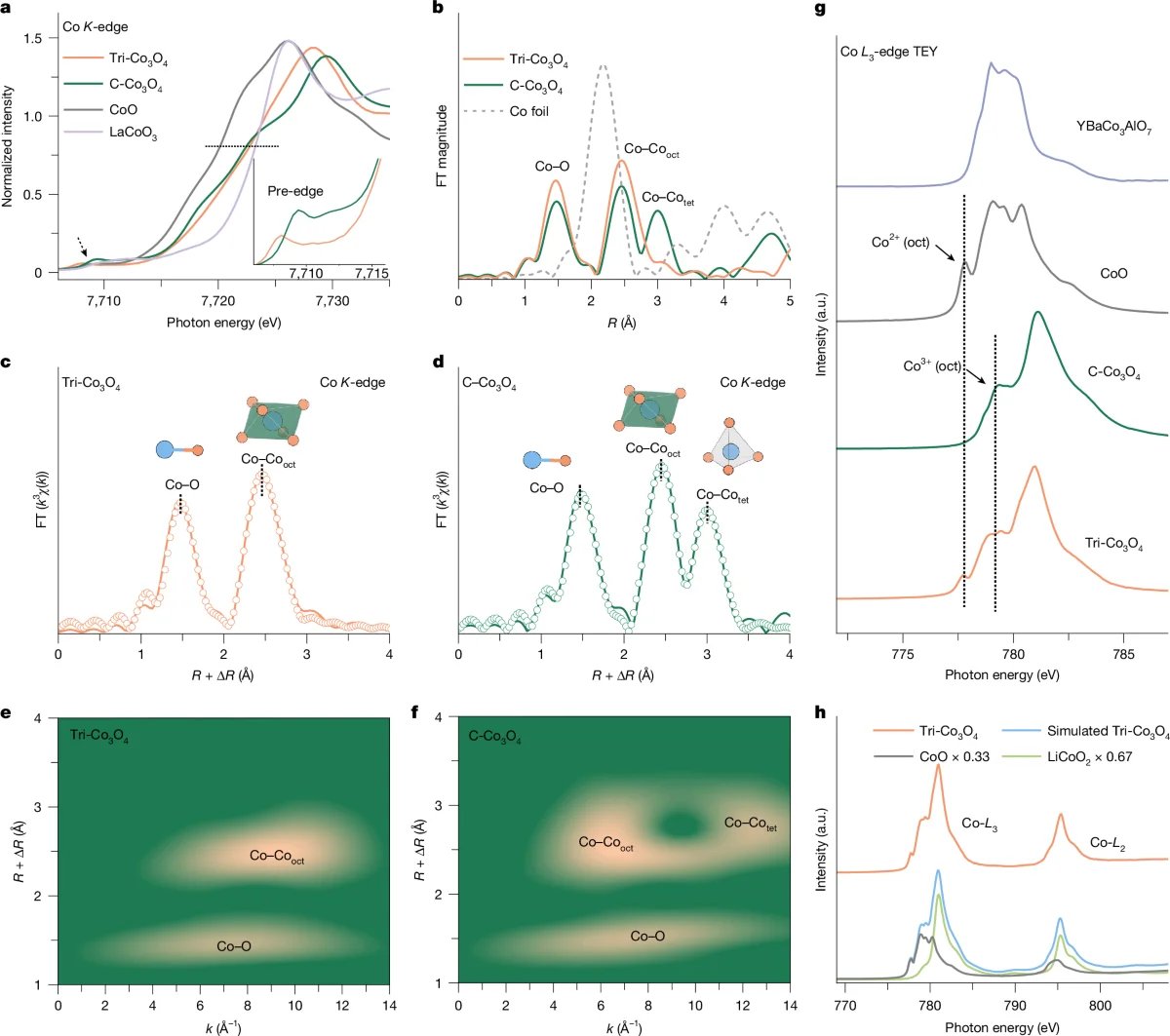
Unlike conventional spinel Co3O4, which contains a mix of inactive tetrahedral and active octahedral cobalt sites, the new trigonal phase (Tri-Co3O4) features exclusively edge-shared [CoO6] octahedra in a P-3m1 space group. This three-layer compact structure arranges Co2+ and Co3+ ions in a 1:2 ratio solely in octahedral coordination, enabling efficient adsorption of reaction intermediates and suppressing cobalt dissolution—the primary degradation pathway in acid.
Commercial Path
Proton-exchange membrane water electrolysis, the leading technology for green hydrogen production, currently relies on iridium-based anodes due to the harsh acidic environment. Iridium’s extreme rarity and cost have spurred a global search for alternatives. The Tri-Co3O4 catalyst’s performance at industrially relevant current densities suggests it could become a viable low-cost drop-in replacement if long-term stability is confirmed.
1 source
Time · lag behind first