
Nanopores activate T cells without biochemical signals, study finds
This digest was compiled by AI from multiple sources — links to the originals are below.
Researchers at Helmholtz-Zentrum Hereon, ETH Zurich, and other institutions have discovered that nanopores on material surfaces can activate human T cells without biochemical signals. The finding, published in ACS Nano, challenges the long-held assumption that T cell activation requires chemical triggers. This could open new avenues for cancer immunotherapy and implant design.
The Discovery
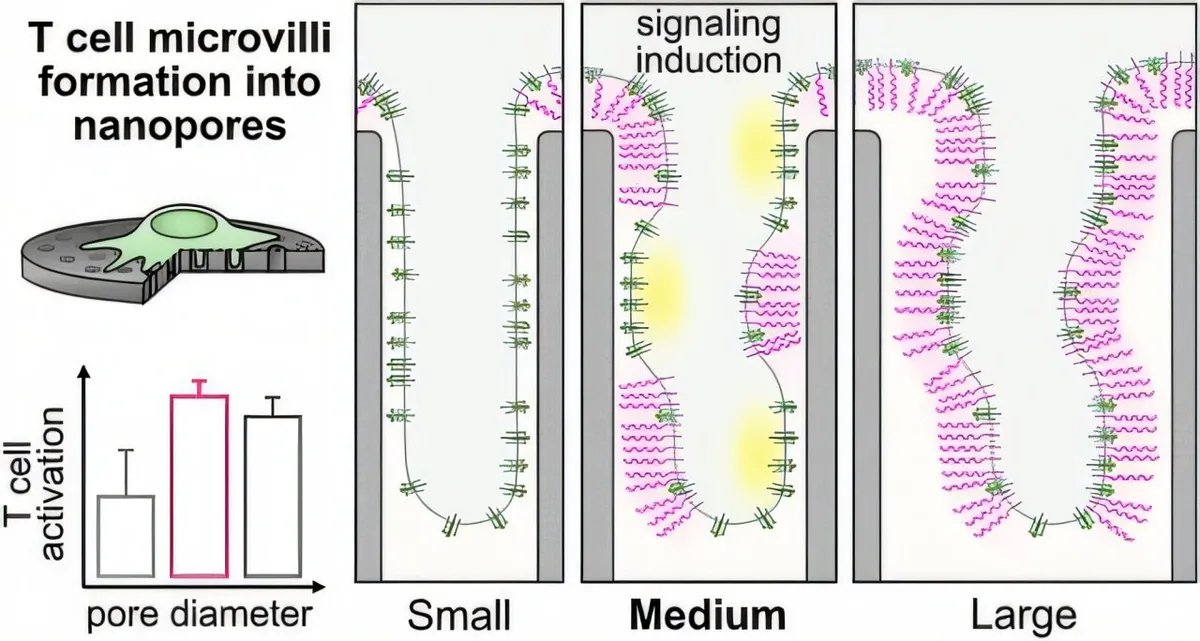
A German-Swiss research team found that T cells respond to the physical structure of materials at the nanoscale. When T cells encounter surfaces with pores 250 nanometers in diameter—thousands of times smaller than a hair—they become activated even without biochemical signals. Lead author Enrico Klotzsch of Hereon described the nanopores as a 'physical switch' that triggers an immune response through contact with microvilli on the cell surface.
Experimental Method
The researchers used anodized aluminum oxide, a biocompatible ceramic with pores of 250 nm diameter. They isolated T cells from patient blood and observed interactions under a microscope. The study, published in ACS Nano, demonstrates for the first time that surface topography alone can activate immune cells.
Medical Implications
The discovery could lead to new biomaterials that regulate the immune system without drugs. Potential applications include cancer immunotherapy, where T cells are activated against tumors, and implantology, where materials could be designed to reduce rejection. Klotzsch noted the findings expand understanding of how cells perceive their environment.
1 source
Time · lag behind first