
KAIST HOUND robot dog adapts gait in real time via new AI training
This digest was compiled by AI from multiple sources — links to the originals are below.
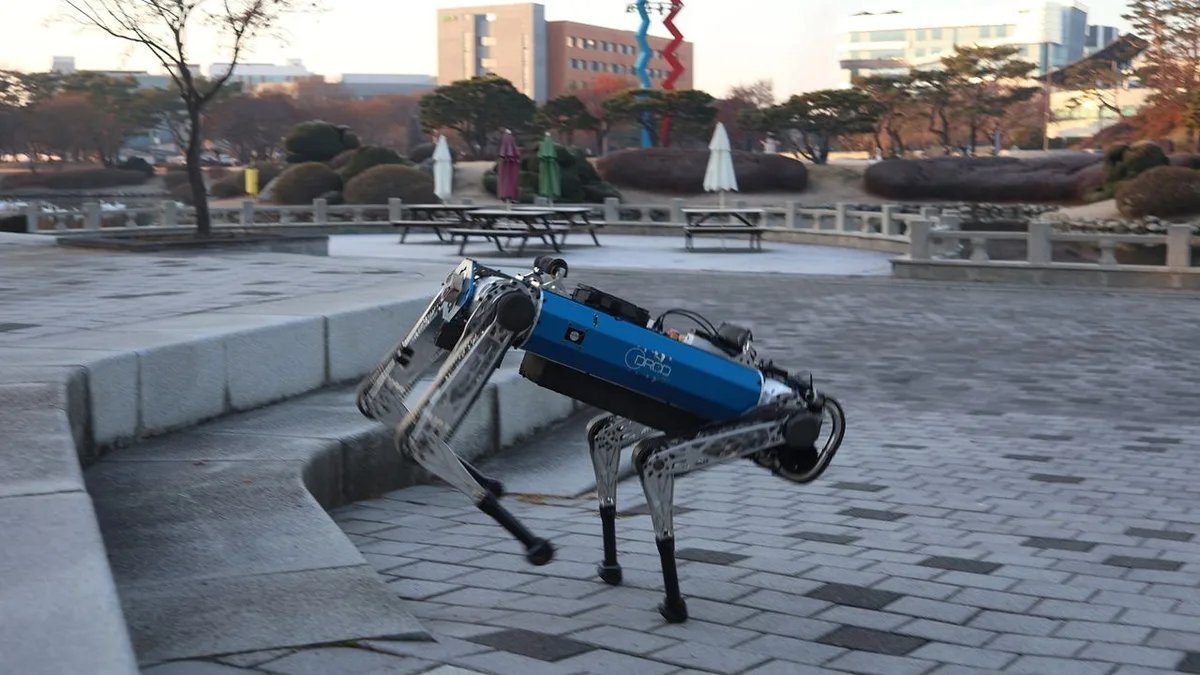
A 100-pound four-legged robot called KAIST HOUND has learned to switch between trotting and bounding gaits autonomously while navigating stairs, forests, and obstacle courses. The robot uses cameras and lidar to scan terrain and adjust its movements in real time without human input. Researchers published the framework on July 15 in Science Robotics.
The Training Framework
Researchers developed APT-RL, an AI training system that combines action pretrained transformers with reinforcement learning. The team first generated 180,000 short trotting and bounding sequences using trajectory optimization on a 2D computer model, representing about 15.5 hours of movement produced in eight minutes. During reinforcement learning, the AI learned to select and modify those skills while navigating simulated stairs, stepping stones, hurdles, gaps, and rough ground.
Real-World Performance
In outdoor tests, the 45-kilogram robot crossed a 1.1-kilometer university campus route and a 0.3-kilometer forest trail with roots, logs, and slippery leaves. The robot was not limited to prerecorded movements; it could also correct for 3D terrain and unexpected situations, such as jumping over a log — a behavior not included in the original flat-ground training data.
Guinness World Record Speed
KAIST Dynamic Robot Control and Design Laboratory achieved the fastest 100-meter sprint by a quadrupedal robot at 19.87 seconds. The record was certified by Guinness World Records at the Korea Advanced Institute of Science and Technology. The performance highlights advancements in legged robot locomotion and dynamic control.
2 sources
Time · lag behind first