
China's humanoid robots outrun Bolt, face precision tests at Beijing games
This digest was compiled by AI from multiple sources — links to the originals are below.
China's humanoid robots ran faster than Usain Bolt's 100-meter world record at the World Humanoid Robot Games in Beijing on August 22, 2026. The five-day event tests robots in sports and work scenarios, with more than 40% of events requiring full autonomy. The games highlight progress in speed but expose challenges in precision tasks like cable connection.
Key Facts
- Two robots ran faster than Usain Bolt's 9.58-second world record in the 100-meter sprint on August 22, 2026.
- The five-day World Humanoid Robot Games in Beijing feature 51 events, including 30 sports competitions and 21 scenario-based contests.
- More than 40% of events require robots to operate fully autonomously, according to Huawei, a tech partner of the games.
- A humanoid robot ran 400 meters in 39.7 seconds, faster than Wayde van Niekerk's world record of 43.03 seconds.
Record-Breaking Sprints
On Saturday, two robots ran faster than Usain Bolt's 9.58-second world record in the 100-meter sprint. That was a sharp improvement from 2025, when the winning robot's time was more than 20 seconds. Braking was an issue, as the machines slammed into a thick mat that organizers placed several metres after the finish line. Another humanoid, the same model as the 100-meter champion, ran 400 metres in 39.7 seconds, faster than South African Wayde van Niekerk's world record of 43.03 seconds.
Precision and Autonomy Tests
Beyond the spectacle, the more revealing tests could come when robots encounter the small imperfections of the physical world: a cable at the wrong angle, an object just out of reach, a shifting package or a missed step. That tests whether robots can identify objects, accurately position their hands and bodies, apply controlled force and recover from errors without human intervention. More than 40% of events require robots to operate fully autonomously, according to Huawei, a tech partner of the games.
Event Scope and Industry Impact
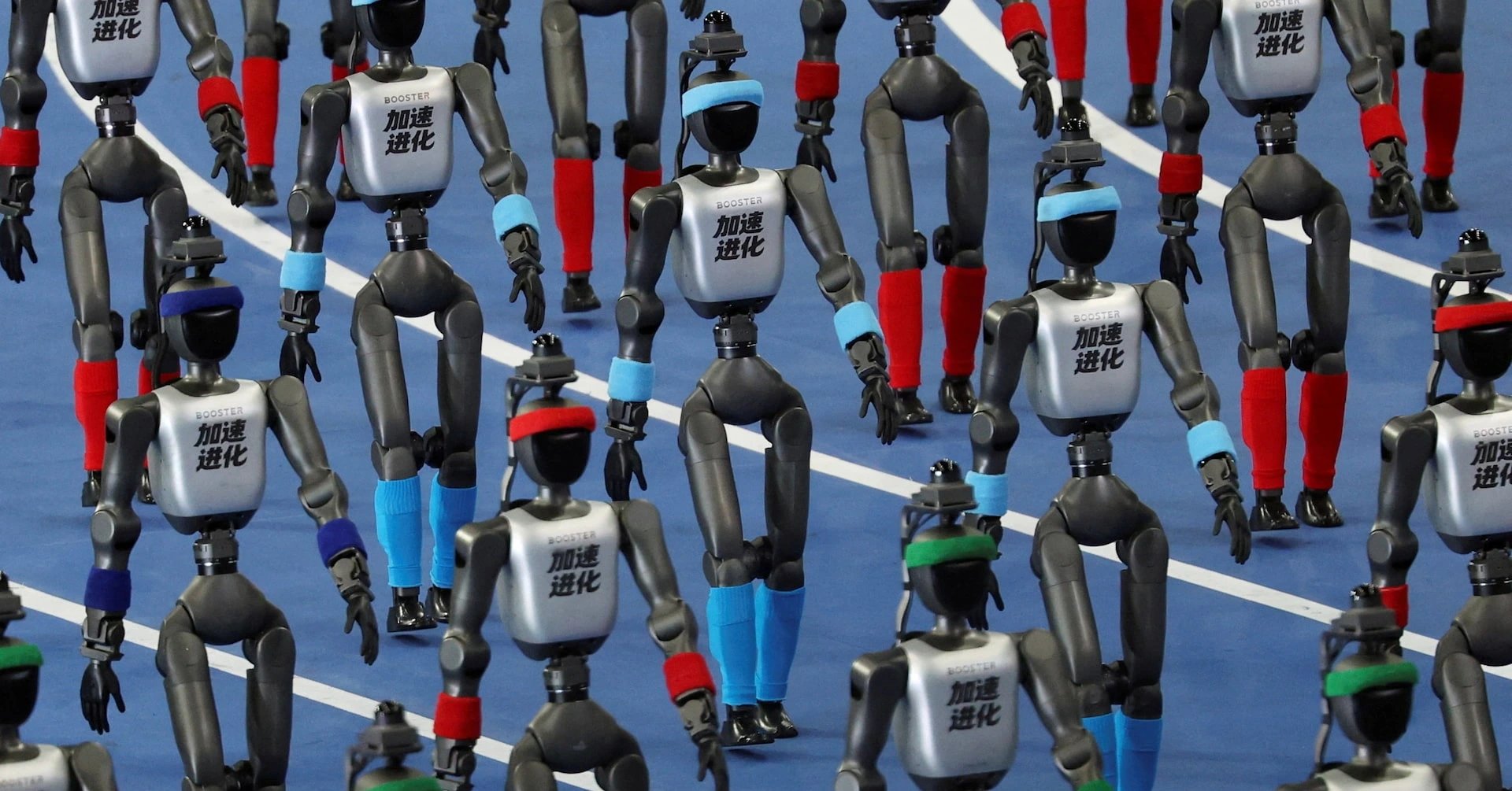
The five-day World Humanoid Robot Games, which began Saturday in Beijing, combine events modelled on human sports with those designed to test the robots in simulated factories, restaurants, offices and in emergency situations. The games, heavily promoted in Chinese state media, feature 51 events, including 30 sports competitions and 21 scenario-based contests. Robots will compete in tug-of-war and weightlifting, while Tai Chi and pitch-pot - in which contestants throw arrow-like sticks into a narrow-necked vase - will give traditional Chinese sports a futuristic twist. "The intensity is higher than last year, which places significant demands on the robot's battery management and thermal dissipation capabilities," said spectator and robotics investor Xu Qiaosheng. "It holds huge significance for the development of China's industrial sector."
1 source
Time · lag behind first