Sleeping sickness parasite enzyme weak spot may guide safer drugs
This digest was compiled by AI from multiple sources — links to the originals are below.
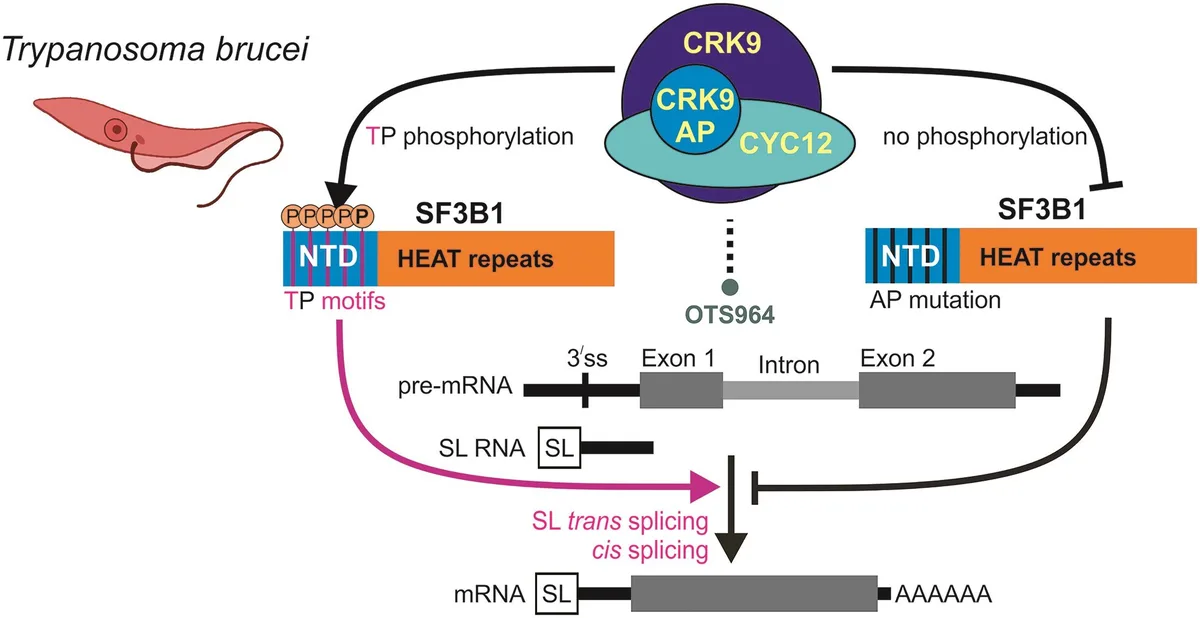
University of Connecticut researchers have identified a key difference in the splicing enzyme CRK9 of trypanosomes that could enable development of safer drugs for sleeping sickness, Chagas disease and leishmaniasis. The trypanosome enzyme is insensitive to a compound that inhibits the human version, suggesting a potential drug target that spares human cells.
The Enzyme Difference
UConn molecular biologist Arthur Gunzl and his team found that trypanosomes use a cyclin-dependent kinase called CRK9 for mRNA splicing, which differs significantly from the human enzyme. The trypanosome CRK9 is insensitive to OTS964, a compound that inhibits the human version, indicating distinct active sites. This opens the possibility of designing inhibitors that target the parasite enzyme without harming human cells.
Evolutionary Surprise
The discovery is unexpected because other single-celled organisms like yeast do not use a cyclin-dependent kinase for splicing; it was thought unique to multicellular organisms. Gunzl's group is the first to demonstrate this enzyme in trypanosomes, suggesting an evolutionarily ancient role. The finding was published in Nucleic Acids Research on July 21, 2026.
What's Next
The team plans to screen for compounds that selectively inhibit CRK9. It remains unclear whether such inhibitors will prove effective in animal models and eventually in humans.
1 source
Sleeping sickness parasite enzyme weak spot may guide safer drugs