
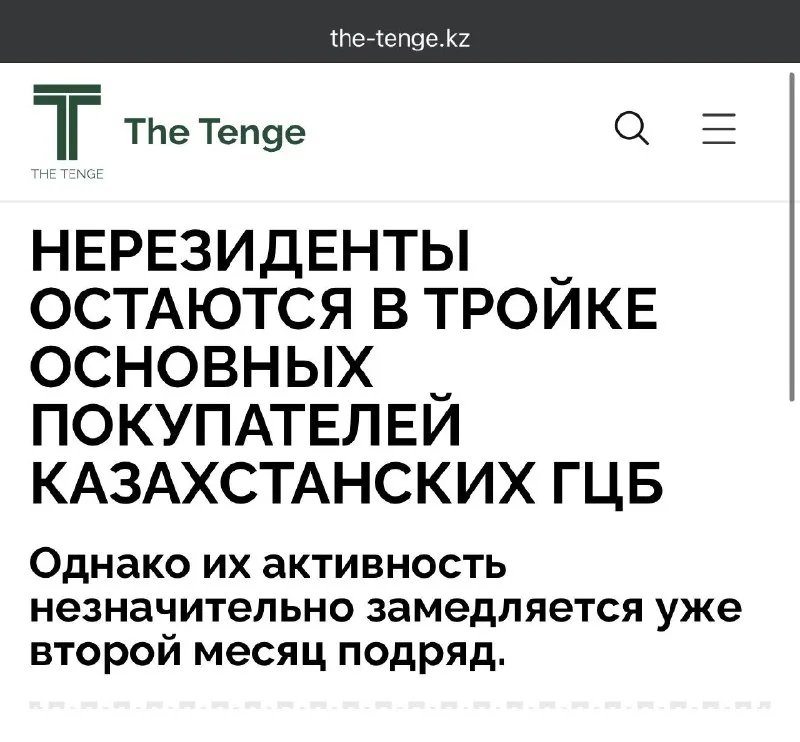
Non-resident demand for Kazakhstan T-bills slows, easing tenge support
This digest was compiled by AI from multiple sources — links to the originals are below.
Non-resident investors accounted for 26.5% of secondary market trading in Kazakhstan government securities (GZB) in June, down from 28.4% in May and 29.0% in April, according to KASE data. The two-month decline signals reduced carry-trade inflows that have been supporting the tenge exchange rate. Total GZB trading volume fell 8.5% month-on-month to 777.4 billion tenge in June.
Carry-Trade Dynamics
Non-residents have been among the top three buyers of Kazakhstan government securities, providing foreign currency inflows that bolster the tenge. Their activity has moderated for two consecutive months, with the June share of 26.5% the lowest since at least April. The decline suggests reduced appetite for carry trades, where investors borrow in low-yield currencies to buy higher-yielding Kazakh bonds.
Market Volume Trends
Total GZB trading volume on KASE reached 777.4 billion tenge in June, down 8.5% from 849.3 billion tenge in May. Over the first six months of 2026, cumulative volume stood at 4.8 trillion tenge, up 6.2% year-on-year. Banks dominated secondary trading with a 45.4% share, followed by other legal entities at 36.2% and non-residents at 26.5%.
1 source
Time · lag behind first