Myosin study reveals 50 new gene subfamilies across vertebrates
This digest was compiled by AI from multiple sources — links to the originals are below.
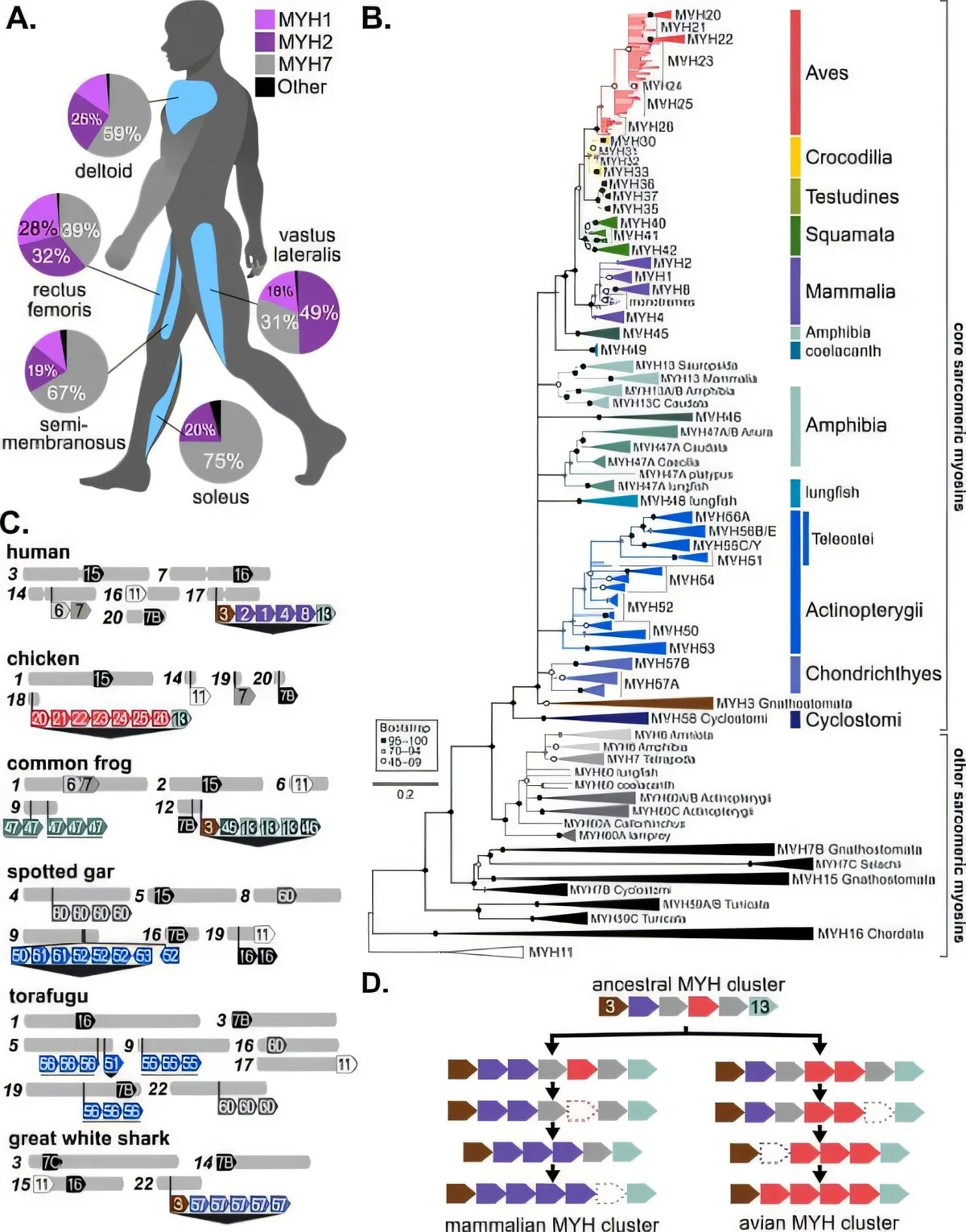
A study of myosin, the protein driving muscle contraction, has identified 50 new gene subfamilies across vertebrates, challenging a century-old assumption of uniform function. The findings, published by an international team, suggest that myosin's molecular machinery varies significantly among birds, reptiles, amphibians, and fish.
The Discovery
Researchers analyzing myosin genes across 50 vertebrate species uncovered 50 previously unknown subfamilies, expanding the known diversity of this essential protein. The study, led by scientists from the University of Tokyo and Harvard Medical School, used comparative genomics to trace evolutionary changes. Each subfamily corresponds to distinct structural adaptations in muscle tissue.
Evolutionary Implications
The findings indicate that myosin evolved differently in major vertebrate lineages, contradicting the long-held view of a single conserved mechanism. For example, birds show unique myosin variants linked to flight muscle efficiency, while fish have subfamilies adapted to aquatic locomotion. This diversity suggests that muscle function has been fine-tuned by natural selection across habitats.
Myosin Waves in Nurse Cells
A 2021 Nikon Small World in Motion competition entry shows nurse cells contracting and shrinking in response to myosin waves during fruit fly egg development. The video, captured by Dr. Jasmin Imran Alsous, Jonathan Jackson, and Dr. Adam Martin, visualizes myosin (red) driving the transport of cellular contents to the egg cell.
What's Next
The team plans to experimentally characterize the newly identified subfamilies in model organisms. It remains unclear how these variations affect muscle performance in vivo or whether they could inform treatments for human muscle disorders.
2 sources
Myosin study reveals 50 new gene subfamilies across vertebrates