
Hubble finds first stellar-mass black hole in Omega Centauri
This digest was compiled by AI from multiple sources — links to the originals are below.
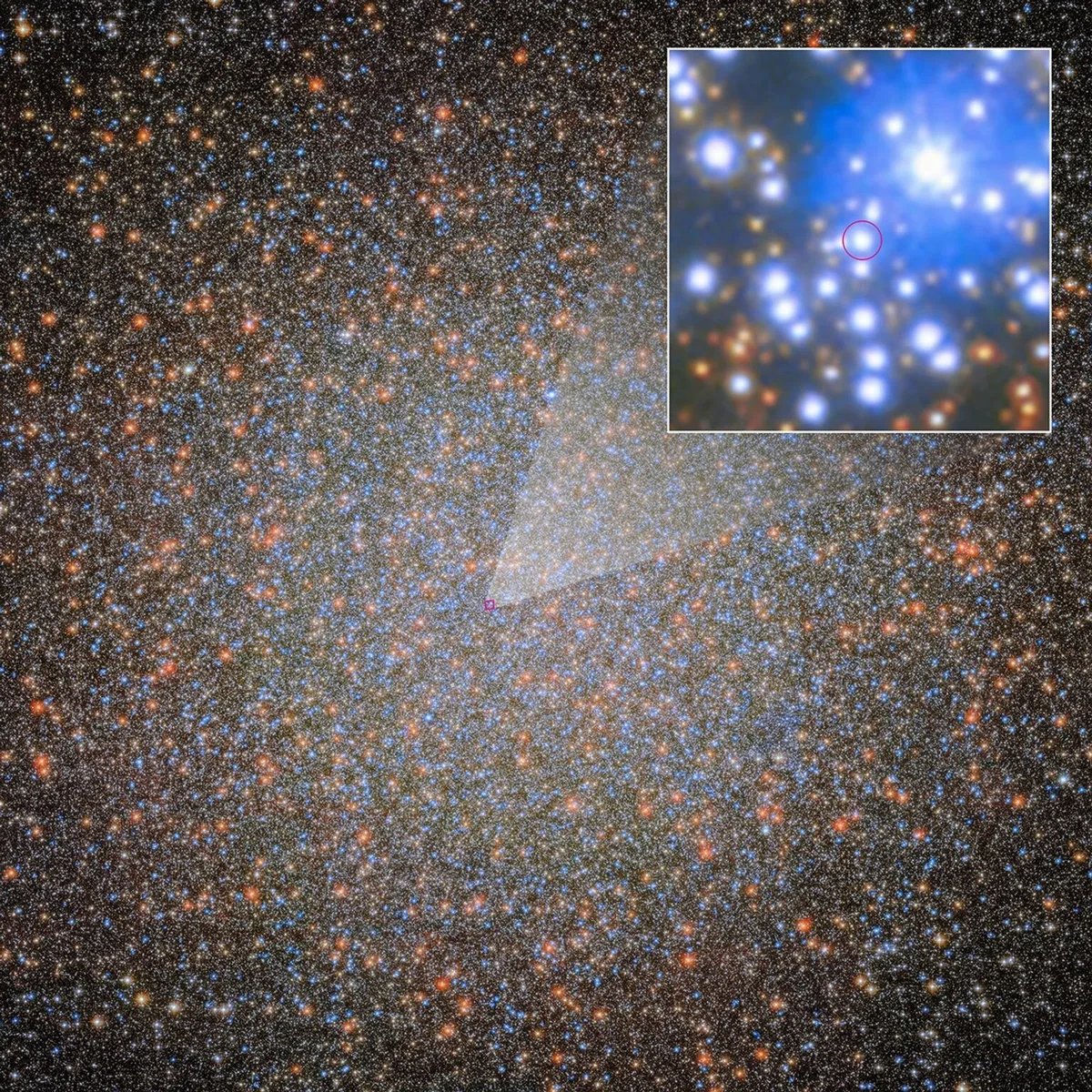
Astronomers using archival data from NASA's Hubble Space Telescope and supporting observations from the James Webb Space Telescope have identified the first stellar-mass black hole in the globular cluster Omega Centauri. The discovery resolves a decades-old puzzle: the cluster should contain numerous black holes from exploded stars, but evidence had been lacking. The findings were published in The Astrophysical Journal Letters.
The Discovery
The black hole, a stellar-mass object, was found in Omega Centauri, the largest globular cluster in the Milky Way, located about 17,000 light-years from Earth. Astronomers analyzed Hubble archival data spanning over a decade, combined with Webb observations, to detect the black hole's gravitational influence on a nearby star. This marks the first direct evidence of a black hole in the cluster, which was previously thought to be devoid of such objects.
Implications for Theory
The finding challenges current models of black hole formation in dense stellar environments. Omega Centauri, containing roughly 10 million stars, was expected to host a population of black holes from supernova explosions. The discovery of at least one suggests that many more may exist, but they are difficult to detect due to their small size and lack of accretion. The team's results will help refine theories on how black holes form and evolve in globular clusters.
1 source
Time · lag behind first