Physicists amplify waves using synthetic rotation, testing Penrose theory
This digest was compiled by AI from multiple sources — links to the originals are below.
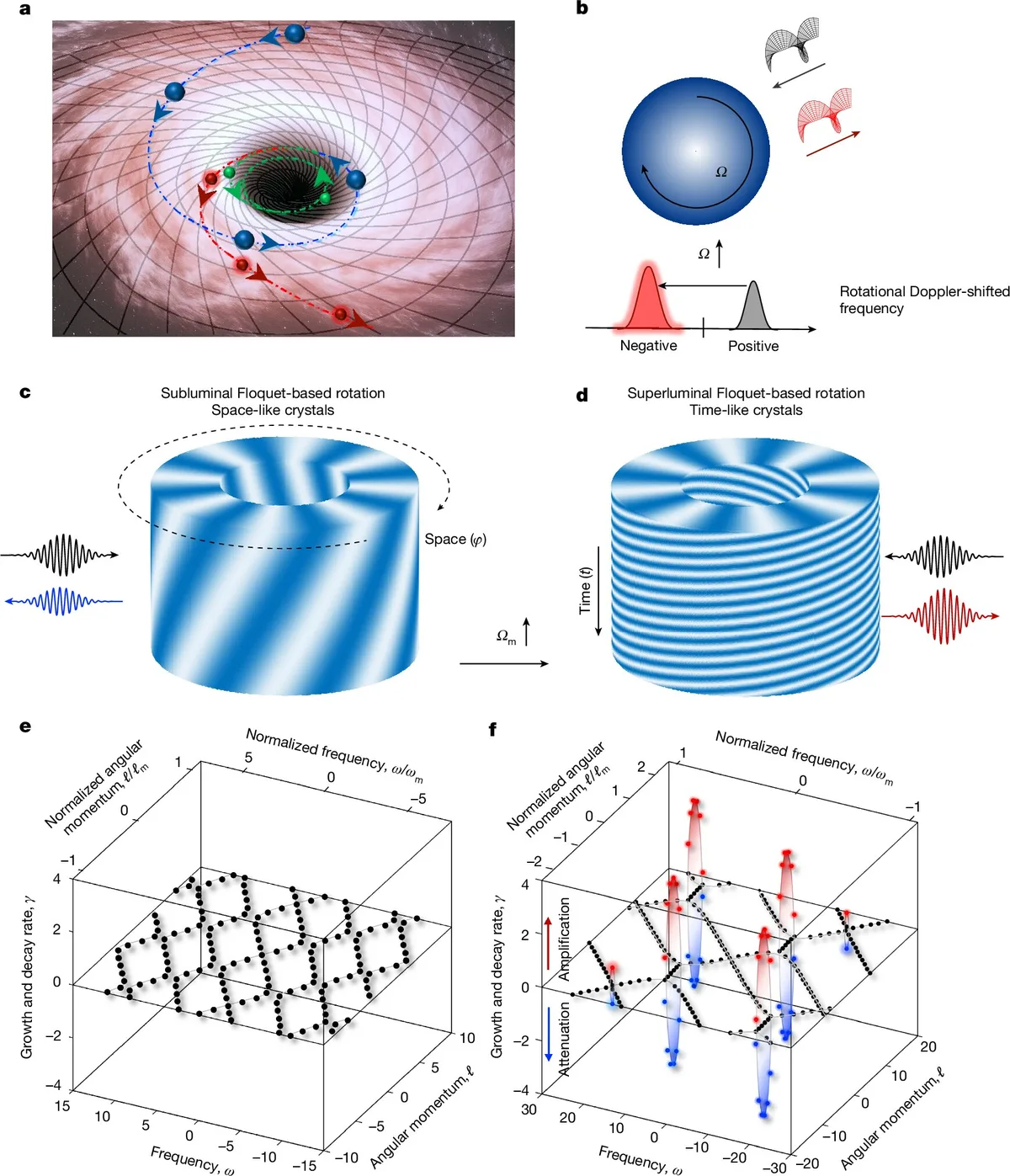
Researchers at the University of Glasgow have demonstrated wave amplification via synthetic rotation, experimentally validating a 1971 prediction by Yakov Zel'dovich. The team used a ring of acoustic resonators rotating at 3,000 rpm to amplify sound waves by up to 30%. The result confirms a key aspect of Roger Penrose's 1969 theory on energy extraction from black holes.
The Experiment
The Glasgow team constructed a ring of 12 acoustic resonators, each 10 cm in diameter, mounted on a rotating platform. The resonators were driven by speakers emitting sound waves at frequencies between 100 and 500 Hz. By adjusting the rotation speed to 3,000 rpm, the researchers observed wave amplification of up to 30%, matching Zel'dovich's theoretical predictions. The experiment was conducted in a vacuum chamber to minimize external interference.
Theoretical Background
Roger Penrose's 1969 theory proposed that a particle entering a black hole's ergosphere could extract rotational energy, escaping with more energy than it entered. Zel'dovich extended this to waves in 1971, predicting that a rotating object could amplify incident waves. The Glasgow experiment is the first to demonstrate this effect using synthetic rotation, bypassing the need for a black hole's extreme gravity.
What's Next
The team plans to test the effect with electromagnetic waves in a similar rotating setup. It remains unclear whether the amplification can be scaled to practical energy extraction or if it will remain a laboratory curiosity.
2 sources
Physicists amplify waves using synthetic rotation, testing Penrose theory