
Bruker to ship first ultra-cold electron microscope to three labs by early 2027
This digest was compiled by AI from multiple sources — links to the originals are below.
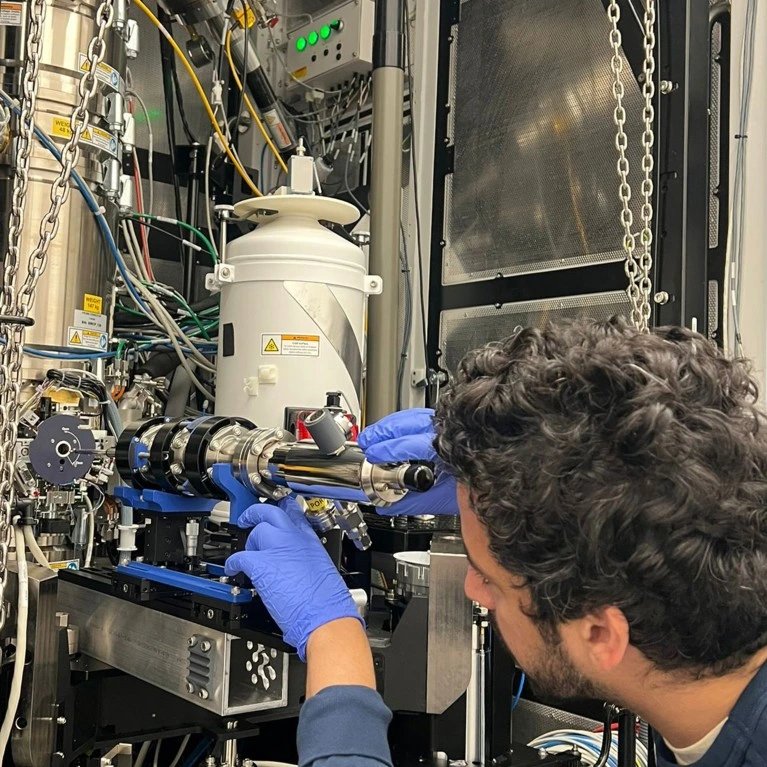
Bruker will ship its GAIA scanning transmission electron microscope, the first to stably operate near absolute zero, to three laboratories in Canada, Germany and the United States by early 2027. The instrument can image materials at temperatures as low as 7 kelvin for 30 hours or more. Researchers have already secured time slots to use the new microscope.
Key Facts
- Bruker will ship the first-ever scanning transmission electron microscope that stably operates near absolute zero using liquid helium to three laboratories by early 2027.
- The microscope, called GAIA, can image materials at temperatures as low as about 7 kelvin (−266 °C) for 30 hours or more.
- The three receiving institutions are the Ernst Ruska-Centre for Microscopy and Spectroscopy with Electrons in Jülich, Germany; Oak Ridge National Laboratory in Tennessee; and the Canadian Centre for Electron Microscopy in Hamilton.
- Last year, researchers in the United States reported using a TEM attachment that cools samples to 20 kelvin (−253 °C) and enables stable atomic-resolution imaging for more than ten hours.
- Shelly Conroy, an electron microscopist at Imperial College London, has secured a time slot to use the GAIA microscope that will be delivered to the Ernst Ruska-Centre.
GAIA Instrument
GAIA, which stands for Generational Advance in Instrumentation for Analysis, is a scanning transmission electron microscope with a built-in system to cool samples to ultra-low temperatures using liquid helium. The instrument can image materials at temperatures as low as about 7 kelvin (−266 °C) for 30 hours or more. Tracy Lovejoy, vice-president and general manager at a division of Bruker, said the company is confident in the microscope's abilities. Bruker is based in Billerica, Massachusetts.
Delivery and Users
By early 2027, Bruker will ship GAIA instruments to three laboratories: the Ernst Ruska-Centre for Microscopy and Spectroscopy with Electrons in Jülich, Germany; Oak Ridge National Laboratory in Tennessee; and the Canadian Centre for Electron Microscopy in Hamilton. Shelly Conroy, an electron microscopist at Imperial College London, has secured a time slot to use the GAIA microscope that will be delivered to the Ernst Ruska-Centre. Electron microscopist Noah Schnitzer, who works with Conroy at Imperial College London, watched a demonstration of GAIA at the Microscopy and Microanalysis conference in Salt Lake City, Utah, last year. Schnitzer said GAIA's stability is impressive and that stability is 'kind of the whole game' in microscopy.
1 source
Time · lag behind first