
Astronomers detect erythrulose sugar in Milky Way cloud 27,000 light-years away
This digest was compiled by AI from multiple sources — links to the originals are below.
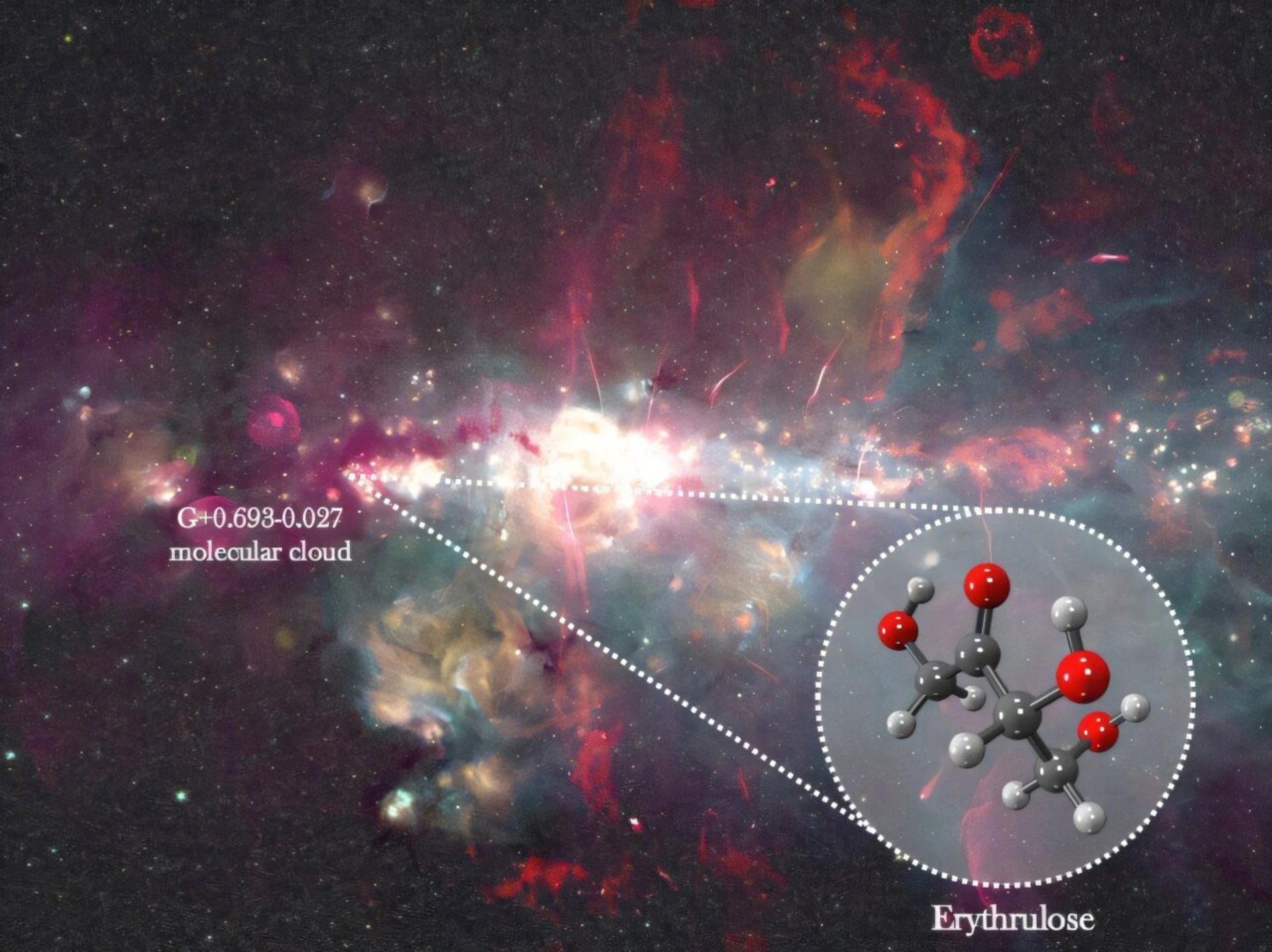
An international team led by Izaskun Jiménez-Serra of Spain's Astrobiology Center has detected erythrulose, a sugar molecule, in the molecular cloud G+0.693−0.027 near the Galactic center. The discovery, published in Nature Astronomy, marks the first confirmed sugar in interstellar space. The molecule could have contributed to the chemical building blocks of life on early Earth.
Key Facts
- Erythrulose was detected in the molecular cloud G+0.693−0.027, about 27,000 light-years from Earth.
- The molecule was identified by 17 spectral lines with a 0.2% probability of random coincidence.
- Erythrulose contains 14 atoms and is the first interstellar molecule with four oxygen atoms.
- Meteorite impacts 4.1–3.9 billion years ago could have delivered between 0.5 million and 50 million tonnes of erythrulose to Earth.
- The study was published in Nature Astronomy.
Detection in Galactic Cloud
Astronomers detected erythrulose in the molecular cloud G+0.693−0.027, located about 27,000 light-years from Earth. The cloud is considered one of the richest molecular reservoirs in the Galaxy. Two radio telescopes in Spain, the 40-meter Yebes telescope and the 30-meter Pico Veleta telescope, were used for the observations. Researchers identified 17 spectral lines of erythrulose, with a 0.2% probability of random coincidence.
Formation and Delivery to Earth
Models indicate erythrulose forms on icy surfaces of interstellar dust from simpler two-carbon molecules like glycolaldehyde and ethylene glycol. The calculated amount of erythrulose matched observations, and it enters the gas phase when cloud collisions eject ice from dust grains. Laboratory experiments simulating early Earth produce sugars too slowly and in small quantities. Ribose and glucose have been found in meteorites and samples from asteroid Bennu, suggesting some of Earth's sugar inventory came from space. Authors calculated that meteorite impacts 4.1–3.9 billion years ago could have delivered between 0.5 million and 50 million tonnes of erythrulose to Earth.
Implications for Life's Origins
In water, erythrulose easily converts into other sugars used to build nucleic acids like RNA. This suggests cosmic material could have supplemented the chemical building blocks of the first life molecules. Erythrulose is the largest known non-cyclic molecule in the interstellar medium, with 14 atoms. It is the first interstellar molecule found with four oxygen atoms. More than 340 molecules are known in the interstellar medium, but no sugar had been found before; glycolaldehyde, discovered in 2000, is not considered a true sugar.
1 source
Time · lag behind first