
Mexico Deepens China Tech Ties as US Pressure Mounts
This digest was compiled by AI from multiple sources — links to the originals are below.
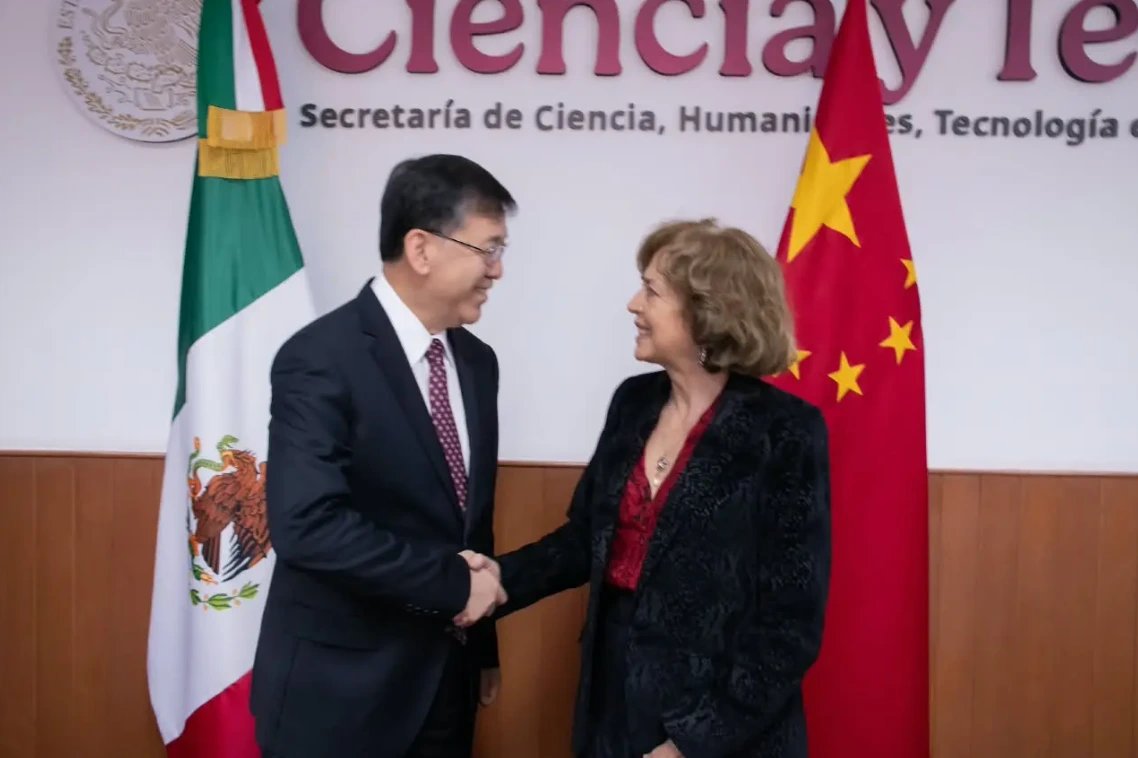
Mexico and China signed a memorandum of understanding to expand cooperation in AI, high-performance computing, robotics, electromobility, and semiconductors at the Ninth Meeting of the Science and Technology Subcommittee in September 2026. The agreement comes as Mexico imposed tariffs on 1,463 product categories, with Chinese imports in affected sectors falling 28.4 percent between January and May. Mexico's Foreign Secretary Roberto Velasco met with Wang Yi in Beijing on September 7, three days after President Trump said Mexico had 'nothing that we really need.'
Key Facts
- Mexico and China signed a memorandum of understanding to expand cooperation in research, digital infrastructure, advanced technology transfer, and public-private partnerships at the Ninth Meeting of the Science and Technology Subcommittee.
- Chinese Minister of Science and Technology Yin Hejun personally attended the subcommittee meeting, the first time a Chinese minister of science and technology has done so since the mechanism was established in 2004.
- Mexico imposed tariffs on 1,463 product categories from countries without a free trade agreement, and Chinese imports covered by these measures fell 28.4 percent between January and May.
- Mexico's Foreign Secretary Roberto Velasco met with Chinese Foreign Minister Wang Yi in Beijing on September 7, 2026, three days after President Trump's Oval Office remarks.
- Secihti is exploring opportunities to work with Huawei on high-performance computing, AI, and specialized talent development.
Science and Technology Cooperation
Rosaura Ruiz Gutiérrez, head of Mexico's Secretariat of Science, Humanities, Technology, and Innovation (Secihti), first met with Chinese Ambassador to Mexico Chen Daojiang and later co-chaired the Ninth Meeting of the Science and Technology Subcommittee with Chinese Minister of Science and Technology Yin Hejun. The two governments signed a memorandum of understanding to expand cooperation among universities, public institutions, and companies in research, digital infrastructure, advanced technology transfer, and public-private partnerships. Areas discussed included artificial intelligence, high-performance computing, robotics, electromobility, and semiconductors. Secihti has acknowledged exploring opportunities to work with Huawei on high-performance computing, AI, and specialized talent development.
US Pressure and Tariffs
Since January, the Mexican government has imposed new tariffs on 1,463 product categories originating in countries with which Mexico has no free trade agreement. Between January and May, Chinese imports covered by these measures fell by 28.4 percent, with declines of 59 percent in footwear and 35 percent in passenger vehicles. Economy Secretary Marcelo Ebrard has defended these measures as a way to protect Mexican industry, but they are difficult to separate from Washington's pressure over China's economic presence and the upcoming USMCA review. On September 4, U.S. President Donald Trump declared from the Oval Office that Mexico had 'nothing that we really need,' beyond 'spicy tamales, tomatoes, a couple of things.'
Diplomatic Response
Three days after Trump's remarks, Mexico's Foreign Secretary Roberto Velasco traveled to Beijing to meet with Wang Yi. Wang Yi expressed support for Mexico against 'foreign interference' and argued that China-Mexico relations 'are not directed at any third party and should not be affected by any third party.' Neither government explicitly mentioned the United States, but both appeared to have it very much in mind.
1 source
Time · lag behind first