
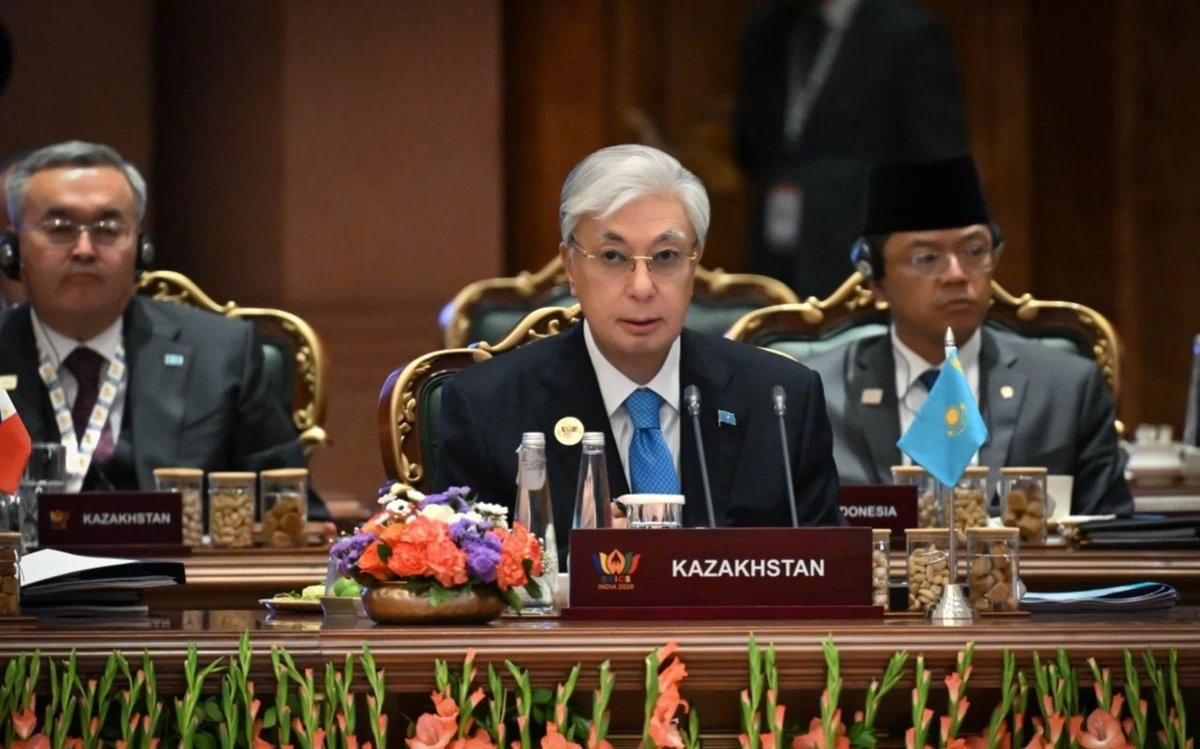
Tokayev addresses BRICS Plus summit in New Delhi, warns of 'Great Fragmentation'
This digest was compiled by AI from multiple sources — links to the originals are below.
Kazakh President Kassym-Jomart Tokayev addressed the BRICS Plus plenary session in New Delhi on September 13, 2026. He warned that geopolitical confrontation, militarization, and trade barriers are fragmenting the global order. Tokayev cited the 2026 Global Peace Index, which estimates violence cost the world economy nearly $22 trillion last year.
Key Facts
- Tokayev addressed the BRICS Plus plenary session in New Delhi on September 13, 2026, under the theme 'Strengthening Resilience, Innovation, Cooperation and Stability.'
- The 2026 Global Peace Index describes the current era as the 'Great Fragmentation,' with global economic losses from violence reaching nearly $22 trillion, or 10% of world GDP, last year.
- Tokayev called for high-level dialogue among nuclear powers to reduce nuclear risks, including those linked to new technologies.
- Kazakhstan's trade turnover with BRICS members and partners reached approximately $72 billion in 2025.
- Tokayev stated that BRICS countries represent almost half of the world's population and 40% of global GDP.
Global Security Challenges
Tokayev highlighted geopolitical confrontation, rising militarization, weakening multilateral institutions, and new trade barriers as fundamental problems facing the international community. He cited the 2026 Global Peace Index, which uses the term 'Great Fragmentation' to describe the current era of geopolitical confrontation and militarization. According to Tokayev, global economic damage from violence reached nearly $22 trillion last year, equivalent to about 10% of world GDP. He warned that regional conflicts extend far beyond their immediate zones and disrupt critical maritime routes, exposing vulnerabilities in global energy, food, and trade chains. Tokayev called for a transition from de-escalation of regional tensions to long-term stability through political dialogue and consistent diplomacy.
UN Reform and Nuclear Dialogue
Tokayev asserted that there is no alternative to the United Nations and called for its reform to strengthen conflict prevention and collective decision-making. He said the UN Charter should be applied consistently, not selectively, and that Security Council reform must reflect modern realities. Tokayev advocated for fair representation of Asia, Africa, and Latin America in the UN Security Council. He urged nuclear powers to resume high-level dialogue to reduce nuclear risks, including those associated with new technologies. Tokayev noted that the erosion of the international security architecture and protracted conflicts increase the risk of a new arms race and strategic miscalculations.
BRICS Cooperation and Kazakhstan's Role
Tokayev described BRICS as an open platform for practical cooperation that complements the multilateral system with the UN at its core. He stated that Kazakhstan's trade turnover with BRICS members and partners reached about $72 billion in 2025. Kazakhstan intends to expand cooperation in energy, critical minerals, agriculture, technology, and infrastructure. Tokayev emphasized Kazakhstan's position as one of the key transit and logistics hubs in Eurasia. He thanked Indian Prime Minister Narendra Modi for hosting the summit and noted that India's BRICS chairmanship has given new impetus to the people-centered agenda.