
SCO Summit in Bishkek Exposes Divisions Among Member States
This digest was compiled by AI from multiple sources — links to the originals are below.
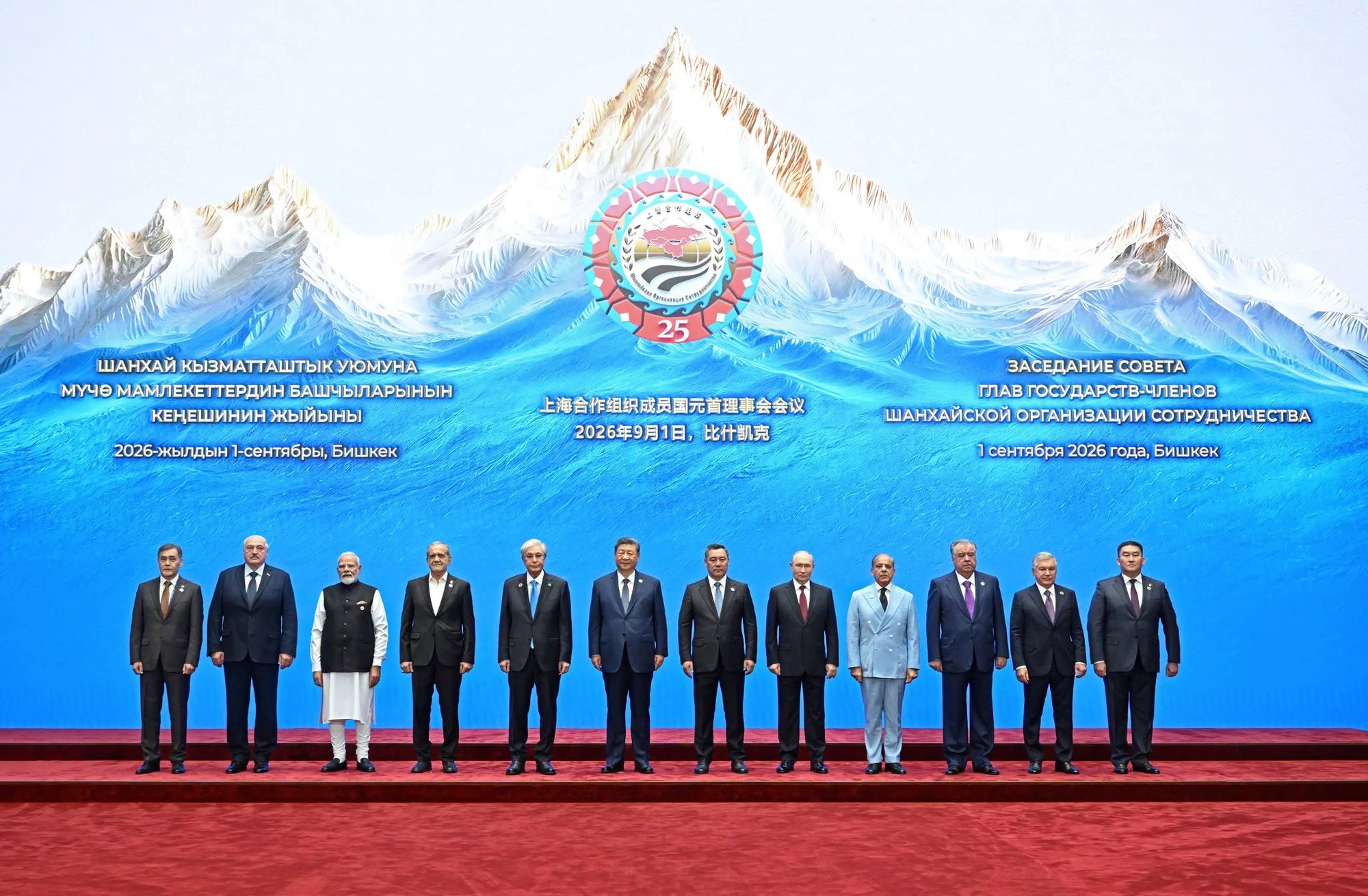
The Shanghai Cooperation Organization summit in Bishkek, Kyrgyzstan, held August 31-September 1, marked 25 years since the group's founding. Leaders from China, India, Russia, and Pakistan clashed over Ukraine and bilateral disputes, with Indian Prime Minister Narendra Modi urging Russian President Vladimir Putin to end the war. The discord highlighted the organization's difficulty in forging a common strategic direction among geopolitical rivals.
Key Facts
- The SCO now includes ten member states: China, India, Russia, Iran, Pakistan, Kazakhstan, Kyrgyzstan, Tajikistan, and Uzbekistan.
- Indian Prime Minister Narendra Modi urged Russian President Vladimir Putin to end the war in Ukraine 'for humanity's sake' during the summit.
- Chinese President Xi Jinping proposed creating AI hubs within the SCO framework.
- Uzbekistan proposed an industrial cooperation mechanism, and Kyrgyzstan pushed for its Tamchy Special Financial Investment Territory to host joint SCO projects.
- Tajikistan advocated for a regional digital agro-ecological platform.
Summit Discord
Chinese President Xi Jinping and Indian Prime Minister Narendra Modi did not hold a formal bilateral meeting, unlike at last year's summit. Modi and Pakistan's Prime Minister Shehbaz Sharif traded predictable barbs. Modi directly urged Russian President Vladimir Putin to end the war in Ukraine 'for humanity's sake.' This came shortly after Ukrainian President Volodymyr Zelenskyy revealed that China delivered an ultimatum to Russia not to use nuclear weapons in Ukraine, which China has not denied.
Institutional Proposals
The summit featured credible proposals for institutional development. Xi proposed AI hubs, Uzbekistan proposed an industrial cooperation mechanism, and Kyrgyzstan pushed its Tamchy Special Financial Investment Territory for joint SCO projects. Kyrgyzstan also advocated for Bishkek as the headquarters of a joint development bank. Tajikistan pushed for a regional digital agro-ecological platform.
Organization Limits
The SCO brings together several geopolitical rivals, making it difficult to imagine the institution evolving into a mirror of NATO. The SCO lacks the degree of institutionalization necessary to impose coherent policy on its members. Its principal powers lack sufficient leverage over one another to establish a common strategic direction. The SCO already possesses permanent structures, including its Regional Anti-Terrorist Structure (RATS) in Tashkent.
1 source
Time · lag behind first