
US-led wars since 9/11 killed 4.5 million, displaced 38 million
This digest was compiled by AI from multiple sources — links to the originals are below.
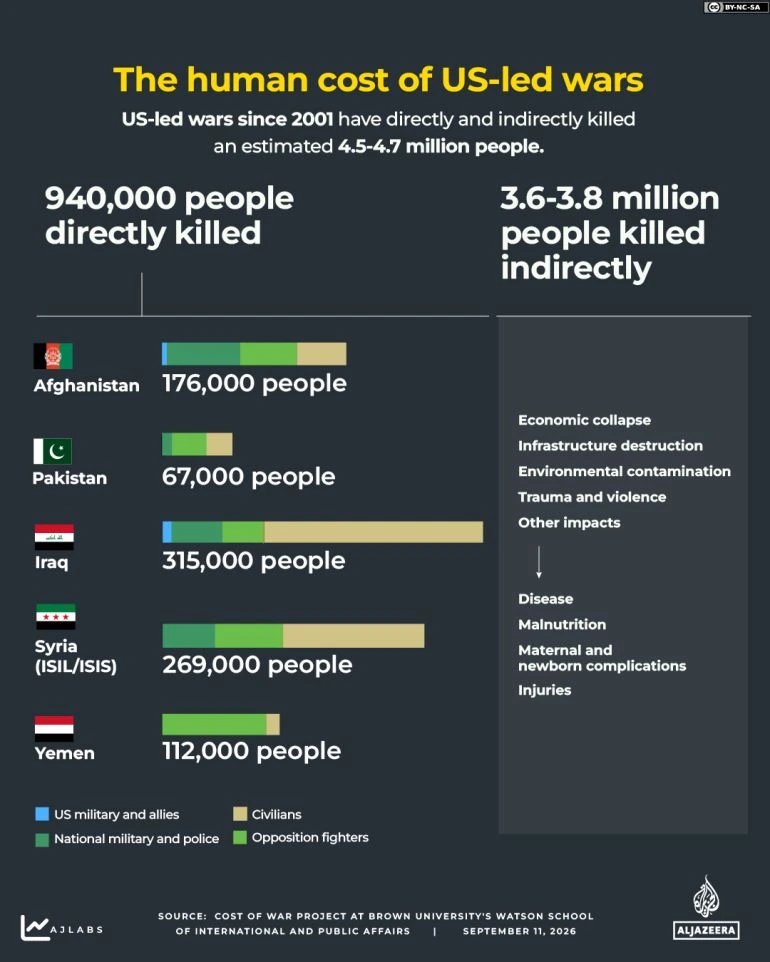
US-led wars launched after the September 11 attacks have killed at least 4.5 million people and displaced more than 38 million, according to Brown University's Costs of War project. The conflicts, spanning Afghanistan, Iraq, and other countries, have reshaped US foreign policy for a generation. The human toll includes 176,000 direct deaths in Afghanistan alone, where food insecurity rose from 62 percent to 92 percent after the war.
Key Facts
- The Costs of War project at Brown University estimates that US-led wars since 2001 have directly or indirectly killed 4.5 to 4.7 million people.
- More than 38 million people have been displaced by the successive wars launched after 9/11.
- An estimated 176,000 people died as a direct result of the war in Afghanistan, according to the Costs of War project.
- Food insecurity in Afghanistan rose from 62 percent before the war to 92 percent after it.
- In 2021, the Taliban regained control of Afghanistan after nearly 20 years of US-led conflict.
The Human Toll
The Costs of War project at Brown University's Watson Institute estimates that US-led wars since 2001 have directly or indirectly killed 4.5 to 4.7 million people. This figure includes approximately 940,000 direct deaths and 3.6 to 3.8 million indirect deaths from disease, malnutrition, and health complications. More than 38 million people have been displaced by the conflicts, according to the same project. Every year since 2001, US forces have bombed a country somewhere in the world, devastating the lives of millions.
Afghanistan's Longest War
On October 7, 2001, the US launched Operation Enduring Freedom in Afghanistan, and the Taliban fell within weeks. The war spanned nearly 20 years across four US presidents, making it the longest conflict in US history. An estimated 176,000 people died as a direct result of the war, according to the Costs of War project. Hunger, disease, and untreated injuries killed hundreds of thousands more, while unexploded ordnance and landmines continue to kill and maim civilians. Food insecurity rose from 62 percent of Afghans before the war to 92 percent after it. In 2021, the Taliban regained control of Afghanistan.
The Iraq Invasion
The 2003 invasion of Iraq was fought on the false pretence that the country harboured weapons of mass destruction. Omar, an Iraqi student at the time, told Al Jazeera that 'everything changed' after the invasion. The war in Iraq was part of the broader 'War on Terror' declared by President George W Bush less than a month after 9/11.
1 source
Time · lag behind first