
Kyrgyzstan hosts SCO summit in Bishkek with Putin, Xi, Guterres attending
This digest was compiled by AI from multiple sources — links to the originals are below.
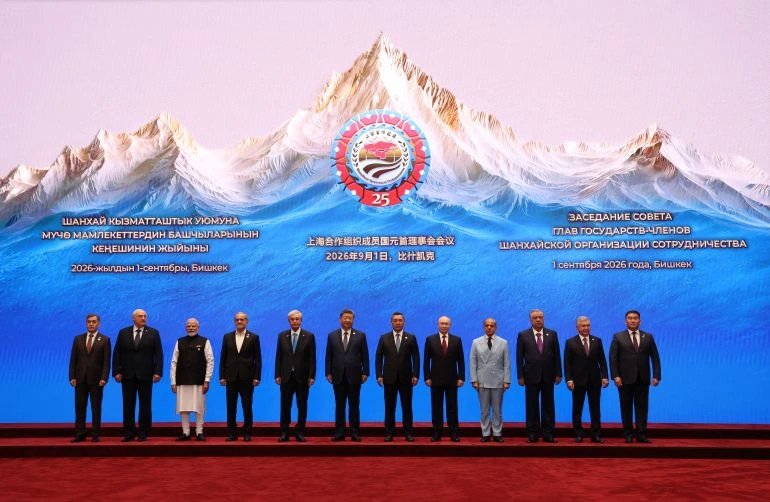
Leaders of Russia, China, India, Iran, Pakistan and other SCO members gathered in Bishkek on September 1, 2026 for the Shanghai Cooperation Organisation summit. Kyrgyzstan used the summit to advance its multi-vector foreign policy, balancing ties with Russia, China, Europe and the United States. The meeting underscored the bloc's role as a platform outside Western-led frameworks.
Key Facts
- The SCO summit took place in Bishkek on September 1, 2026, with leaders from Russia, China, India, Iran, Pakistan and other member states.
- Russian President Vladimir Putin described the SCO as 'one of the independent and influential centres of the emerging multipolar world'.
- Kyrgyzstan's President Sadyr Japarov hosted the summit, which also included UN Secretary-General Antonio Guterres and Turkey as an SCO Plus participant.
- The SCO has grown from six founding members in 2001 to what Putin called the world's largest regional association.
- Kyrgyzstan's multi-vector foreign policy aims to balance relations with Russia, China, Europe and the United States.
Summit Participants
The summit brought together leaders from Russia, China, India, Iran, Pakistan, and other SCO member states. Turkey and UN Secretary-General Antonio Guterres attended as part of the SCO Plus format. Russian President Vladimir Putin addressed the summit, calling the SCO an independent centre of the multipolar world. The organisation has expanded from six founding members in 2001 to a broader regional association.
Kyrgyzstan's Balancing Act
Kyrgyzstan, a landlocked and mountainous country, depends on transport corridors through Russia and China. President of the Crossroads Central Asia think tank Shairbek Dzhuraev said the summit's timing is important because members are directly involved in key geopolitical conflicts. Since independence in 1991, Central Asian states have pursued multi-vector foreign policies, keeping Russia close while building ties with China and maintaining relations with Europe and Washington. Dzhuraev noted that Kyrgyzstan's biggest weakness is dependence on transport routes, energy, and economic relationships. Kyrgyzstan cannot dictate the SCO agenda but helped shape the summit's language.
1 source
Time · lag behind first