
AI-designed RNA carrier STV-C8 outperforms lipid nanoparticles in gene delivery
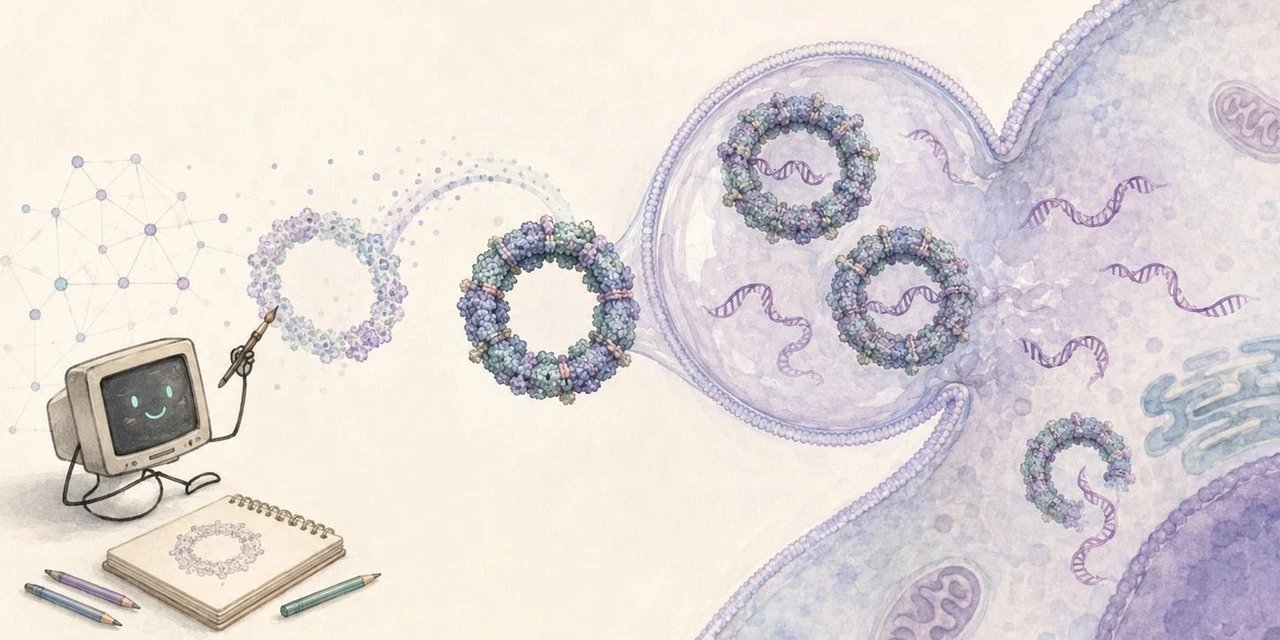
This digest was compiled by AI from multiple sources — links to the originals are below.
Researchers have engineered a synthetic RNA transfer vehicle, STV-C8, using AI-designed protein assemblies. STV-C8 delivers RNA several orders of magnitude more efficiently than natural counterparts and clinically used lipid nanoparticles. The vehicle successfully delivered CRISPR-Cas9 to delete dystrophin exon 51 in patient-derived and pig skeletal muscle cells for Duchenne muscular dystrophy.
Key Facts
- STV-C8 is built from an unusual planar symmetry and is the most efficient structure for RNA delivery among hundreds of tested designs.
- STV-C8 delivers RNA several orders of magnitude more efficiently than natural counterparts and lipid nanoparticles in clinical use.
- STV-C8 delivered CRISPR-Cas9 to delete dystrophin exon 51 in patient-derived and pig skeletal muscle cells as a treatment strategy for Duchenne muscular dystrophy.
- STV-C8 demonstrated an excellent safety profile in two animal models and showed near-single-cell resolution biodistribution in a mouse model.
Design and Screening
Researchers used AI models for protein design to create synthetic protein assemblies that do not occur naturally. They developed a multidimensional screening system to test hundreds of designs for RNA delivery. STV-C8, built from an unusual planar symmetry, emerged as the most efficient structure for RNA delivery. STV-C8 exhibits unique characteristics including cyclic and dihedral symmetries, open structures, and low complexity of the assembled protein.
Delivery Performance
STV-C8 is several orders of magnitude more efficient in RNA transfer compared with natural counterparts and lipid nanoparticles in clinical use. The vehicle delivered various cargo RNAs, including reporter RNAs, gene editors, programmable antivirals, and transcription factors, into cellular models from several species. A comprehensive in vivo biodistribution analysis of STV-C8 was performed at near-single-cell resolution in a mouse model. STV-C8 confirmed an excellent safety profile in two animal models.
Therapeutic Application
Researchers evaluated the translational capacity of STV-C8 by delivering the CRISPR-Cas9 gene editor into patient-derived and pig skeletal muscle cells. The delivery targeted deletion of dystrophin exon 51 as a treatment strategy for Duchenne muscular dystrophy.
1 source
Time · lag behind first