
Bond market revolt deepens as Trump rejects Iran deal and oil hits $92
This digest was compiled by AI from multiple sources — links to the originals are below.
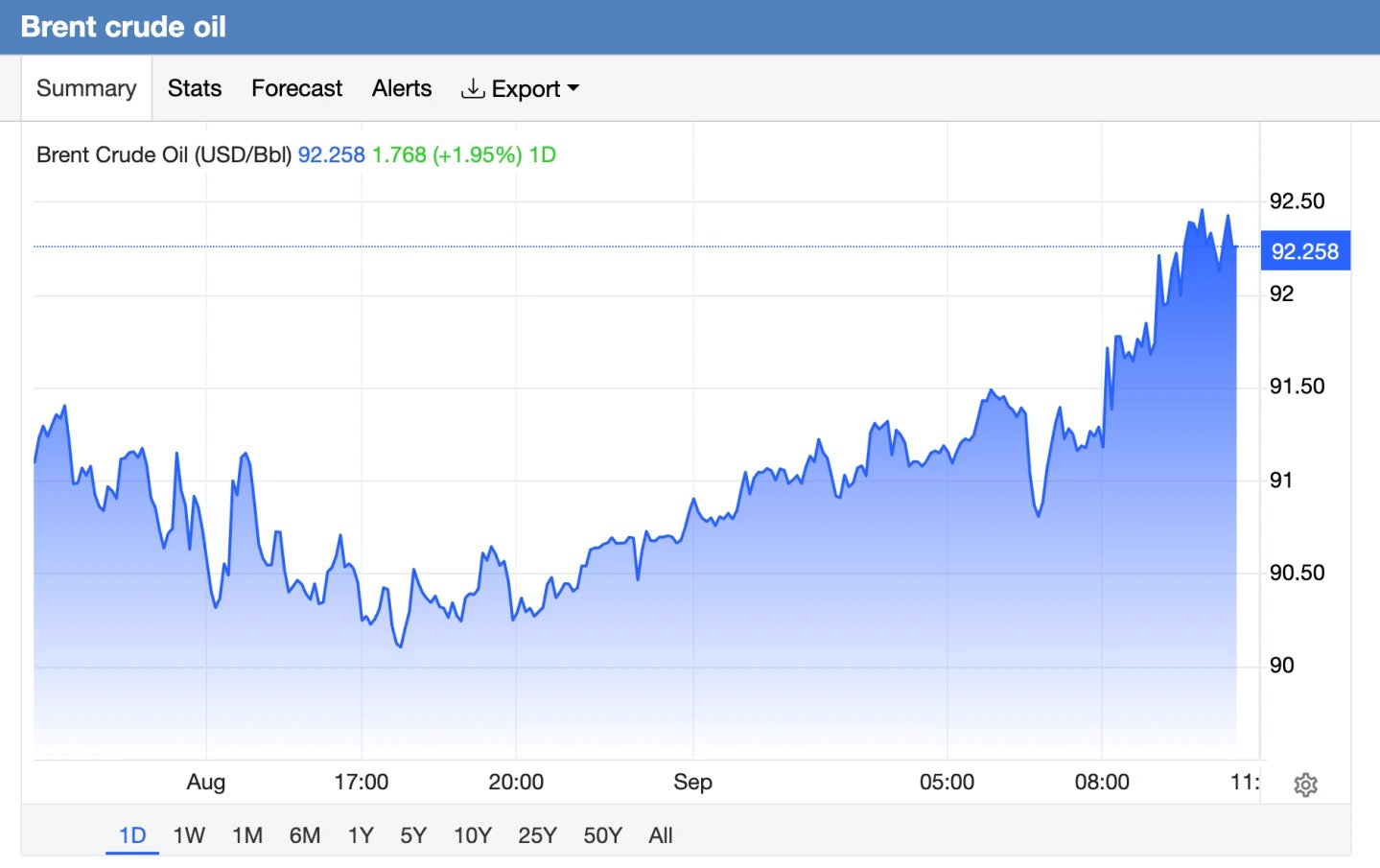
Global bond markets sold off sharply on September 1 as President Trump declined to accept an Iranian peace deal and oil prices climbed above $92 a barrel. The selloff reflects investor concern that renewed U.S.-Iran hostilities will keep energy costs elevated and push the Federal Reserve toward another rate hike. The risk-off move hit equities worldwide even as Iran again offered to accept the White House's June memorandum of understanding.
Key Facts
- Brent crude rose 1.3% to $91.67 a barrel and WTI rose 1.48% to $87.03 on September 1, according to Reuters data cited by Kazinform.
- Iran's President Masoud Pezeshkian said Iran was prepared to reciprocate if the U.S. honored its commitments under the June memorandum of understanding, Al Jazeera reported.
- The MOU proposes an end to all hostilities, an end to sanctions, and $300 billion in reparations, while requiring Iran not to procure or develop nuclear weapons.
- Money markets are pricing in a near-certain Federal Reserve rate hike in October, according to Sozcu.
- The Strait of Hormuz carried about 20% of global oil supply before the escalation, and attempts to fully restore shipping through the strait have so far failed.
Oil Market Reaction
Brent crude rose 1.3% to $91.67 a barrel and WTI rose 1.48% to $87.03 on September 1, according to Reuters data cited by Kazinform. The increase followed renewed direct military exchanges between the U.S. and Iran and persistent disruption risks in the Strait of Hormuz. The strait carried about 20% of global oil supply before the escalation, and attempts to fully restore shipping through it have so far failed. On August 28, Brent settled at $89.31 a barrel and WTI at $83.40, while on August 31 Brent traded at $90.29 and WTI at $85.25. Analysts polled by Reuters expect Brent to average about $85.08 a barrel and WTI $80.20 for 2026, with shipping disruptions and Middle East geopolitical risks as the main factors.
Iran Diplomacy and Military Tensions
Iran's President Masoud Pezeshkian said Iran was prepared to reciprocate if the U.S. honored its commitments under the June memorandum of understanding, Al Jazeera reported. Iran made a similar offer to accept the MOU on August 26, but the MOU technically expired on August 17. The MOU proposes an end to all hostilities, an end to sanctions, and $300 billion in reparations, while requiring Iran not to procure or develop nuclear weapons. President Trump is considering a further set of relatively limited strikes on Iran to degrade its ability to hit ships in the Strait of Hormuz, Axios reported. Trump told Fox News yesterday, "We are going to hit them hard," in response to Iran's previous strikes on U.S. sites in the Gulf, which were triggered by U.S. strikes on Iranian missile launchers near the strait.
Market and Fed Impact
Global markets traded negatively on September 1 as expectations of a Federal Reserve rate hike remained strong, Middle East geopolitical tensions escalated, and bond market selling pressure increased again, Sozcu reported. Rising geopolitical risk and higher oil prices are causing stock market declines and rising bond yields, while growing inflation concerns are strengthening forecasts of a Fed rate hike. Money markets are pricing in a near-certain Federal Reserve rate hike in October, according to Sozcu. A stronger-than-expected U.S. nonfarm payrolls report on Friday could further strengthen rate hike expectations, Sozcu noted. President Trump announced the U.S. would respond after Iran targeted U.S. air bases in Jordan with ballistic missiles, Sozcu reported.
3 sources
Time · lag behind first