
Asteroid 2024 YR4 warning shows planetary defense system working as designed
This digest was compiled by AI from multiple sources — links to the originals are below.
Asteroid 2024 YR4 triggered the first formal notification through the international planetary-defense system after its impact probability crossed 1% on January 27, 2025. The asteroid was later cleared as an Earth threat, and a lingering lunar-impact possibility was eliminated in 2026. The episode demonstrates how the warning system is designed to function when initial calculations are incomplete.
Key Facts
- On January 27, 2025, three independent orbit-computation centers agreed that asteroid 2024 YR4's chance of Earth impact had crossed 1%.
- On January 29, 2025, the International Asteroid Warning Network sent a formal notice to the United Nations Office for Outer Space Affairs and the Space Mission Planning Advisory Group.
- The asteroid was discovered by the NASA-funded ATLAS survey at Río Hurtado, Chile, on December 27, 2024.
- The asteroid reached level 3 on the Torino Scale, which calls for attention from astronomers and public officials for an encounter less than a decade away.
- The asteroid was later cleared as an Earth threat, and a lingering lunar-impact possibility was eliminated in 2026.
First Formal Notification
The warning did not predict that impact was the likely outcome; its 1.3% estimate meant there was still a 98.7% chance of a miss. What changed was that the risk had become large enough, for an object of this size, to activate an agreed process for observations, government notification and possible mission planning. It was the first formal asteroid notification issued through an international planetary-defense system created more than a decade earlier.
Uncertainty Corridor
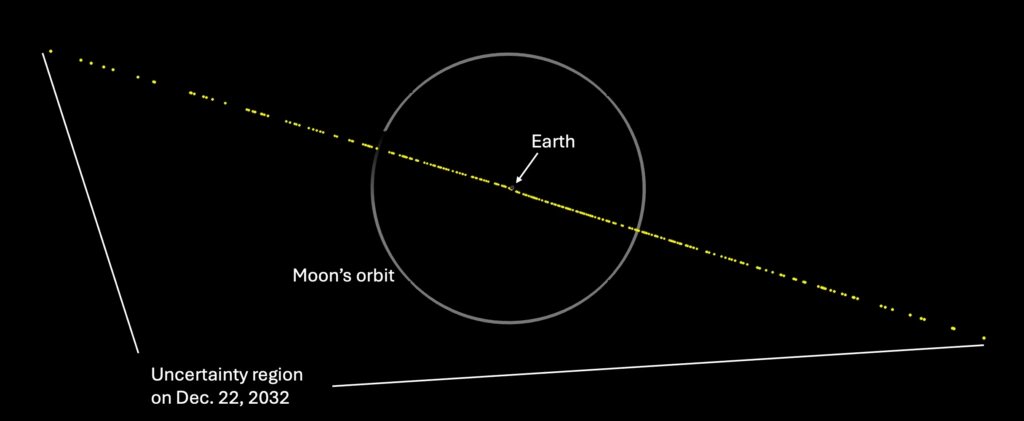
Astronomers began with a very short observed segment of an orbit that had to be projected eight years forward to December 22, 2032. An early orbit prediction is not a single line through space but a range of statistically possible trajectories, often shown as a long uncertainty region. As new measurements reduced the range of possible positions, Earth remained inside it, and the calculated impact probability rose even though the asteroid had not changed course.
Threshold as Trigger
IAWN's notification threshold applies when an object larger than roughly 10 meters has a greater than 1% chance of impact. The threshold is deliberately much lower than 50% because waiting until a collision becomes the most likely outcome could waste years needed for tracking, physical characterization, disaster planning or deflection. The rule also creates a communication discipline.
1 source
Time · lag behind first