
Astronomers discover S301 star orbiting Milky Way's black hole at 25,000 km/s
This digest was compiled by AI from multiple sources — links to the originals are below.
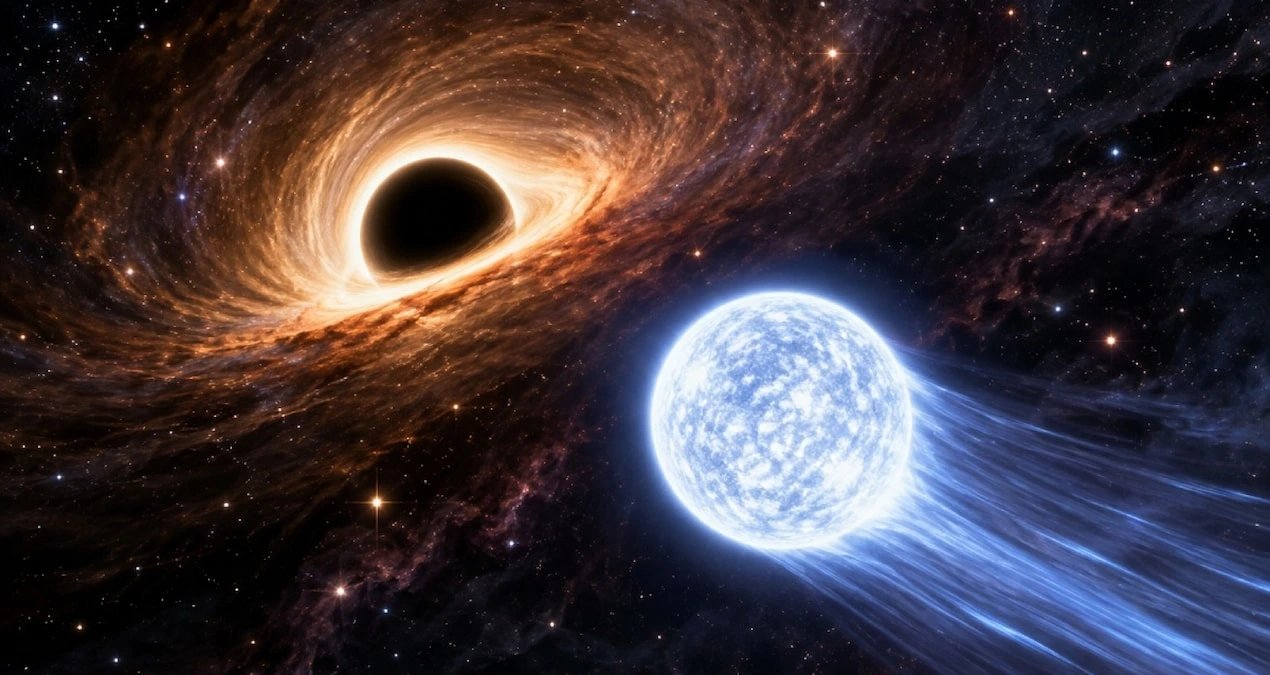
Astronomers using the European Southern Observatory's Very Large Telescope Interferometer in Chile have discovered a star, S301, orbiting the supermassive black hole Sagittarius A* at the center of the Milky Way at speeds reaching 25,000 kilometers per second. The star completes one orbit in 8.7 years and passes within 1.7 billion kilometers of the black hole, roughly the distance from the Sun to Saturn. The discovery was announced on August 19, 2026.
Key Facts
- S301 orbits Sagittarius A*, the supermassive black hole at the Milky Way's center, completing one revolution in 8.7 years.
- At its closest approach, S301 passes within 1.7 billion kilometers of the black hole, comparable to the Sun-Saturn distance.
- The star reaches speeds of about 25,000 kilometers per second, fast enough to circle Earth in 1.6 seconds if maintained.
- Researchers suggest S301 may be a remnant of a binary system disrupted by the black hole's gravity.
- The next closest approach of S301 to Sagittarius A* is expected in 2031.
Discovery and Observation
The discovery was announced based on observations made with the European Southern Observatory's Very Large Telescope Interferometer in Chile. The research results were published on August 19, 2026. S301 attracted attention not only for its speed but also because it approaches the black hole at the Milky Way's center more closely than any previously observed star.
Orbital Characteristics
S301 moves in a highly elliptical orbit around Sagittarius A*, a supermassive black hole with a mass about 4 million times that of the Sun. The black hole's powerful gravity accelerates the star to extraordinary speeds as it nears the closest point of its orbit. At that point, S301 reaches approximately 25,000 kilometers per second, a speed that would allow it to circle Earth in about 1.6 seconds.
Scientific Significance
S301's close passage may allow scientists to measure the spin of Sagittarius A* through the frame-dragging effect predicted by Einstein's general relativity. Researchers plan to track the star's motion precisely in the coming years to directly measure the black hole's rotation speed. Sagittarius A*, located about 26,000 light-years away, cannot be seen directly, but the motions of surrounding stars reveal its properties.
1 source
Time · lag behind first