
Cornell team calculates universe may reverse expansion in 20 billion years
This digest was compiled by AI from multiple sources — links to the originals are below.
A Cornell-led team has calculated that the universe could stop expanding and begin contracting in about 20 billion years. The model, built to reproduce hints that dark energy evolves, finds a maximum cosmic scale factor roughly 11 billion years from now. The result contrasts with the standard cosmological model's prediction of endless expansion.
Key Facts
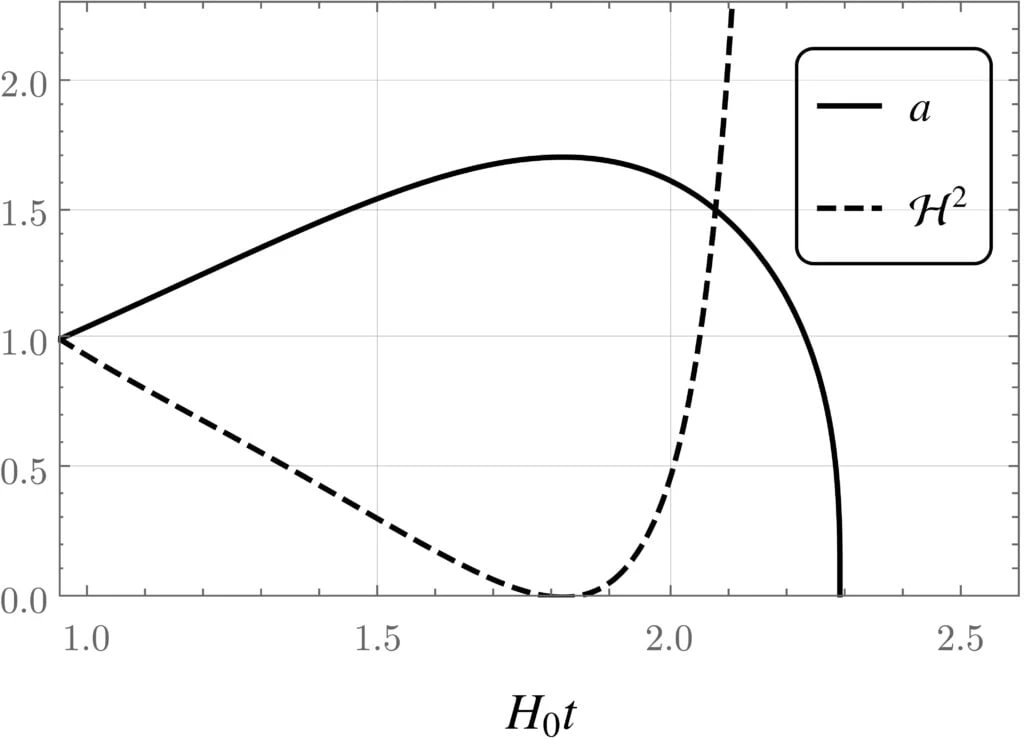
- The Cornell-led model predicts the cosmic scale factor will peak at about 1.69 times its present value roughly 11 billion years from now.
- Contraction would end when the model universe reaches a total age of 33.3 billion years, about 20 billion years from now.
- The model's dark energy combines a positive ultralight axion-like field with a negative cosmological constant.
- The standard ΛCDM model assumes dark energy is a positive cosmological constant that never dilutes, leading to endless expansion.
- The 1998 discovery of accelerating expansion by two supernova teams led to the adoption of the cosmological constant as the simplest explanation.
The Model's Prediction
The Cornell-led team calculated the future of the universe inside a model built to reproduce recent hints that dark energy may evolve. The model's dark energy has two hidden parts: a positive contribution from an ultralight axion-like field and a negative cosmological constant. For one best-fit set of parameters, the cosmic scale factor grows to about 1.69 times its present value, reaches its maximum roughly 11 billion years from now, and then reverses. Contraction ends when the model universe reaches a total age of 33.3 billion years, which is approximately 20 billion years from now given the current age of 13.8 billion years.
Standard Cosmology's Endless Expansion
For much of the 20th century, cosmologists expected gravity to slow the expansion that began with the Big Bang, with the outcome depending on the amount of matter in the universe. In 1998, two teams using Type Ia supernovae found that the expansion was accelerating, not slowing as expected. The simplest explanation was a cosmological constant, represented by the Greek letter lambda in Einstein's equations. The standard ΛCDM model combines that constant with cold dark matter and describes the dark-energy equation of state with the parameter w, where a cosmological constant has w equal to minus one. If lambda is positive and truly constant, it eventually overwhelms every component that thins with expansion, leading to a cold and sparse universe often called heat death.
1 source
Time · lag behind first