
San Andreas and San Jacinto faults reach 1,000-year peak stress near Los Angeles
This digest was compiled by AI from multiple sources — links to the originals are below.
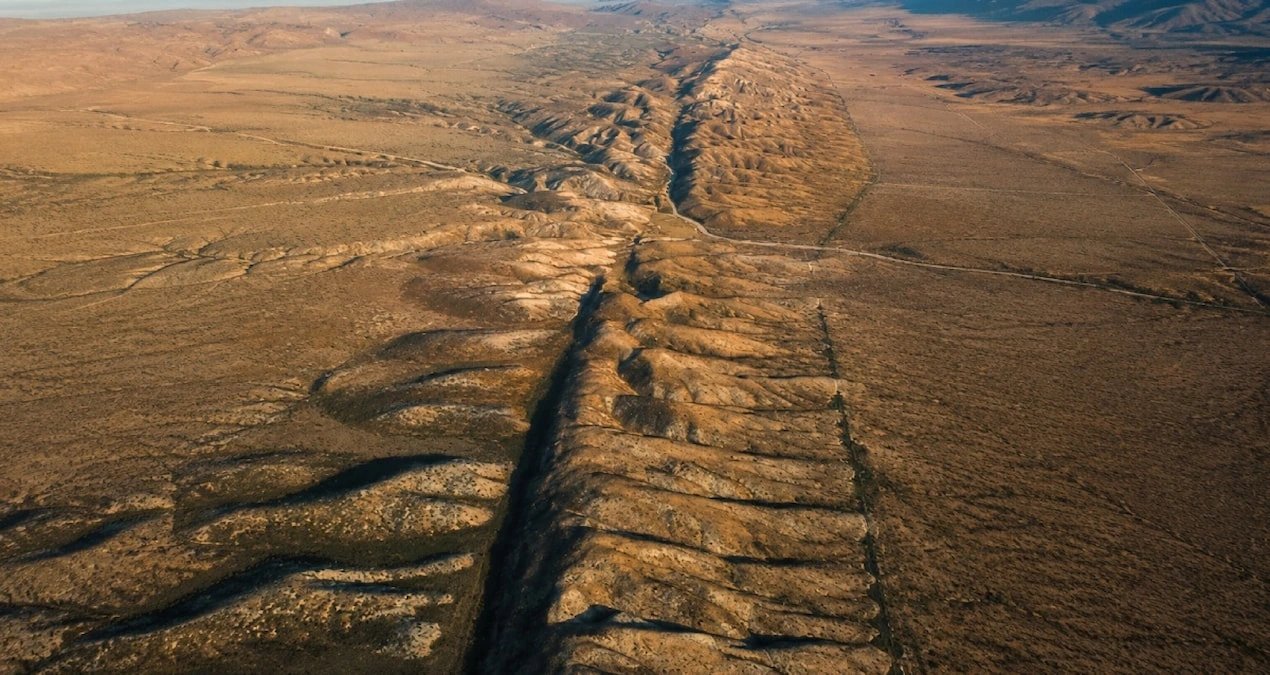
Computer models show stress on parts of the San Andreas and San Jacinto faults near Los Angeles has reached or exceeded the highest levels calculated in the past 1,000 years. The study, led by geophysicist Liliane Burkhard, identifies Cajon Pass as a critical zone where a rupture could jump between the two fault systems. Researchers stress the findings do not predict the timing of a major earthquake.
Key Facts
- The study was led by geophysicist Liliane Burkhard and used 1,000 years of paleoseismic earthquake history to model stress changes on the faults.
- The San Jacinto San Bernardino section and the San Andreas southern Mojave section are at historically very high stress levels.
- Cajon Pass, northeast of Los Angeles, is identified as a critical zone where the San Andreas and San Jacinto fault systems come close together.
- The Parkfield section of the San Andreas has experienced magnitude-6 earthquakes roughly every 22 years, with the last major event in 2004.
Stress Accumulation
New findings are based on computer models that combine past major earthquakes with stress accumulated on faults over centuries. Researchers determined that some fault segments have reached the highest stress values calculated in the last 1,000 years, and in some places exceeded those levels. The model led by geophysicist Liliane Burkhard used 1,000 years of paleoseismic earthquake history to calculate how stress on the faults changed over time. Results show the San Jacinto San Bernardino section and the San Andreas southern Mojave section are at historically very high stress levels.
Cajon Pass Junction
The research focuses on Cajon Pass, northeast of Los Angeles, where the San Andreas and San Jacinto fault systems come very close together. Scientists view this area as a kind of 'earthquake gate' that could influence whether a large rupture jumps from one fault to the other. Normally a rupture starting on one fault can stop at a certain point, but the model suggests that if stress on both faults is simultaneously high enough, the rupture could cross this critical zone and propagate to other fault segments. Such a scenario could mean a much larger earthquake affecting a far wider area than a rupture on a single fault segment.
No Timing Prediction
The researchers emphasize that the results do not mean a major earthquake will definitely occur soon. While high stress on a fault is important for assessing earthquake hazard, scientists cannot determine the day, month, or year of an earthquake from these data. The researchers state that current conditions point to one of the highest stress periods in the past millennium and that scenarios where the San Andreas and San Jacinto rupture together should be considered in earthquake risk calculations. The Parkfield section of the San Andreas has produced magnitude-6 earthquakes roughly every 22 years, with the last major event in 2004, and studies there also indicate the fault's earthquake cycle may be in an advanced stage, though again without a precise timing.
1 source
Time · lag behind first