
China's LandSpace lands reusable Zhuque-3 rocket stage in Gobi Desert
This digest was compiled by AI from multiple sources — links to the originals are below.
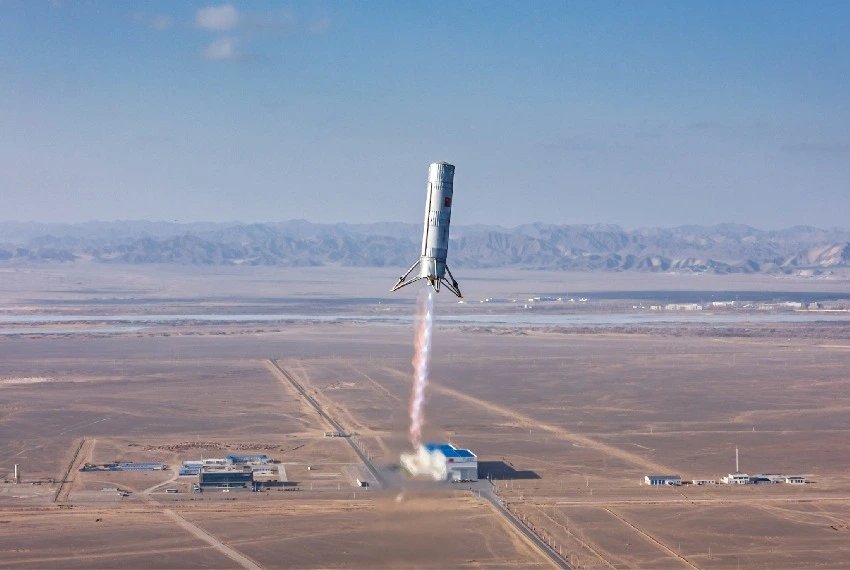
Chinese private rocket startup LandSpace launched its Zhuque-3 (ZQ-3) rocket from Jiuquan spaceport on August 21, 2026, and successfully landed the first stage on land in the Gobi Desert, 390 km from the launch site. The second stage delivered the Honghu-03 communications satellite to low Earth orbit. The landing marks the first controlled return of an orbital-class rocket stage to land by a private Chinese company.
Key Facts
- LandSpace's Zhuque-3 rocket lifted off from Jiuquan spaceport on August 21, 2026, and its first stage landed 390 km away in the Gobi Desert.
- The second stage placed the Honghu-03 communications satellite into low Earth orbit.
- The first stage is designed for up to 20 flights, potentially cutting launch costs to $2,000 per kilogram versus the standard $8,000–10,000.
- LandSpace has invested 7.5 billion yuan ($1.05 billion) in development and IPO preparation.
- State-owned CASC successfully landed a rocket stage on a sea platform in summer 2026.
Launch and Landing
LandSpace launched the two-stage Zhuque-3 rocket from Jiuquan spaceport on August 21, 2026. The first stage separated and performed a controlled vertical landing on dedicated supports in the Gobi Desert, Gansu Province, 390 km from the launch site. The second stage delivered the Honghu-03 communications satellite to low Earth orbit. Reuters reported this as the first successful return of an orbital-class rocket stage to land by a private Chinese company.
Rocket Design and Cost Targets
The Zhuque-3 stands 66.1 meters tall and is built from stainless steel, powered by in-house methane and liquid oxygen engines. Stainless steel construction significantly reduces production costs and simplifies inter-flight maintenance, according to N+1. The first stage accounts for 70–80 percent of total rocket cost, while fuel represents only 1–3 percent. LandSpace aims to reuse each stage up to 20 times, targeting a launch cost of $2,000 per kilogram compared with the standard $8,000–10,000.
Competitive Landscape
Spaceflight Now experts said LandSpace's success puts China in direct competition with SpaceX and Blue Origin. China becomes the second country where a private enterprise has achieved a powered vertical landing of an orbital booster. State-owned CASC conducted a successful stage landing on a sea platform in summer 2026, confirming the formation of redundant launch infrastructure in China.
1 source
Time · lag behind first