
Mecca Pact tests India's Gulf strategy without direct military threat
This digest was compiled by AI from multiple sources — links to the originals are below.
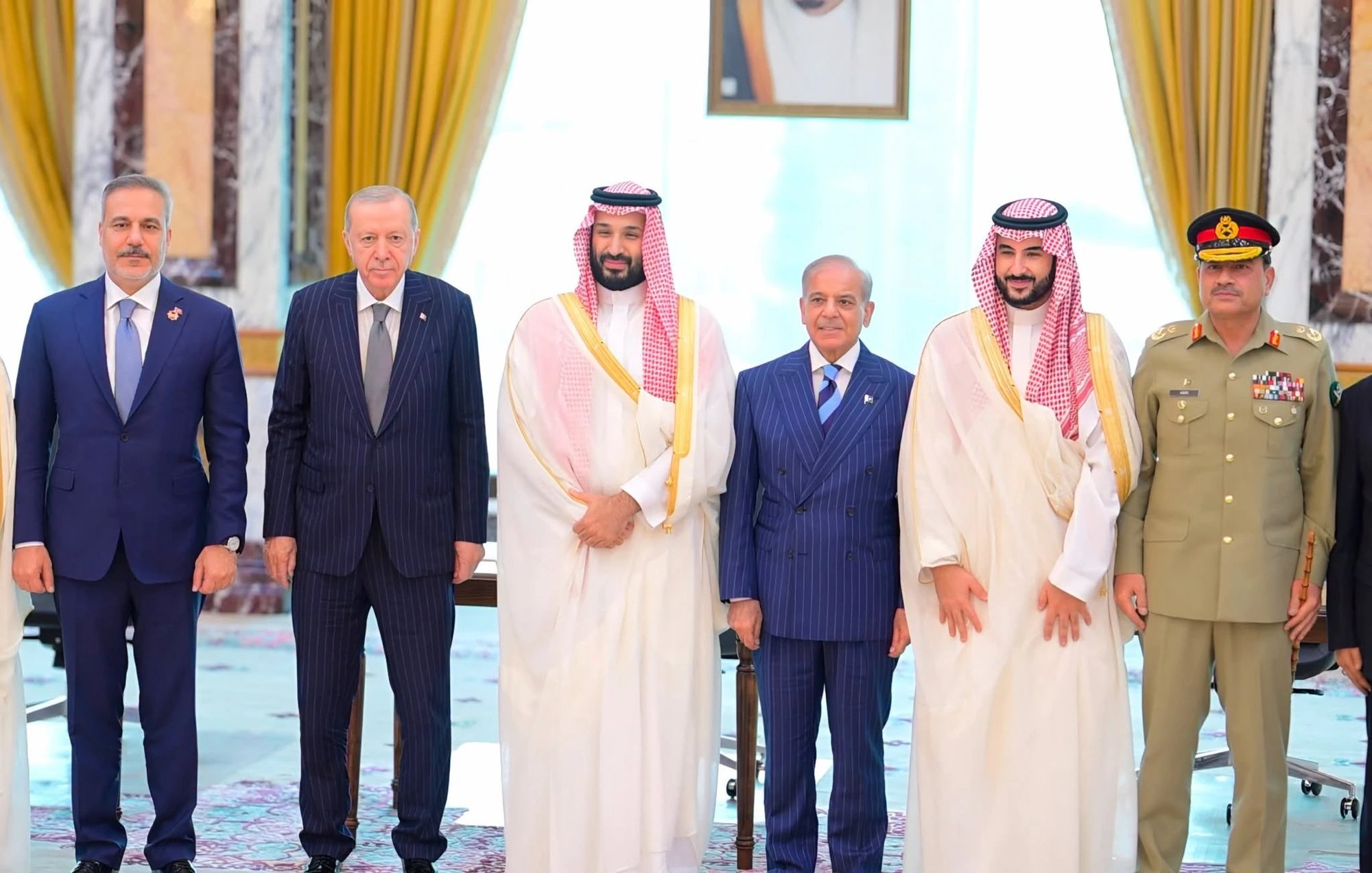
The August 7 Mecca Joint Defence Agreement between Saudi Arabia, Pakistan and Turkiye has India's Ministry of External Affairs examining its implications for national security and regional stability. The pact creates a collective deterrence mechanism combining 1.4 million active personnel, more than 6,000 tanks, 3,415 military aircraft and more than $124 billion in defence spending. Indian strategic analysts see it as a Pakistani signalling move that accelerates New Delhi's Gulf recalibration.
Key Facts
- The pact's combined military strength totals 1.4 million active personnel, more than 6,000 tanks, 3,415 military aircraft, 844 naval assets, and more than $124 billion in defence spending.
- India ranked fourth in the Global Firepower Index 2026, with 1.4 million active personnel, a $86 billion defence budget, 343 naval assets, 3,913 tanks, and 2,183 military aircraft.
- About 8.8 million Indian nationals reside in the Gulf region, and the Gulf Cooperation Council accounts for 15.4% of India's total trade.
- India's External Affairs Ministry spokesperson said the government is examining the pact's implications for national security and regional peace and stability.
India's Official Response
India's External Affairs Ministry spokesperson said the government is examining the Mecca Joint Defence Agreement from the perspective of national security and regional peace and stability. The spokesperson said India will safeguard its national interests in response to the August 7 agreement. Most of India's strategic community reacted with greater alarm than the official response. Some analysts described the pact as a master stroke by Pakistan, India's arch-rival, while others dismissed it as more optics than substance.
Military Balance
The Mecca pact brings together Saudi Arabia, a Gulf Cooperation Council member; Turkiye, a NATO member; and Pakistan, the only Islamic nuclear power, under a collective deterrence mechanism. The combined forces of the three signatories include 1.4 million active personnel, more than 6,000 tanks, 3,415 military aircraft, 844 naval assets and more than $124 billion in defence spending, according to the Global Firepower Index 2026. India ranked fourth in the same index, behind the United States, Russia and China, with 1.4 million active personnel, a $86 billion defence budget, 343 naval assets, 3,913 tanks and 2,183 military aircraft. The pact does not identify a single adversary, and barring Israel the three signatories share no common enemy for a joint defence scenario.
Gulf Stakes and Signalling
About 8.8 million Indian nationals reside in the Gulf region, making it an area of immense economic and strategic importance for New Delhi. The Gulf Cooperation Council is India's largest regional-bloc trading partner, accounting for 15.4% of India's total trade. India and the Gulf Cooperation Council signed a free trade agreement in February 2026. The pact's primary function is hedging and signalling, with Saudi Arabia signalling reduced reliance on the U.S. security umbrella and Turkiye signalling its NATO position after severing ties with Israel.
1 source
Time · lag behind first