
ESA's Gaia telescope discovers a travelling wave warping Milky Way's outer disc over 33,000 light-years
This digest was compiled by AI from multiple sources — links to the originals are below.
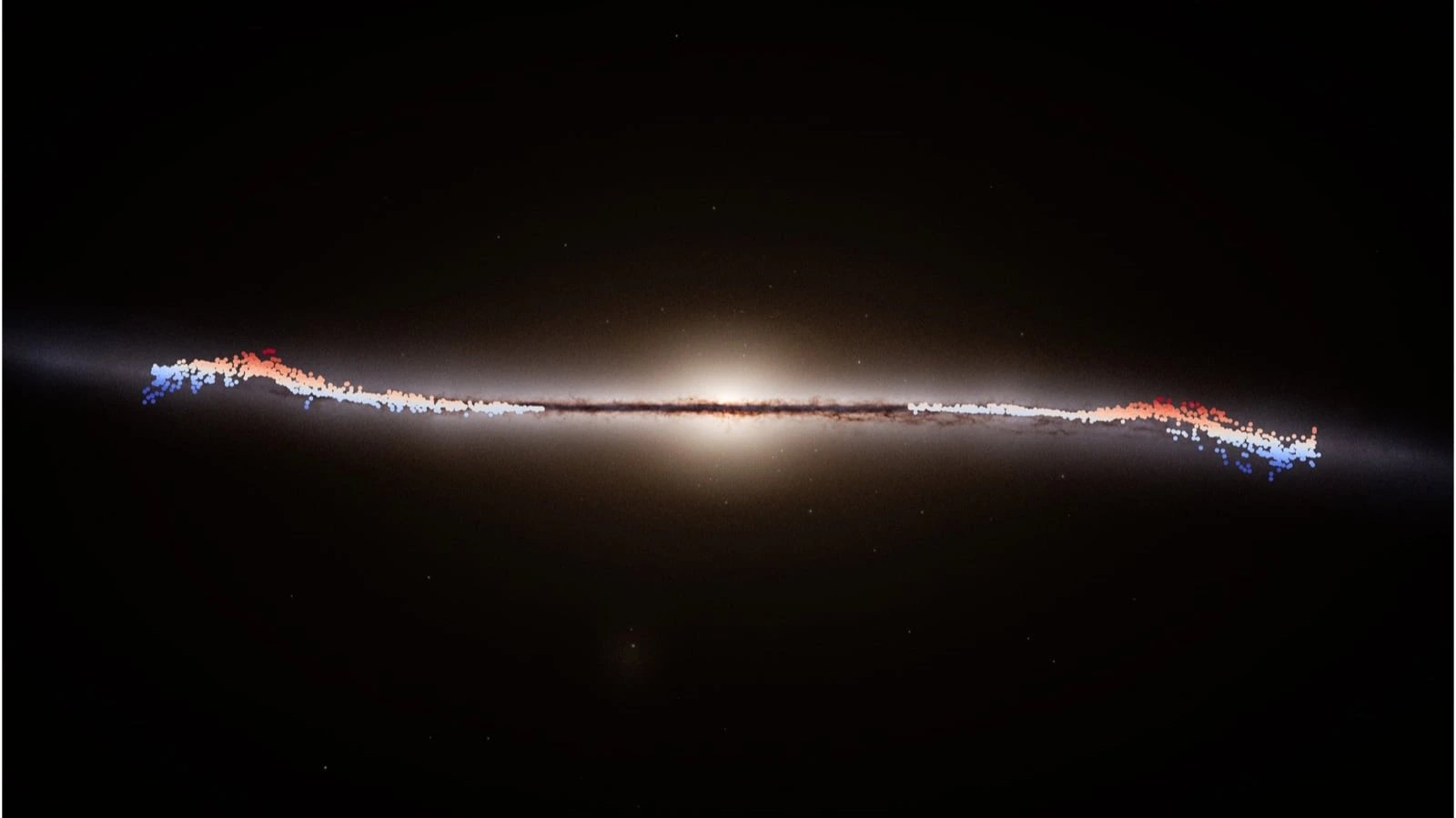
ESA's Gaia telescope has revealed a vast, travelling wave in the Milky Way's outer disc, pushing stars up to 650 light-years above and below the galactic plane and spanning at least 33,000 light-years. The discovery, reported in a 2025 study in Astronomy & Astrophysics, shows the wave moving outward through the disc at about 10–15 km/s. The cause of the disturbance remains unknown, even as the wave's motion is confirmed by offset patterns in star positions and velocities.
The Wave Structure
The wave lies between 30,000 and 65,000 light-years from the Milky Way's centre, spanning at least 33,000 light-years. Stars are vertically displaced by roughly 150 to 200 parsecs (500 to 650 light-years) from the expected disc. The feature is smaller than the known large-scale warp and appears to ride on top of it. Researchers from ESA first modelled the familiar warp, then identified the residual corrugation.
Motion Evidence
Gaia's velocity measurements show the crest in stellar positions does not align with the crest in vertical motion — an offset consistent with a travelling wave. A simple model reproduced this relationship when a disturbance was allowed to propagate outward. Stars in the region also exhibit an average outward radial motion of about 10 to 15 kilometres per second. The telescope collected three trillion observations of two billion objects during its 2014–2025 mission.
1 source
Time · lag behind first