
Lithium insertion in graphite anodes occurs through rapid avalanche-like events
This digest was compiled by AI from multiple sources — links to the originals are below.
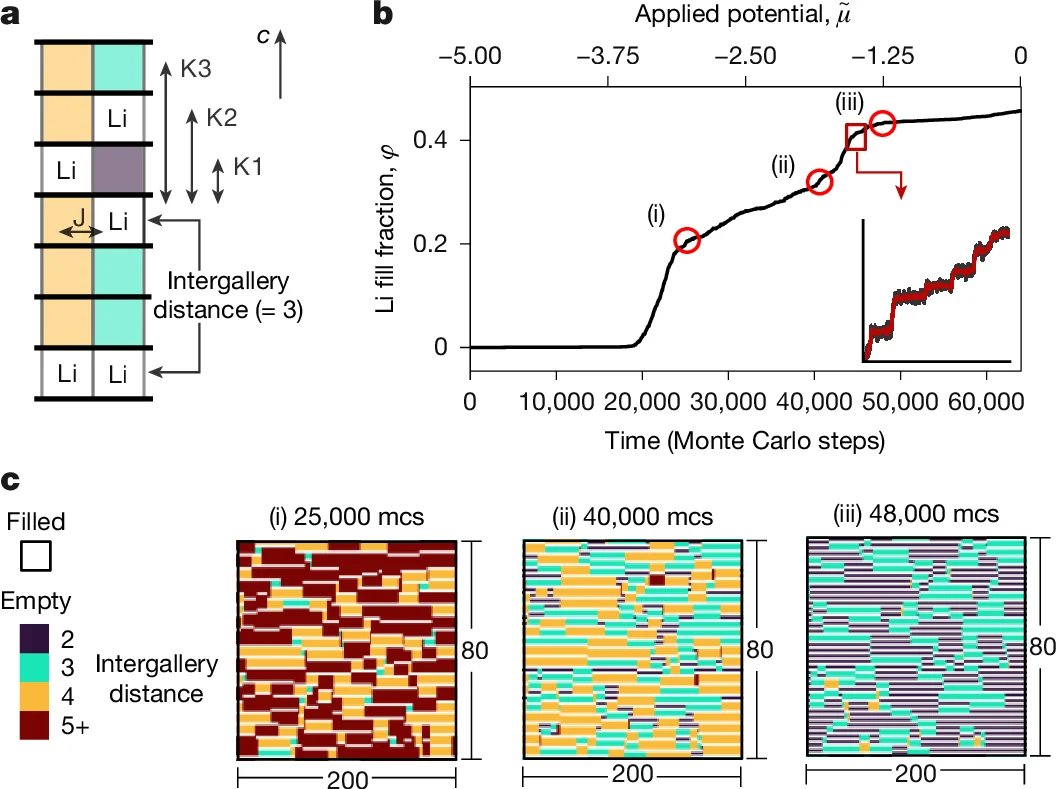
Lithium intercalation in graphite anodes, the most common negative electrode in Li-ion batteries, occurs through rapid, localized step events that resemble avalanches, according to a new study in Nature. Using operando optical microscopy, researchers observed that micrometer-sized regions undergo deintercalation-intercalation within seconds, resolving longstanding contradictions about dilute-stage phase behavior. The findings, based on a modified random field Ising model, highlight the role of static disorder in driving these transitions.
Avalanche-Like Transitions
During the dilute stages of lithiation (stages 4L to 1), graphitic particles exhibit sudden, micrometer-scale deintercalation-intercalation events rather than smooth continuous transitions. These step changes, occurring within seconds, mirror avalanche phenomena seen in disordered systems. The dynamics explain why previous studies, using X-ray or neutron diffraction, gave contradictory results for dilute stage compositions. The observation of avalanches reconciles reports of both first-order and continuous phase behavior.
Role of Static Disorder
The team modeled the process using a modified random field Ising model, linking avalanches to static disorder in the graphite structure. Disorder disrupts intercalation dynamics, causing jumps between multiple metastable states that appear as seemingly continuous transitions at larger scales. The model successfully reproduces experimental avalanche statistics, including size distributions. The findings suggest that local structural variations, not just thermodynamic factors, govern critical battery performance aspects.
Operando Optical Method
The researchers developed a spatiotemporal analysis technique based on operando optical microscopy to directly visualize lithium movement in individual particles. This method overcomes limitations of traditional diffraction techniques, which struggle with low atomic weight of lithium, rapid diffusion, and beam damage. The approach revealed heterogeneous connectivity patterns in the sequences of avalanche events across particles. It provides a new toolkit for studying phase transitions in layered battery materials.
1 source
Time · lag behind first