
Physicists create black hole from light, detect Hawking radiation back reaction
This digest was compiled by AI from multiple sources — links to the originals are below.
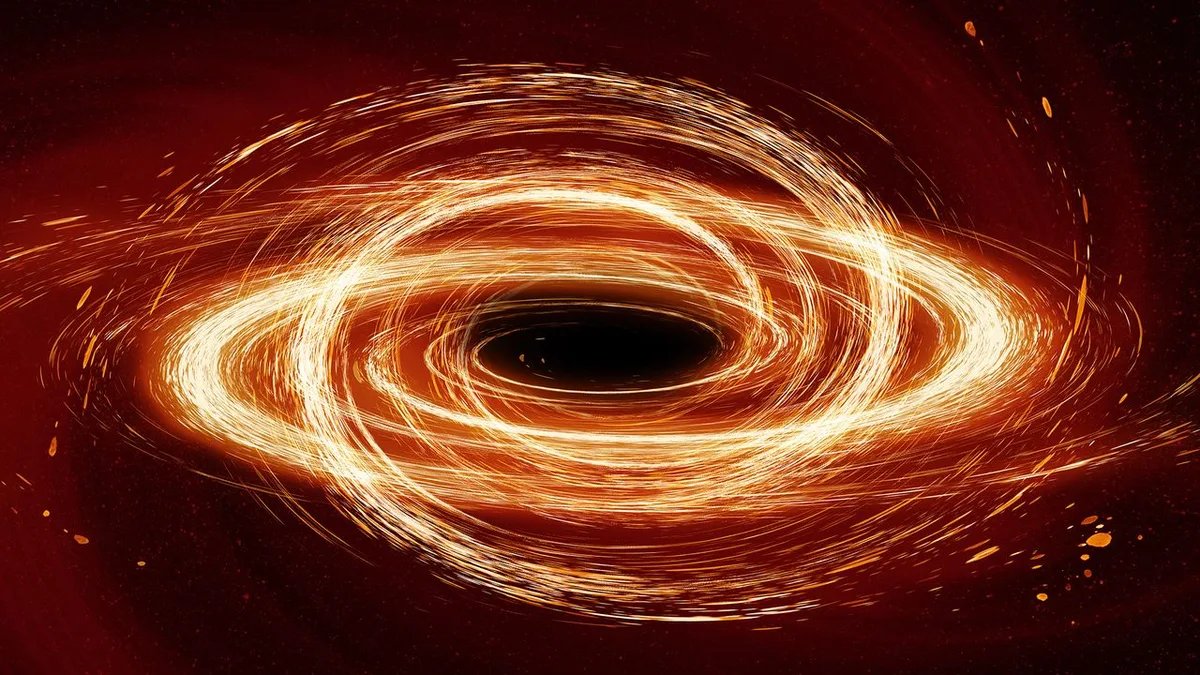
Physicists coaxed Hawking radiation from a simulated black hole made of light in an optical fiber and, for the first time, observed its back reaction on the black hole itself. The experiment, published July 1 in Nature, confirmed the radiation's thermal spectrum even where standard theory should break down. The result offers a rare glimpse into the interplay of quantum physics, general relativity and thermodynamics.
The Experiment
An international team used a tabletop setup with optical fibers to create a black hole analogue from light. The moving medium — a pulse of light that alters the fiber's refractive index — acted as an event horizon, trapping a second probe pulse. The researchers detected Hawking radiation and its back reaction, the energy feedback that reshapes the black hole. The study, led by Ulf Leonhardt of the Weizmann Institute, was published in Nature on July 1.
Hawking Radiation Confirmed
The emitted light matched Hawking's prediction: a thermal glow with a definite temperature and a spectrum fading at higher frequencies. This held true even in a regime where the usual black hole description should fail. Hawking radiation, predicted in 1974, arises at the intersection of quantum mechanics, general relativity and thermodynamics — three frameworks that are normally incompatible.
Implications for Black Hole Evaporation
The back reaction observed is a first clue about the tiny push that could make real black holes slowly evaporate over time. Astronomers have never detected Hawking radiation from actual black holes because the signal is too faint. Laboratory analogues like this one allow physicists to test the underlying equations in controlled conditions.
1 source
Time · lag behind first