
Goldman Sachs sees global conflict risk at highest since 1960s
This digest was compiled by AI from multiple sources — links to the originals are below.
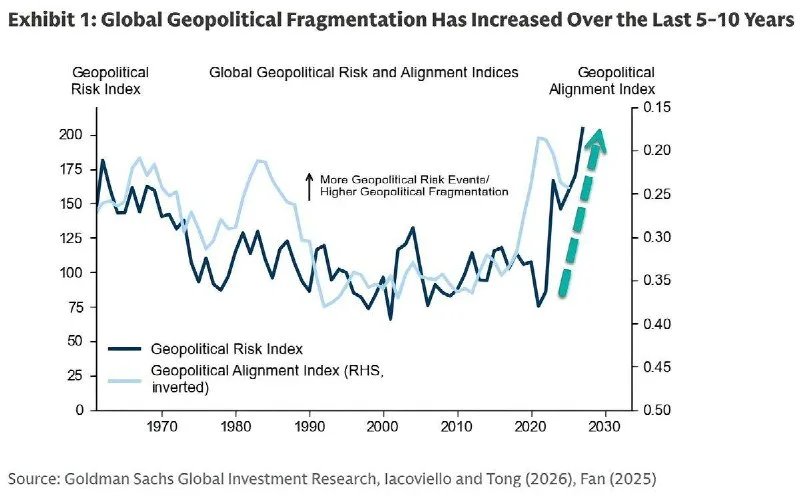
Goldman Sachs estimates the risk of a global conflict has reached its highest level since the mid-1960s, exceeding levels during the Cuban Missile Crisis, the Cold War, and after the September 11 attacks. The world is fragmenting into opposing blocs at the fastest pace on record, with fewer countries remaining neutral. For Kazakhstan, geography becomes a strategic asset, but the cost of external shocks is rising.
The Risk Assessment
Goldman Sachs has identified the current geopolitical cycle as the most dangerous in half a century, with the risk of global conflict at its highest since the mid-1960s. According to the bank, this risk surpasses that of the Cuban Missile Crisis, the Cold War, and the aftermath of 9/11. The assessment is based on multiple simultaneous fractures: geopolitical rivalry, trade wars, technological decoupling, competition for critical raw materials, sanctions, and supply chain restructuring.
Economic Consequences
Capital is increasingly flowing to politically safe jurisdictions, while companies relocate production closer to allies. Governments are tightening control over investments and reviving industrial policy. The cost of risk now rivals the cost of money in decision-making. These trends reinforce each other, and Goldman Sachs warns that the peak of these processes is still ahead.
Implications for Kazakhstan
For Kazakhstan, the new landscape turns geography into a strategic asset, but also raises the cost of any external shock. Countries that maintain predictability, attract capital, and build economic ties with multiple power centers will benefit. The main risk in the coming years is not a single conflict but a transition to sustained geopolitical tension where economy, trade, and investment become extensions of global rivalry.
2 sources
Time · lag behind first