MeerKAT telescope detects record-breaking hydroxyl megamaser
This digest was compiled by AI from multiple sources — links to the originals are below.
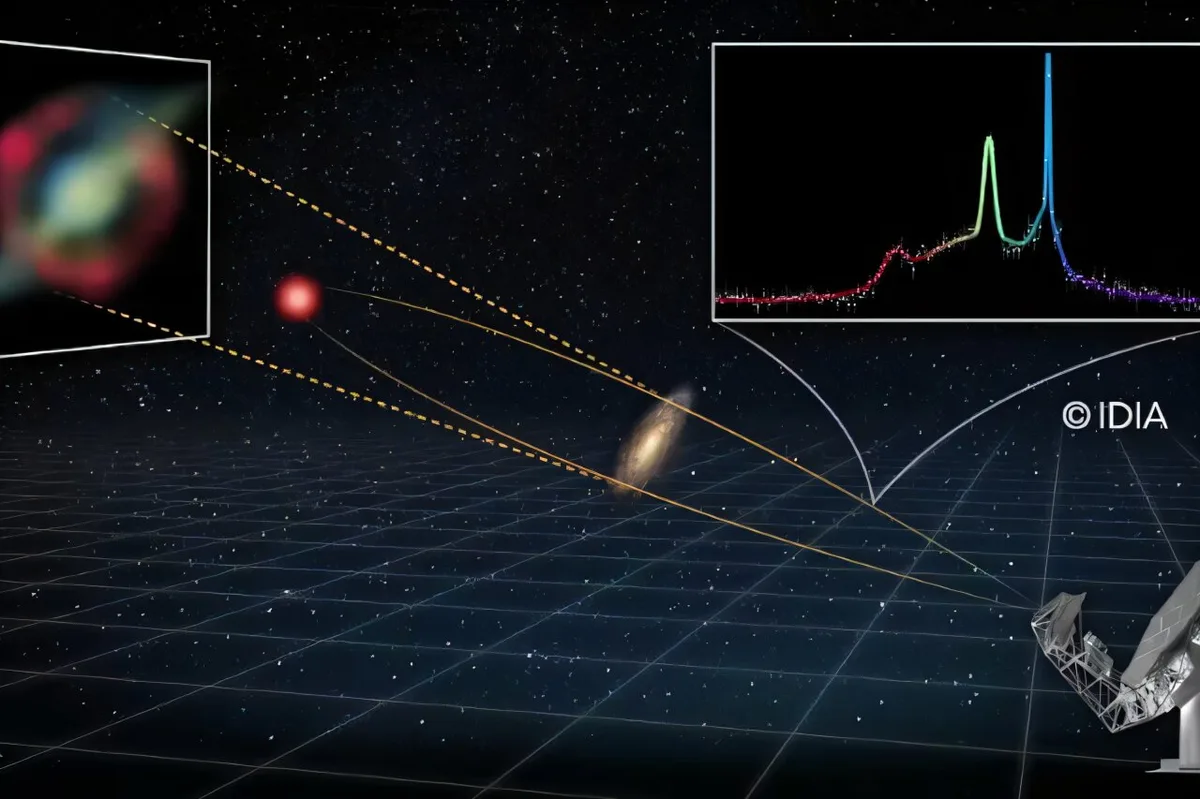
Astronomers using the MeerKAT radio telescope in South Africa have detected the most distant hydroxyl megamaser ever observed, located in a merging galaxy more than 8 billion light-years away. The discovery opens a new frontier for radio astronomy, allowing researchers to study galaxy mergers at unprecedented distances.
The Discovery
The MeerKAT telescope, located in the Karoo region of South Africa, detected the hydroxyl megamaser during a survey of the early universe. A hydroxyl megamaser is a natural maser (microwave equivalent of a laser) emitted by hydroxyl molecules in galaxies undergoing violent mergers. The newly found megamaser is more than 8 billion light-years away, making it the most distant ever recorded.
Scientific Significance
Hydroxyl megamasers serve as powerful tools for studying galaxy mergers and star formation in the distant universe. This detection pushes the observational frontier back by billions of years, providing a new way to probe the conditions of galaxies when the universe was less than half its current age. The MeerKAT telescope's sensitivity was key to capturing the faint signal.
Gravitational Wave Background Confirmation
The MeerKAT telescope confirmed the gravitational wave background of the universe at record speed. This detection provides a new tool for studying cosmic phenomena beyond the hydroxyl megamaser discovery.
What's Next
The team plans to conduct follow-up observations with other telescopes to study the host galaxy in detail. It remains unclear how many more such megamasers exist at similar distances, but this discovery suggests that MeerKAT and future instruments like the Square Kilometre Array could uncover many more.
2 sources
MeerKAT telescope detects record-breaking hydroxyl megamaser